
UNO: Steering Visual Generation with Internal Understanding Supervision
Steering Visual Generation in Unified Multimodal Models with Understanding Supervision
The paper introduces Understanding-Oriented Post-Training (UNO), a lightweight framework designed to enhance visual generation in Unified Multimodal Models (UMMs). By leveraging the model's existing understanding capabilities through language and visual supervision, UNO achieves state-of-the-art results on benchmarks like GenEval2 and UniGenBench++, significantly outperforming the BAGEL baseline.
TL;DR
Unified Multimodal Models (UMMs) are supposed to understand and generate images with equal prowess. However, most SOTA models actually decouple these tasks to prevent performance degradation. UNO (Understanding-Oriented Post-Training) bridges this gap by using a model's internal "understanding expert" to supervise its "generation expert." By forcing the model to describe and structure its own internal noised representations, it achieves significantly better semantic alignment and fine-grained detail in image generation and editing.
The "Decoupling" Dilemma
In the world of unified models (like BAGEL or Janus), there is a trade-off. Understanding requires high-level semantic abstraction, while generation needs dense, pixel-perfect details. To keep both sharp, researchers often build "specialized experts" or separate FFNs within the same transformer.
While this prevents "task interference," it creates a wall: the generation pathway doesn't benefit from the deep semantic knowledge the understanding pathway has already mastered. This leads to models that can "see" a complex scene perfectly but fail to "draw" it when given the same complex prompt.
Methodology: Turning Understanding into Supervision
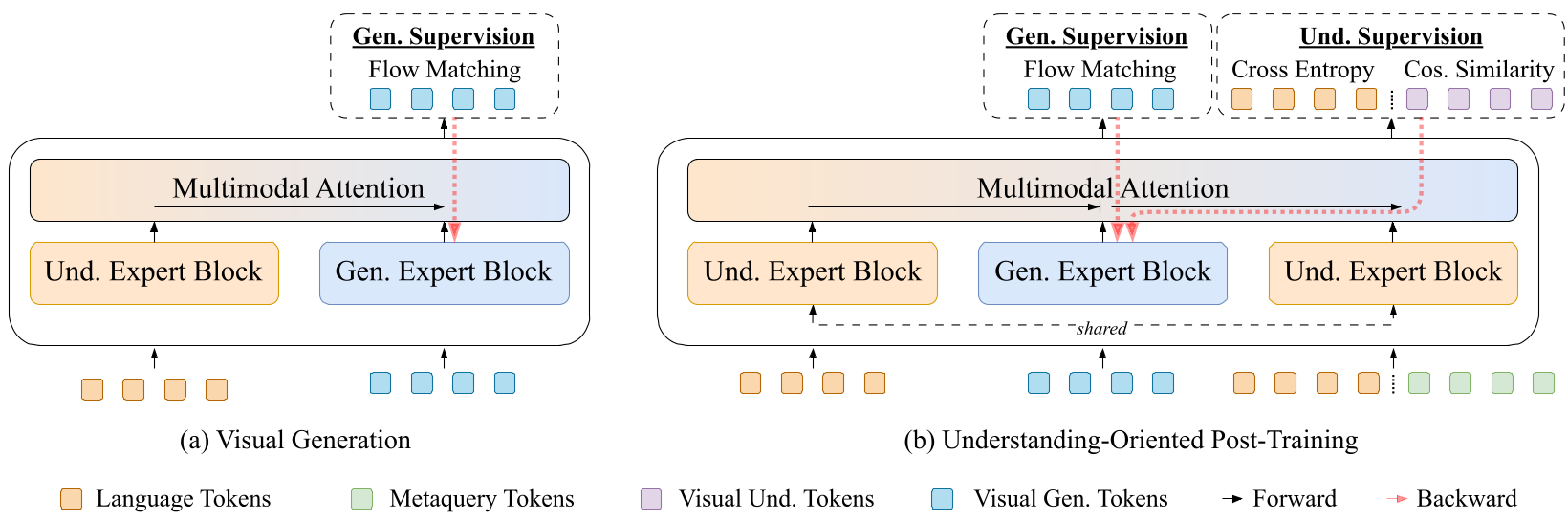
UNO's core insight is to re-route the gradient flow. Instead of training understanding and generation as two side-by-side tasks, UNO makes the Understanding Expert the teacher for the Generation Expert.
1. Language Supervision (Captioning)
The model takes a noised generative representation () and tries to generate a text caption. To avoid the model simply "copying" the input prompt (a shortcut), the authors use Semantic Augmentation—re-captioning the target image with an external model to ensure the supervision text is lexically different but semantically identical.
2. Visual Understanding Supervision (MetaQueries)
Since text is sparse, it can't capture every spatial detail. UNO uses "MetaQuery tokens" that are inserted into the understanding expert to regress dense visual features from a target image. This forces the generative latent space to maintain its 2D structural integrity even at high noise levels.
Experiments & Results: Does Synergy Work?
The results are a resounding "yes."
- Semantic Following: On UniGenBench++, UNO saw its biggest gains in "Attribute," "Action," and "Relationship" categories—areas where standard diffusion models typically trip up.
- Feature Quality: Visualizing the latent space via PCA (see below) shows that UNO features are much cleaner and more structured at early denoising stages compared to standard training.

Quantitative Benchmarks:
| Metric | BAGEL (Baseline) | BAGEL + UNO | Improvement |
|---|---|---|---|
| GenEval2 | 71.7 | 75.1 | +3.4 |
| DPG-Bench | 84.03 | 86.12 | +2.09 |
| GEdit-Bench (EN) | 6.52 | 7.17 | +0.65 |
Critical Insights: Why It Works
The authors performed a gradient analysis (Fig 8) which revealed that the gradients from the "understanding" objective are largely orthogonal to the "denoising" gradients. This is a crucial finding: it means the understanding supervisor isn't fighting the generator; it's providing a "orthogonal" semantic guide that helps the model navigate the latent space more effectively.
Conclusion and Future Outlook
UNO demonstrates that we don't need massive new datasets to improve generation; we just need to better utilize the intelligence already residing in our models' understanding components.
Limitations: While UNO excels at general semantic adherence, its performance is still bound by the quality of the frozen understanding expert. If the "teacher" doesn't know a concept, it can't supervise the "student" generator. Future work may explore "Co-Training" where both components evolve together without catastrophic forgetting.