
The Flare Factor: How Young M Dwarfs Shape the Primordial Atmospheres of Early Exo-Earths
Stellar flare-driven evolution of primordial early exo-Earth atmospheres: Insights from a Young M Dwarf Flare model
This study utilizes the Young M Dwarf Flare (YMDF) model and VULCAN photochemical code to simulate the atmospheric evolution of primordial exo-Earths orbiting active M dwarfs like AU Mic. The research demonstrates that frequent, high-energy flares significantly reshape the chemical composition of H2-H2O dominated atmospheres, achieving a new state of chemical disequilibrium.
TL;DR
Directly challenging the assumption that stellar flares are mere "transient noise," a new study reveals that for young exo-Earths orbiting M dwarfs, flares are the primary architects of atmospheric chemistry. Using the Young M Dwarf Flare (YMDF) model, researchers found that cumulative high-energy radiation can drive atmospheres into a permanent state of chemical disequilibrium, creating high levels of abiotic Oxygen and depleting trace gases like Methane.
Background Positioning: The M Dwarf Paradox
M dwarfs are the most common stars in the galaxy and the primary targets for finding habitable worlds. However, their youth is characterized by violent magnetic activity. This paper positions itself at the intersection of stellar astrophysics and planetary science, asking: Can an atmosphere survive the "teenage years" of its parent star?
Problem & Motivation: Beyond the "Fiducial" Average
Previous studies often used a "Fiducial Flare" (FF) model—a simplified, single-power-law approach based on older, quieter stars. The authors argue this significantly underestimates the energy of flares from young stars like AU Mic (~22 Myr). These high-energy bursts aren't just larger; they have a different spectral "shape" in the FUV and NUV regions, which are the primary drivers of molecular dissociation.
Methodology: Simulating a Year of Solar Fury
The team coupled the YMDF model with VULCAN, a 1D photochemical kinetics code. They didn't just look at one flare; they simulated 360 days of repeated flaring across a grid of 16 different atmospheric compositions (ranging from 0.1% H2O to 100% H2O/Steam).
1. The Power of the Broken Power Law
Unlike the standard FF model, the YMDF model uses a broken power-law for flare frequency. This accounts for the higher prevalence of mid-to-high energy flares that smaller stars produce during their early stages.
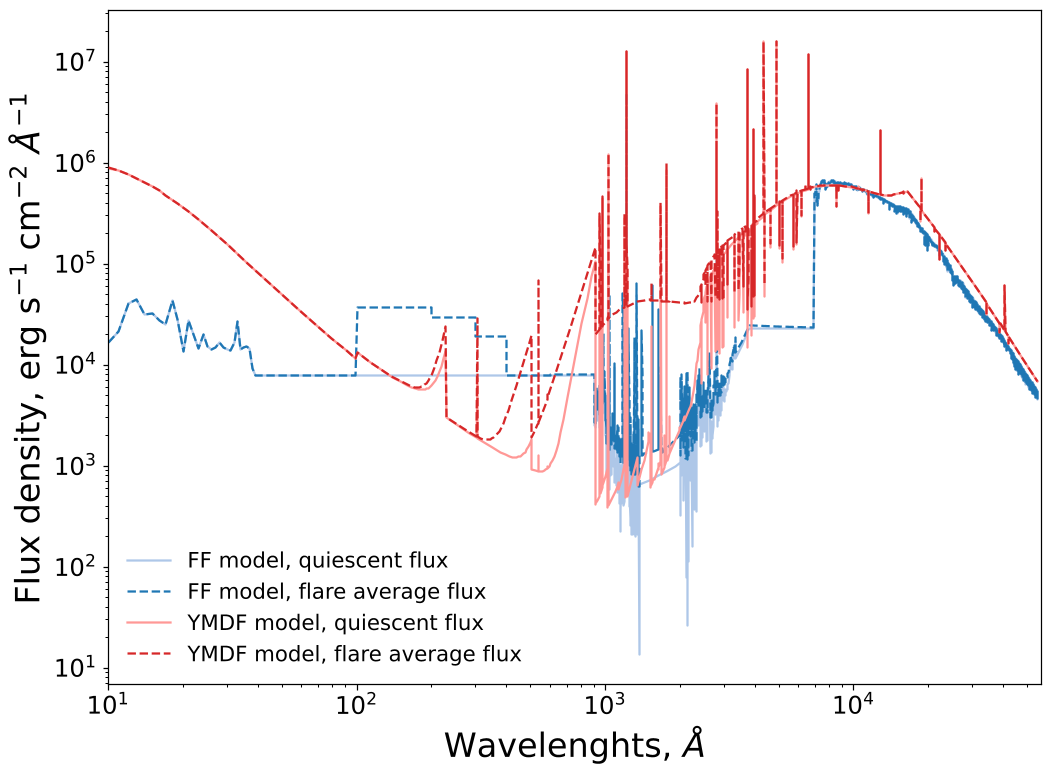 Fig 2: The YMDF model (dashed red) shows a massive UV/NUV excess compared to the Fiducial model (FF), which is critical for driving photochemistry.
2. Physical Shielding and Radiative Transfer
The study utilized the HELIOS code to determine the Temperature-Pressure (T-P) profiles. A key insight was the role of self-shielding: Water vapor absorbs much of the incoming UV, protecting the deeper layers of the atmosphere from instant destruction.
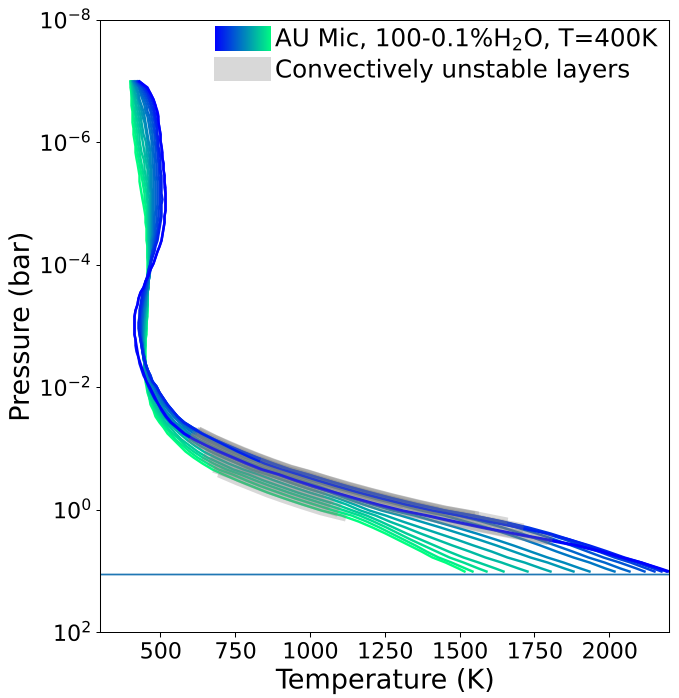 Fig 4: Optical depth (τ ≈ 1) for various wavelengths. Notice how the atmosphere is opaque to UV (FUV/NUV) at much higher altitudes, confining flare impacts to the upper atmosphere.
Key Results: Abiotic Oxygen and Trace Gas Depletion
- Oxygen Accumulation: In steam-rich atmospheres (100% H2O), flares produced O2 levels as high as 10%. This is a massive "false positive" for life, as it is produced entirely by flare-driven water splitting, not biology.
- The Decoupling Effect: The study found a sharp "decoupling" between the upper and lower atmosphere. Flare impacts were violent at low pressures but barely reached the surface, thanks to the shielding properties of the bulk atmosphere.
- Methane Destruction: Trace species like CH4 and NH3 were efficiently "scrubbed" from the upper atmosphere. Under the YMDF model, recovery between flares was impossible, leading to a permanent change in mixing ratios.
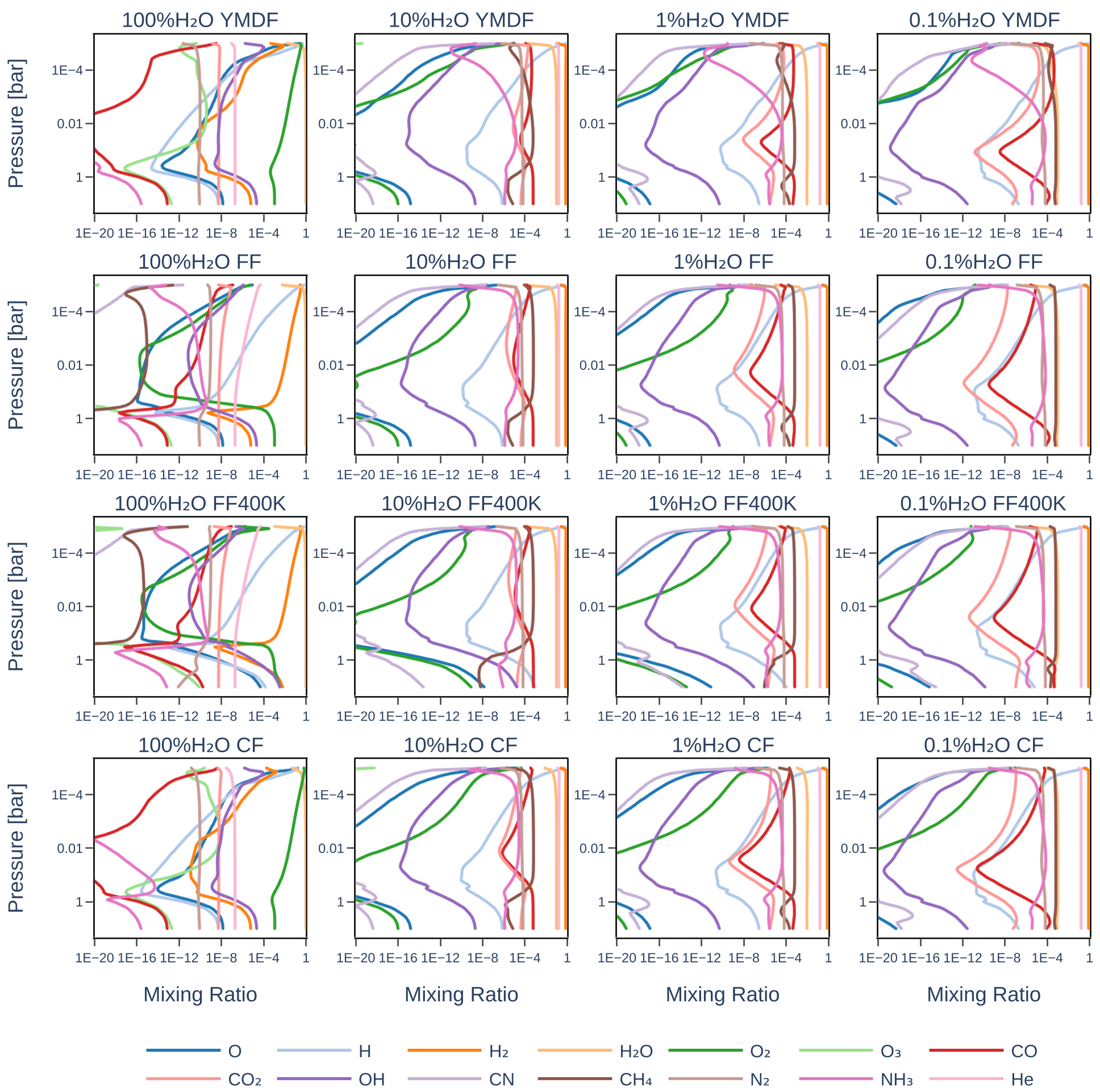 Fig 6: Comparison of end-state chemistry. The YMDF model (top row) maintains higher levels of oxygen species (O, O2) in the upper layers compared to the FF model.
Critical Analysis & Future Outlook
Takeaway: This work proves that the "flare statistics" of a star are just as important as its distance or temperature. If we use the wrong flare model, we will fundamentally misunderstand the chemical history of the planets we observe with JWST.
Limitations: As a 1D model, it cannot account for 3D atmospheric circulation which might redistribute these photochemical products to the night side or deeper layers. Furthermore, surface-atmosphere interactions (like mineral oxidation) were not fully modeled.
Future Work: The next frontier is coupling these photochemical results with hydrodynamic escape models. If flares heat the upper atmosphere enough, they might blow the entire hydrogen envelope into space, leaving behind a desiccated, oxygen-rich "early Venus" instead of an early Earth.