
Stream-R1: Surpassing the Teacher via Reliability-Perplexity Aware Distillation
Stream-R1: Reliability-Perplexity Aware Reward Distillation for Streaming Video Generation
Stream-R1 is a Reliability-Perplexity Aware Reward Distillation framework for streaming video generation. It enhances Distribution Matching Distillation (DMD) by adaptively reweighting the objective based on rollout reliability and spatiotemporal perplexity, allowing a 4-step distilled student (Wan2.1-1.3B) to outperform its multi-step teacher in visual quality and semantic alignment.
TL;DR
Stream-R1 is a breakthrough in streaming video generation that challenges the "distillation gap." By moving away from uniform loss functions, it uses a pretrained reward model to identify reliable student rollouts (Inter-Reliability) and high-impact pixels/frames (Intra-Perplexity). The results are startling: a 4-step distilled model that is not only 30x faster but actually better in quality than its original multi-step teacher.
Background: The Problem with Indiscriminative Distillation
In the world of streaming video generation, Distribution Matching Distillation (DMD) has become the standard for turning slow, bidirectional diffusion models into fast, causal generators. However, DMD has a hidden flaw: it assumes every rollout from the student model is equally valid as a learning signal.
In reality, if a student generates a total "hallucination," the teacher's gradient (freal - ffake) becomes unreliable—it provides a local correction within a low-quality region rather than a path to the high-quality manifold. Furthermore, current methods waste optimization budget on pixels or frames that are already "perfect," while ignoring high-perplexity areas that need refinement.
Methodology: High-Resolution Reward Guidance
Stream-R1 breaks the uniform loss constraint through a unified reward-guided mechanism.
1. Inter-Reliability (Whether to learn)
The framework assigns a weight to each rollout. If the reward model gives a low score, the rollout's contribution to the gradient is attenuated. This ensures the model learns only from rollouts where the DMD supervision is trustworthy.
2. Intra-Perplexity (Where to learn)
This is the core innovation. Instead of treating the reward as an opaque number, Stream-R1 back-propagates through the reward model back to the input pixels.
- Saliency Maps: Higher gradient magnitudes indicate regions where the reward is most sensitive to changes.
- Spatiotemporal Decomposition: These maps are factored into independent spatial and temporal weights, ensuring every frame retains internal contrast while up-weighting frames with critical artifacts.
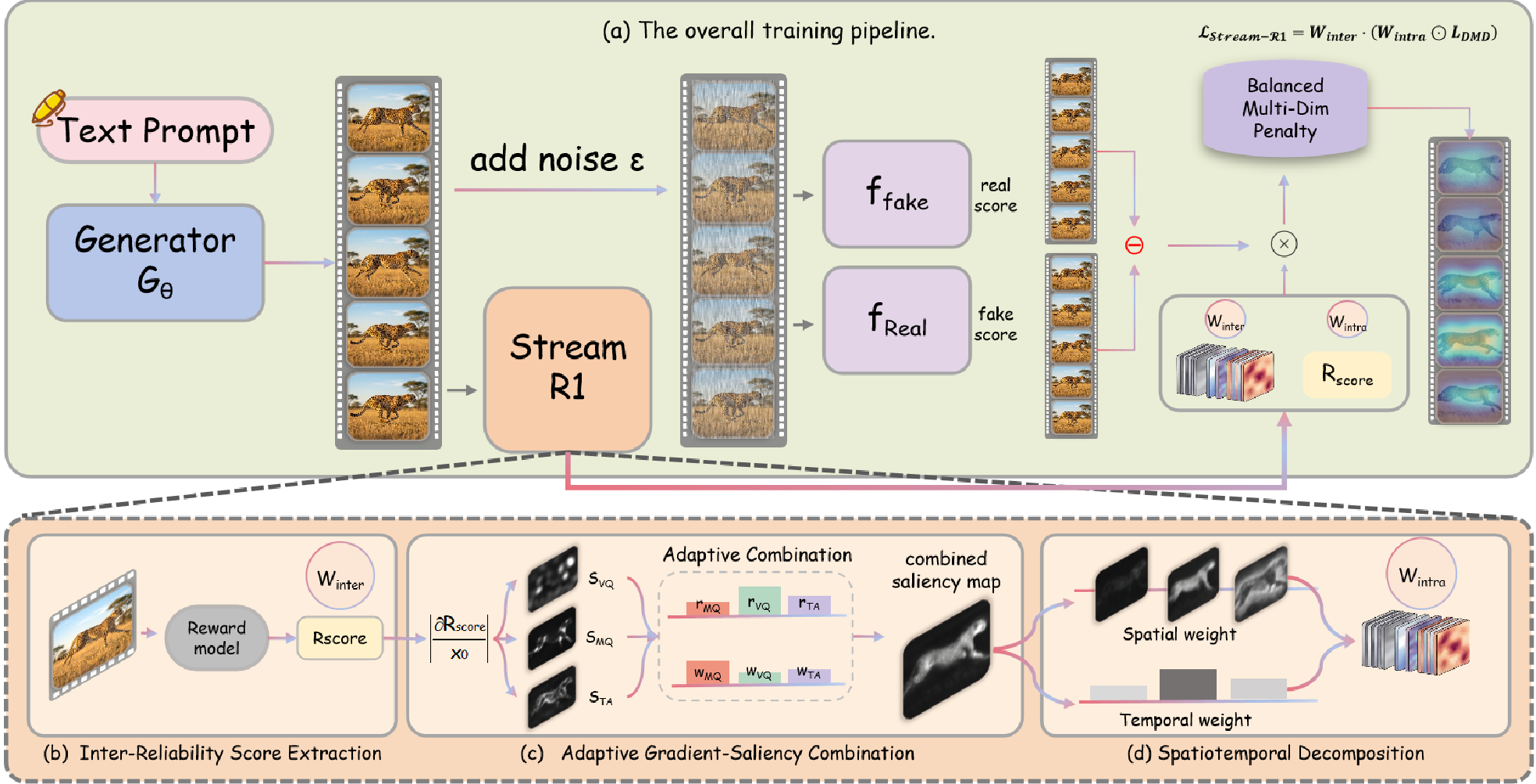 Figure 1: Overview of Stream-R1 showing the Inter-Reliability and Intra-Perplexity weighting modules driven by a shared reward model.
Experimental Excellence: Speed AND Quality
Stream-R1 was tested on Wan2.1-1.3B, generating 5-second videos and long-form content up to 180 seconds.
- SOTA Benchmarking: It achieved a VBench score of 84.40, higher than all other streaming models like LongLive or CausVid.
- Surpassing the Teacher: Remarkably, it beat the base Wan2.1 teacher (84.26) in total score, specifically excelling in semantics and text alignment.
- Drift Prevention: In long-video tasks, the gap between Stream-R1 and previous SOTA methods widened over time. The temporal reweighting prevents "quality collapse" by identifying and fixing early-frame artifacts before they propagate.
 Table 1: Stream-R1 performance comparison. Note how it outpaces its teacher in Total and Semantic scores.
Visual Proof: Why Saliency Matters
To prove the system works, the authors performed a "stress test" by injecting Gaussian blur into specific parts of a video. The reward gradient immediately identified these degraded regions, automatically up-weighting the blurred frames and pixels for more intense optimization.
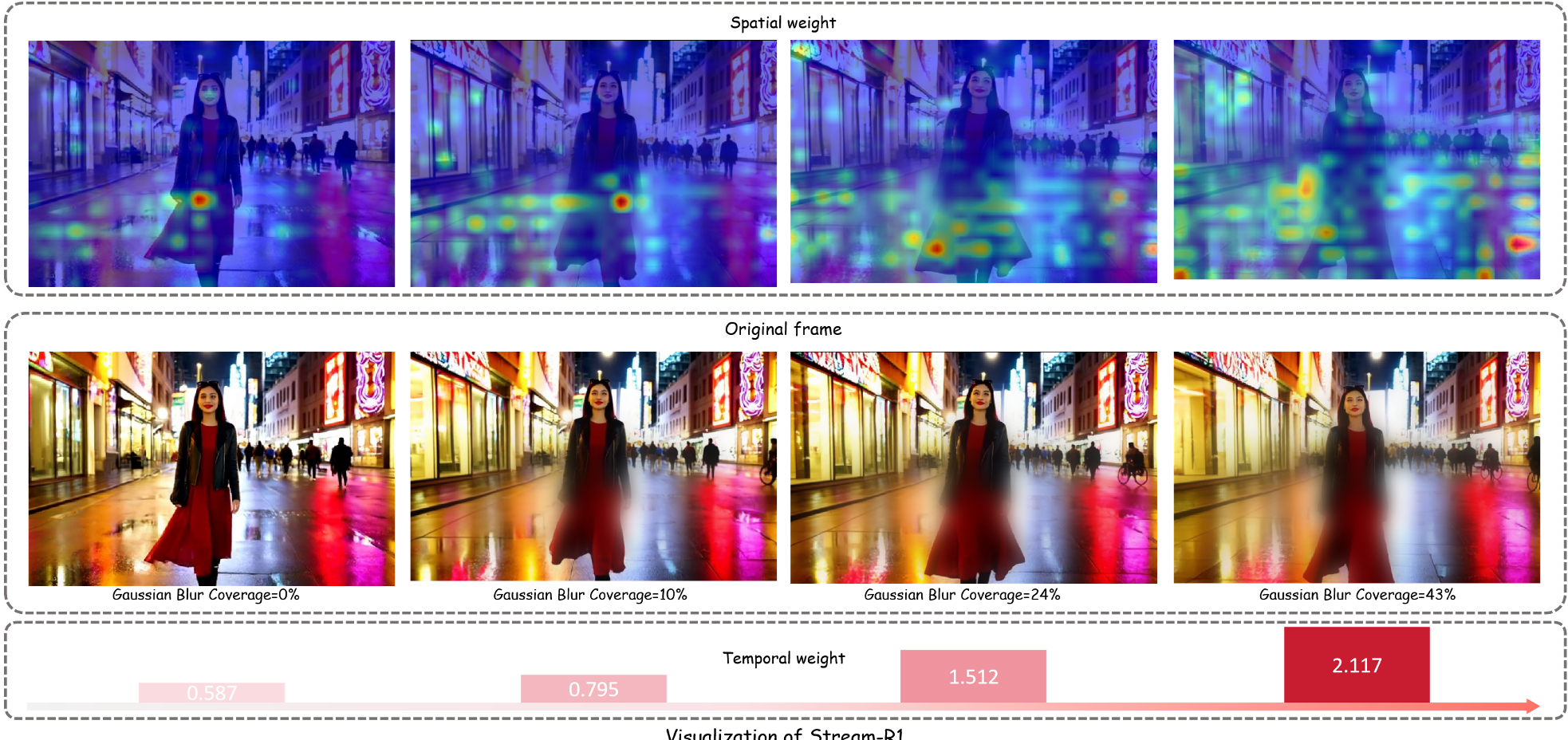 Figure 2: Gradient saliency responding to artificial degradation. The model "knows" where the quality is lacking.
Critical Insight & Conclusion
Stream-R1 shifts the paradigm of reward-guided learning. While prior work like Reward Forcing used scalars to filter data, Stream-R1 uses the internal logic of the reward model to guide the optimizer's attention.
Takeaway: The "ceiling" of distillation is not the teacher's performance, but the quality of the supervision signal. By filtering for reliability and focusing on perplexity, we can create student models that are faster, lighter, and more capable than the models they were originally designed to mimic.
Limitations: The reliance on a pretrained reward model means Stream-R1 is only as good as its evaluator. If the reward model has biases or "blind spots," the saliency maps will inherit them. Future work should explore co-training or online reward refinement.