
[Technical Report] StreamingClaw: Bridging Real-Time Perception and Proactive Embodied Action
StreamingClaw Technical Report
StreamingClaw is a unified agent framework developed by the MindGPT-ov team for real-time streaming video understanding and embodied intelligence. It integrates a main-sub agent architecture to achieve SOTA performance in low-latency perception, multimodal long-term memory management, and proactive interaction (watch-and-respond) across diverse hardware such as robots and autonomous vehicles.
Executive Summary
TL;DR: StreamingClaw is a sophisticated multi-agent framework designed to solve the "perception-action" lag in embodied AI. By decomposing complex video understanding into specialized agents—StreamingReasoning, StreamingMemory, and StreamingProactivity—it enables AI to not just watch video, but to remember context, predict needs, and execute physical tools in real-time.
Positioning: This work moves beyond traditional "offline" Video-LLMs into the realm of proactive streaming assistants, competing with SOTA frameworks like OpenClaw but optimized for the continuous, non-stationary data streams found in robots and smart vehicles.
Problem & Motivation: The "Frozen" Agent Problem
Most current AI agents treat video like a movie file: static and finite. However, a robot or a self-driving car interacts with a dynamic flow. Existing methods face a trilemma:
- Computational Bottleneck: Recomputing the entire history at every frame leads to exponential latency.
- Memory Amnesia: Using only a short window causes the agent to "forget" what happened minutes ago, losing the global context.
- Passive Response: Agents only act when asked, failing to bark a warning before an accident happens.
StreamingClaw solves this by treating video as continuous spatiotemporal data rather than discrete files.
Methodology: The Core Architecture
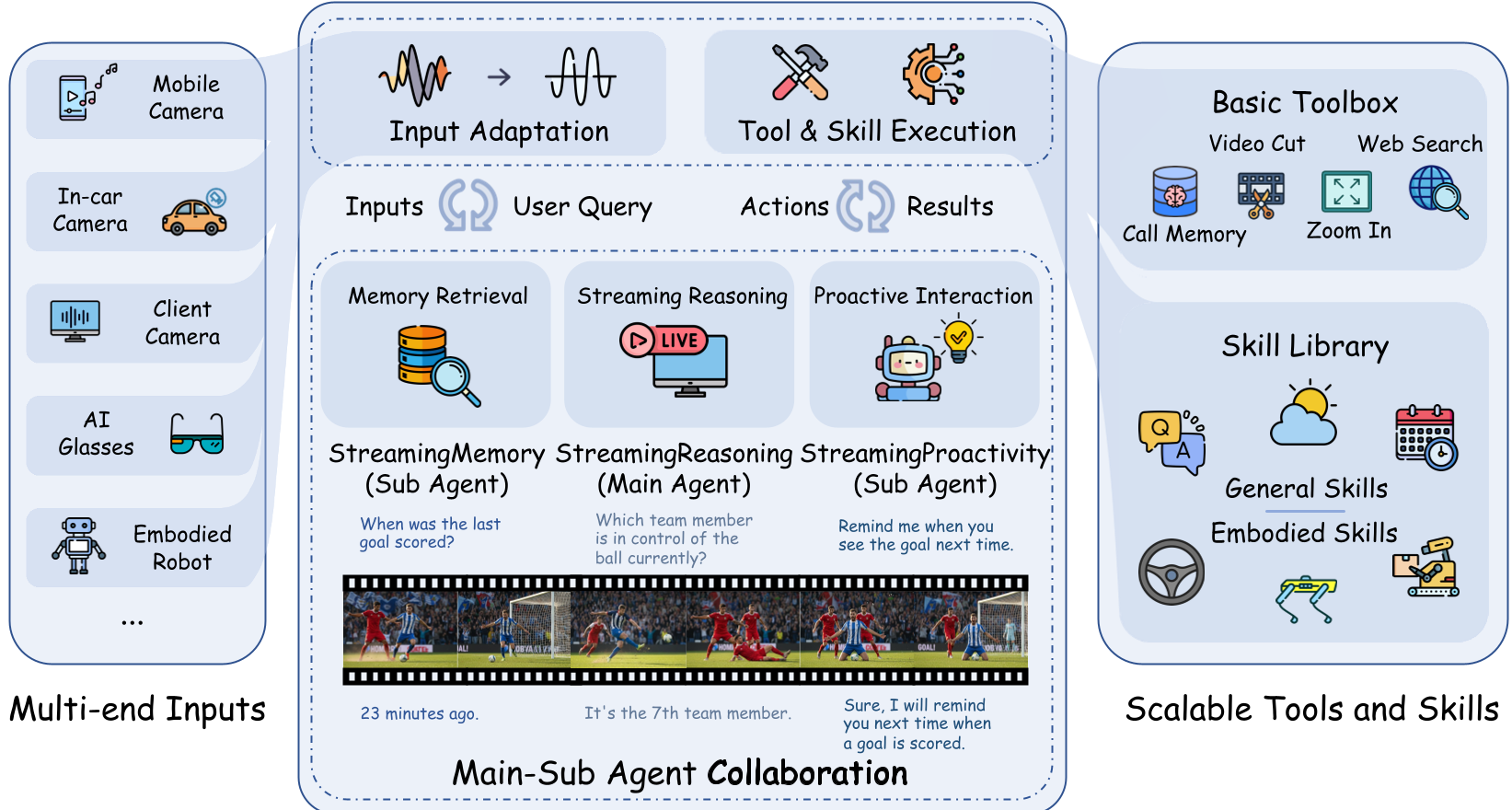
The framework is built on a collaborative ecosystem of three specialized agents:
1. StreamingReasoning: The "Brain"
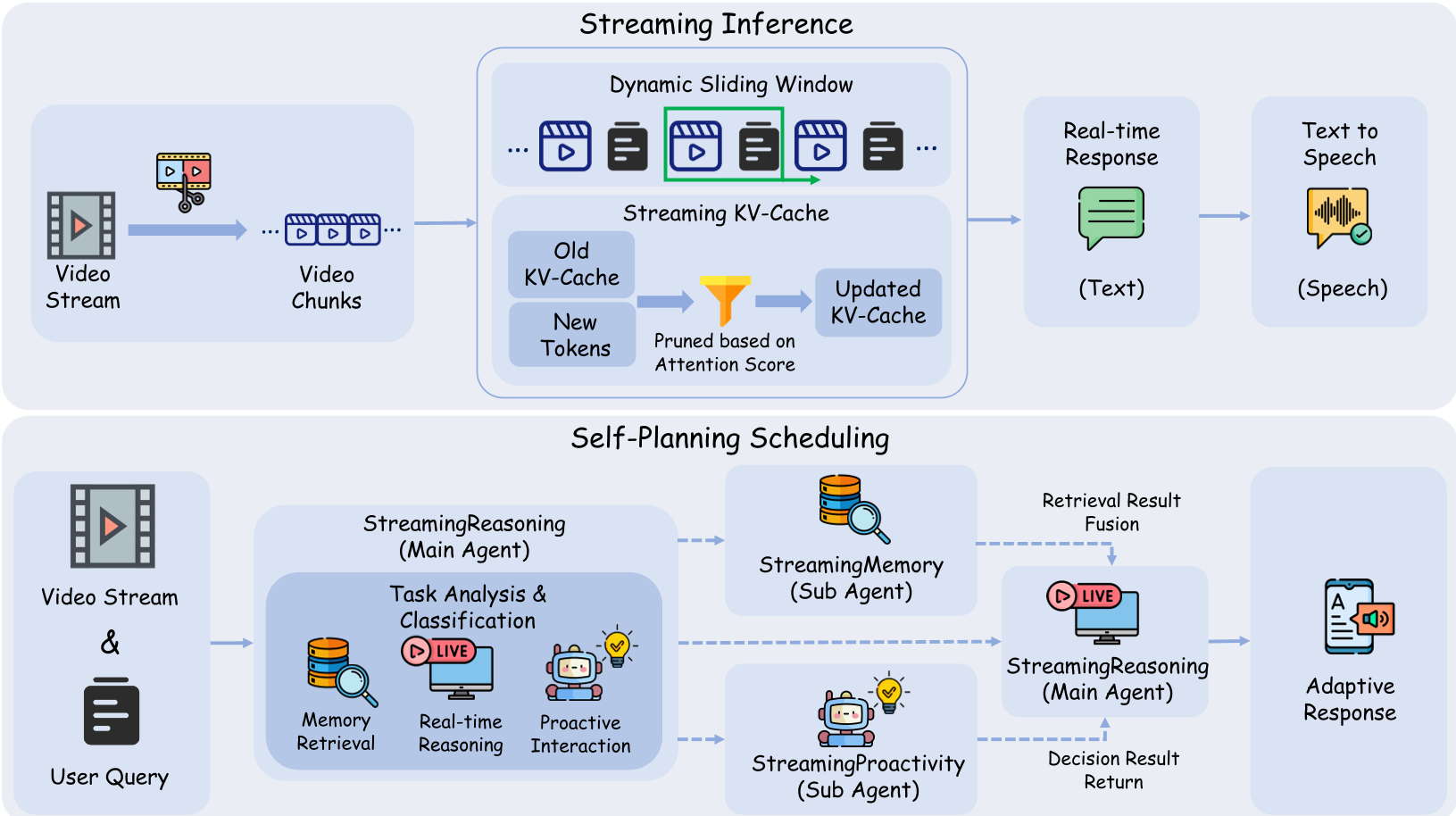
This agent manages the watch-and-respond cycle. To keep things fast, it uses a dynamic sliding window and streaming KV-cache. Instead of re-reading everything, it only processes the incremental changes in the video stream.
- Token Pruning: It calculates "contribution scores" for visual tokens. High-scoring tokens (important objects/actions) stay in memory; the rest are discarded to save GPU resources.
2. StreamingMemory: The "Long-Term Storage"
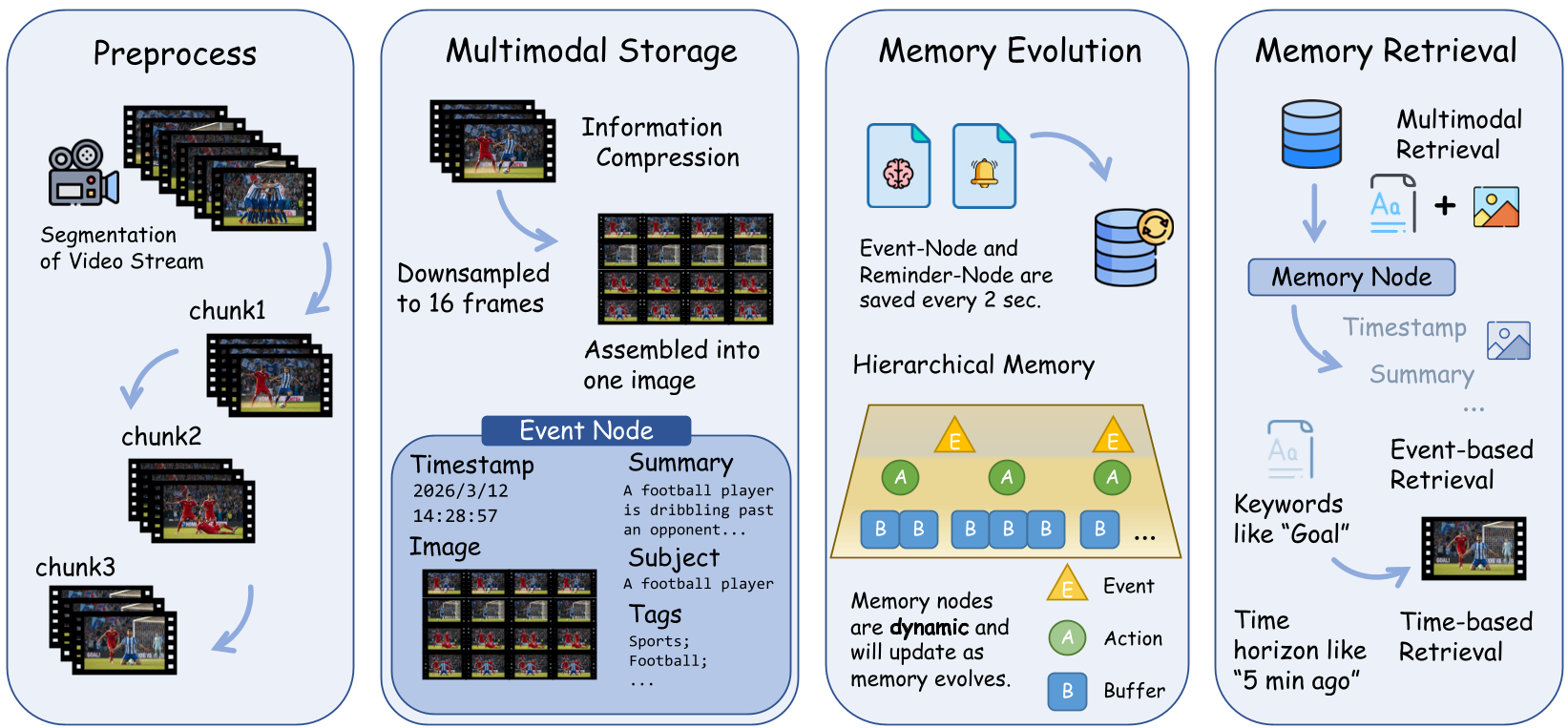
Unlike regular RAG (Retrieval-Augmented Generation) which uses text, StreamingMemory stores multimodal nodes.
- Hierarchical Evolution (HME): It evolves memory from fine-grained "segments" -> "atomic actions" -> "abstract events." This mimics human cognitive pruning, ensuring the agent doesn't get bogged down in trillions of useless video frames.
3. StreamingProactivity: The "Predictor"
This is the most innovative part. It introduces Trigger Tokens. The model is trained to generate specific tokens when it detects "silent" anomalies (e.g., a driver getting sleepy or a person falling), allowing it to intervene without being prompted by a user.
Experiments & Real-World Skills
The authors validated StreamingClaw through a series of "Embodied Skills" that demonstrate the perception-to-action pipeline:
- Autonomous Driving: Real-time driver monitoring (Fatigue detection Level 0-2).
- Home Robotics: Detecting a fall and proactively asking the person if they need help.
- AI Wearables: Using "Video Cut" tools to zoom in on a specific problem and provide tutoring steps.
The Video Cut Tool is particularly notable: the agent can "decide" to crop a specific timestamp of a long video to send to a higher-capacity MLLM (like Qwen3.5) for deeper analysis, balancing efficiency with precision.
Critical Analysis & Conclusion
Takeaway
StreamingClaw successfully creates a distributed cognition framework for agents. By separating "reasoning," "memory," and "proactivity," it achieves the low latency required for real-world physical interaction.
Limitations
- Modality Gap: It currently follows a "Vision + Text" paradigm. Audio is mostly an output, but synchronized audio-visual reasoning (e.g., hearing a siren while seeing an ambulance) is still in the "future work" phase.
- Hardware Dependency: While compatible with community tools, the efficiency of the hierarchical memory retrieval still depends heavily on the underlying vector database performance.
Future Outlook
The move toward "Omnimodal" agents—merging audio, video, and touch into a single backbone—is the clear next step. StreamingClaw provides the architectural blueprint for how those agents will manage their attention and memory in eternity.