
SCOPE: Closing the Conceptual Rift in Complex Image Generation
SCOPE: Structured Decomposition and Conditional Skill Orchestration for Complex Image Generation
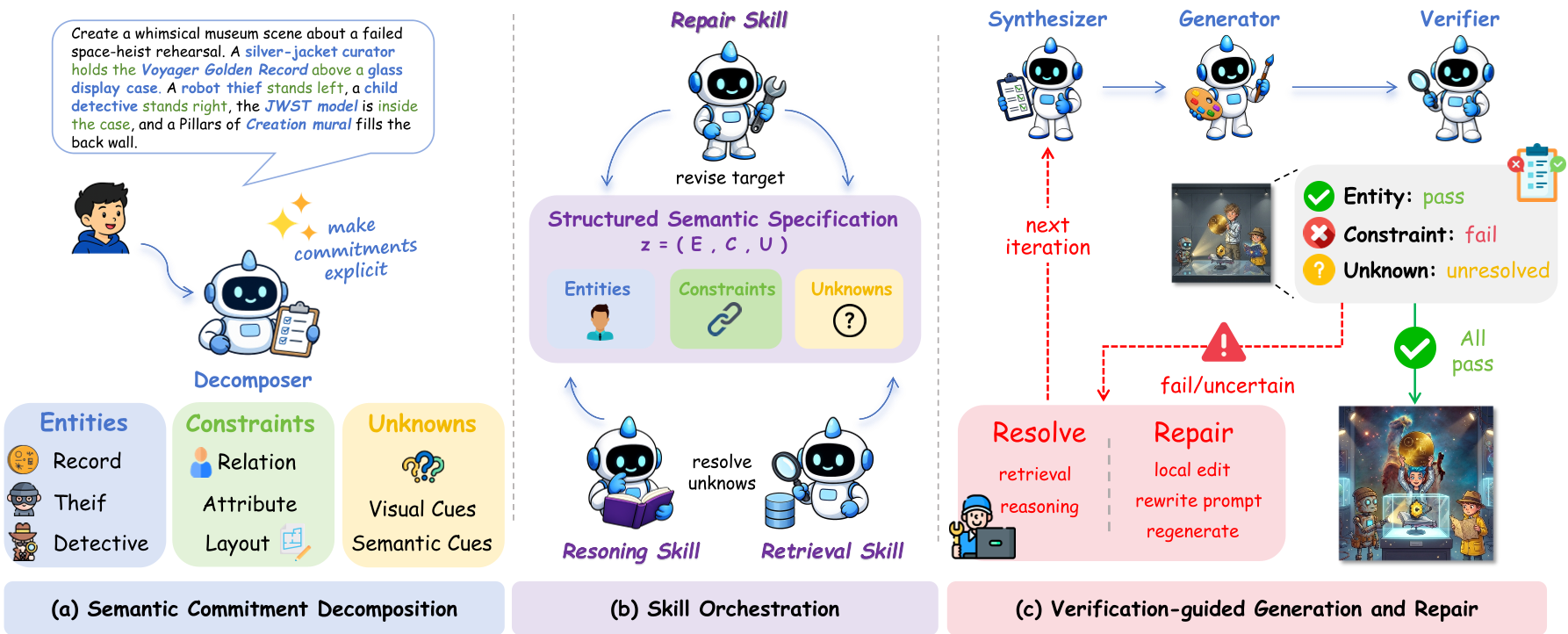
SCOPE is a specification-guided skill orchestration framework designed for complex image generation. It introduces a structured semantic specification to maintain "semantic commitments" across the generation lifecycle, achieving SOTA results on the new Gen-Arena benchmark with an Entity-Gated Intent Pass Rate (EGIP) of 0.60.
TL;DR
Standard text-to-image models often fail when prompts require intricate knowledge, specific entity counts, or complex spatial relations. SCOPE (Structured Decomposition and Conditional Skill Orchestration) solves this by treating image generation not as a single "shot," but as a lifecycle. By maintaining a structured "semantic specification," it effectively tracks what needs to be in the image, retrieves missing info, and repairs specific errors, boosting success rates on complex prompts from ~21% to 60%.
The Problem: The "Conceptual Rift"
In professional or high-utility creative workflows, an image isn't just "pretty"; it must be faithful. If you ask for a "medieval feast with three specific historical kings and a specific layout," the model must track these three kings through grounding (who are they?), generation (draw them correctly), and verification (are all three there?).
The authors identify a Conceptual Rift: the gap where these "semantic commitments" lose their identity between stages. A model might retrieve the right data but fail to use it, or see an error but not know which entity it belongs to.
Methodology: Orchestration via Specification
The core innovation of SCOPE is the Structured Semantic Specification (). It breaks a prompt into three components:
- Entities (): The target objects/people.
- Constraints (): Attributes (color, text), Relations (who is doing what), and Layouts (where).
- Unresolved Information (): Missing facts or visuals that need retrieval.
The Skill Orchestration Loop
Instead of a fixed pipeline, SCOPE uses conditional skills:
- Retrieval: If the specification has an "unknown" (e.g., a specific logo), it hits an API (Google Search).
- Reasoning: Infers implicit requirements (e.g., "physics of a splashing water").
- Repair: If the Verifier finds a failure (e.g., "King Henry is missing"), the model decides whether to rewrite the prompt, edit a local patch, or regenerate.
Gen-Arena: A Stricter Benchmark
Existing benchmarks often give partial credit. If you want 5 cats and get 4, you might still get a high score. The authors propose Gen-Arena and the Entity-Gated Intent Pass Rate (EGIP).
- Rule: If a required entity is missing or wrong, the entire instance fails. Constraints are only checked after entities are correctly instantiated.
Experiments and Results
SCOPE was tested against industry heavyweights like Nano Banana (Gemini family) and FLUX.1.
| Method | EGIP (Strict Pass) | Entity Pass | Gated Constraint Pass |
|---|---|---|---|
| Nano Banana Pro | 0.21 | 0.82 | 0.59 |
| FLUX.1-dev | 0.01 | 0.78 | 0.42 |
| SCOPE | 0.60 | 0.92 | 0.83 |
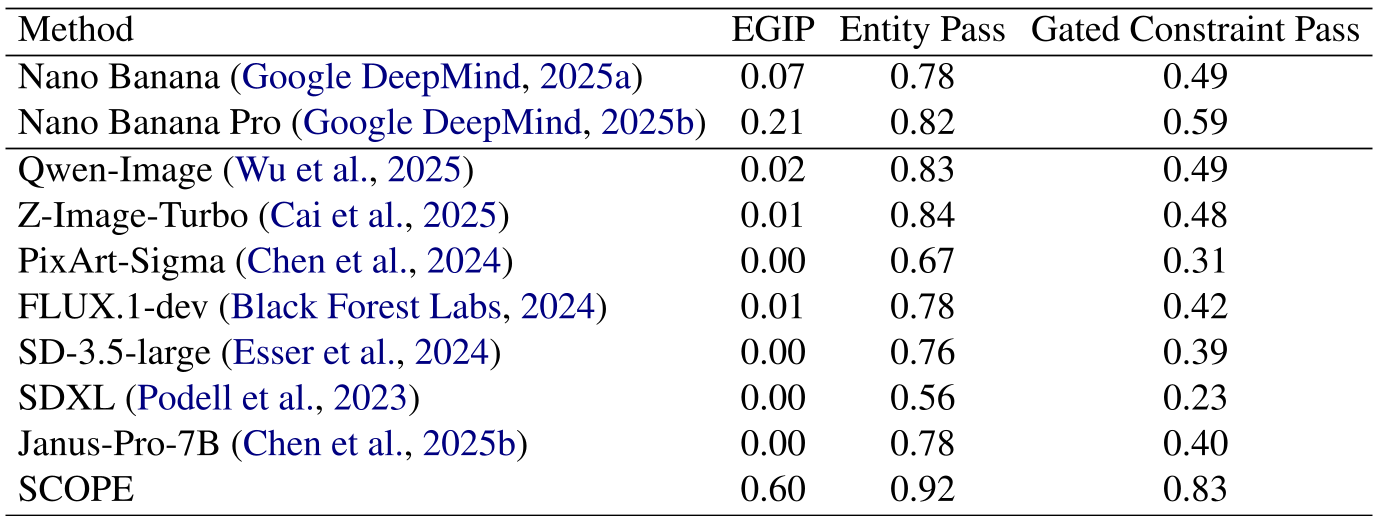
The results reveal a stark reality: even though models like FLUX or Qwen-Image are good at individual entities (~80% pass rate), their failure to handle all entities and constraints simultaneously leads to a near-zero success rate on complex, multi-entity scenes. SCOPE’s ability to "repair" and "ground" pushes it to a 60% success rate.
Critical Insights
- Decomposition is not enough: Ablation studies show that just breaking down the prompt (w/o active retrieval or repair) only yields a 0.22 EGIP. The "skills" are the engine; the specification is the steering wheel.
- Inference Trade-off: The primary limitation is cost. SCOPE requires multiple MLLM and Diffusion calls. However, for "high-stakes" creative work (e.g., advertising, storyboarding), this latency is a worthy trade for accuracy.
- The Verifier is the Bottleneck: If the Verifier makes a mistake, the Repair skill works on the wrong thing. Future work will likely focus on "self-correcting" verifiers.
Conclusion
SCOPE demonstrates that the future of complex image synthesis resides in Agentic Orchestration. By maintaining a persistent "memory" of user intent through a structured specification, we can finally bridge the gap between "generative art" and "visual intent realization."