
Super Apriel: Turning Architecture into a Runtime Variable
Super Apriel: One Checkpoint, Many Speeds
ServiceNow Research presents Super Apriel, a 15B-parameter supernet that enables runtime switching between four distinct token mixers—Full Attention (FA), Sliding Window Attention (SWA), Kimi Delta Attention (KDA), and Gated DeltaNet (GDN). This single-checkpoint approach achieves up to 10.7x throughput improvement while retaining high performance (96% quality retention at 2.9x speedup) and supporting native speculative decoding.
In the current LLM landscape, deploying a model often feels like a permanent compromise. If you want the fidelity of Full Attention (FA), you pay the quadratic price in KV-cache memory and latency. If you opt for State Space Models (SSMs) or Linear Attention, you gain speed but often sacrifice the "needle-in-a-haystack" retrieval capabilities that attention provides.
SLAM Labs (ServiceNow Research) has introduced Super Apriel, a 15B-parameter supernet that challenges the status quo. Instead of forcing a single architectural choice, Super Apriel offers a "Menu of Speeds" from a single weight checkpoint.
TL;DR
- The Supernet: One 15B model where every layer can be FA, Sliding Window (SWA), Kimi Delta Attention (KDA), or Gated DeltaNet (GDN).
- The "Magic": You can switch the model's speed/quality preset at serving time without reloading weights.
- The Performance: It matches its teacher (Apriel 1.6) at 1x speed, but can be "reconfigured" on the fly to hit 10.7x throughput at 77% quality retention.
- Speculative Decoding: The same checkpoint acts as both the "Target" (FA) and the "Draft" (GDN), making speculative decoding seamless.
The Problem: The Static Hybrid Trap
Existing hybrid models (like Nemotron-H or Falcon-H1) fix the ratio of Attention to SSM layers during training. This is problematic because:
- Workloads are Heterogeneous: High-batch short prompts need different optimizations than long-context reasoning.
- Load-Adaptive Serving: You can't easily swap a "Quality" model for a "Fast" model during peak traffic hours without massive VRAM overhead or redeployment.
Methodology: Training the "Universal" Layer
Super Apriel's architecture is a feat of "Model Surgery." The authors took Apriel 1.6 (a 48-layer transformer) and equipped every layer with four trained mixer choices.
1. Stochastic Distillation (The Search for Harmony)
To ensure the shared parameters (FFNs, LayerNorms) could work with any mixer, the team used Stochastic Distillation. During training, each layer's mixer was drawn uniformly at random. This forced the FFNs to become "robust" to different signal types coming from different mixers.
 Figure 1: The Super Apriel architecture demonstrates how shared weights are utilized across different mixer types.
2. Solving the 4^48 Combination Problem
With 4 choices across 48 layers, there are possible placements. To find the best ones, the authors used a Cluster Expansion Surrogate borrowed from statistical physics. They modeled the model's performance as a sum of per-layer "energies" and pairwise interactions, allowing them to find Pareto-optimal configurations using Dynamic Programming.
Experiments: The Frontier of Speed
The results prove that the "Supernet" approach doesn't just work—it scales.
Breaking the Context Barrier
One of the most striking findings is how Super Apriel's advantage grows with sequence length. Because GDN and KDA have fixed-size states, their speedups over FA relative to sequence length are massive.
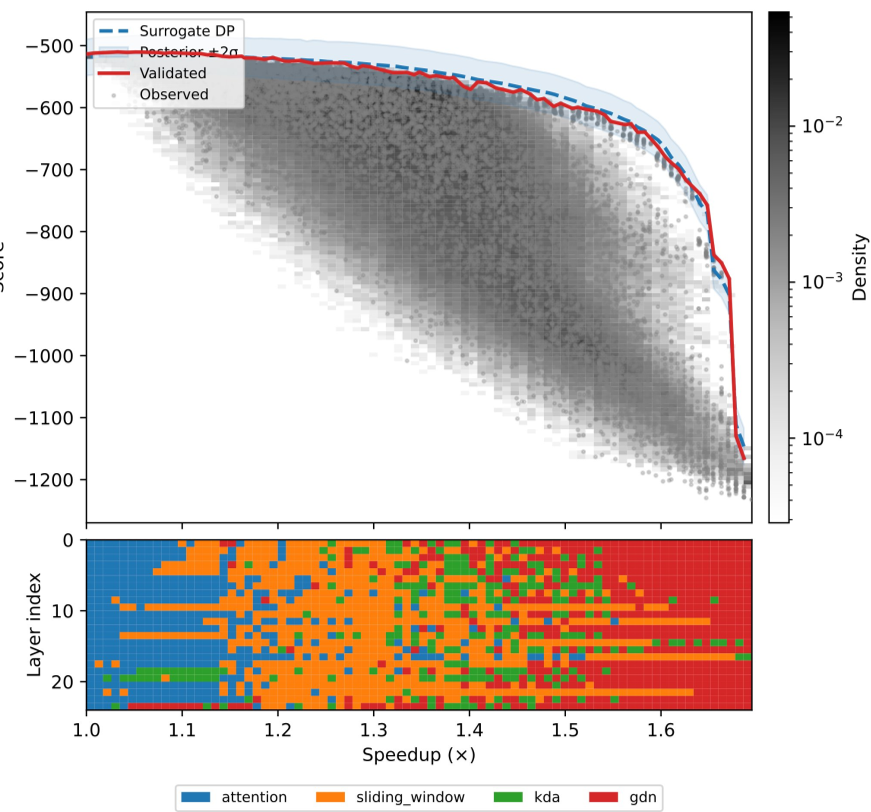 Figure 2: The Pareto frontier shows a smooth tradeoff between throughput and performance average.
Key Benchmarks (SFT Improvements)
The authors found that Supervised Fine-Tuning (SFT) was critical. While distillation provided a strong base, targeted SFT on specific "Pareto presets" recovered significant reasoning capabilities, especially in Math (AIME/MATH-500).
| Preset | Speedup @32k | Avg Accuracy | Retention |
|---|---|---|---|
| all-FA (Teacher) | 1.0x | 74.2 | 100% |
| Reg/Lklhd-26 | 2.9x | 71.1 | 96% |
| Reg/Lklhd-13 | 6.9x | 60.2 | 81% |
| Reg/Lklhd-10 | 10.7x | 57.2 | 77% |
Landscape Dynamics: Can we trust small models?
A fascinating part of the paper explores "Landscape Drift." Do the best layer placements for a 0.5B model stay the same for a 15B model? The answer is: Not exactly. While global rankings are stable, the "Frontier" (the very best models) is volatile at the 15B scale. This suggests that while small-scale proxies are useful for general trends, final architecture search must be done at the production scale.
Critical Analysis & Conclusion
The Good
- Speculative Decoding Winner: By using GDN as a draft and FA as a verifier from the same checkpoint, the system achieves speedups without any quality loss and without loading a second model.
- Operational Efficiency: One checkpoint to rule them all. DevOps teams no longer need to manage five different versions of a model for different latency SLAs.
The Limitations
- Long-Range Decay: As speed increases, long-range retrieval (RULER/NIAH) drops significantly. Recurrent mixers still struggle to compress 32k+ context into a fixed state as effectively as a KV-cache.
- VRAM Overhead: If served in "Supernet mode" (supporting all presets at once), all mixer weights must reside in GPU memory, which captures VRAM that could otherwise be used for batching.
Final Takeaway: Super Apriel is a blueprint for the future of "Elastic Inference." By treating architecture as a software-defined variable selectable at the request level, it bridges the gap between research-grade accuracy and production-grade efficiency.