
SwiftI2V: 202x Faster 2K Video Generation via Decoupled Motion and Detail
SwiftI2V: Efficient High-Resolution Image-to-Video Generation via Conditional Segment-wise Generation
SwiftI2V is an efficient two-stage framework for 2K-resolution Image-to-Video (I2V) generation that decouples motion modeling from high-frequency detail synthesis. It achieves state-of-the-art fidelity on the VBench-I2V benchmark while reducing total GPU-time by 202x compared to end-to-end high-resolution baselines.
TL;DR
SwiftI2V is a breakthrough in high-resolution Image-to-Video (I2V) synthesis. By decoupling global motion modeling (Stage I) from high-resolution detail refinement (Stage II) and introducing Conditional Segment-wise Generation (CSG), it achieves 2K resolution outputs with 202x less GPU-time than previous end-to-end models. Remarkably, it brings 2K video generation to consumer GPUs like the RTX 4090.
Problem & Motivation: The Fidelity-Efficiency Dilemma
Generating 2K video from a single image is extremely difficult because the model must simultaneously master two things:
- Global Motion: Moving objects naturally across the scene.
- Fine-grained Fidelity: Preserving the exact textures, identity, and background details of the input image without "drifting" over time.
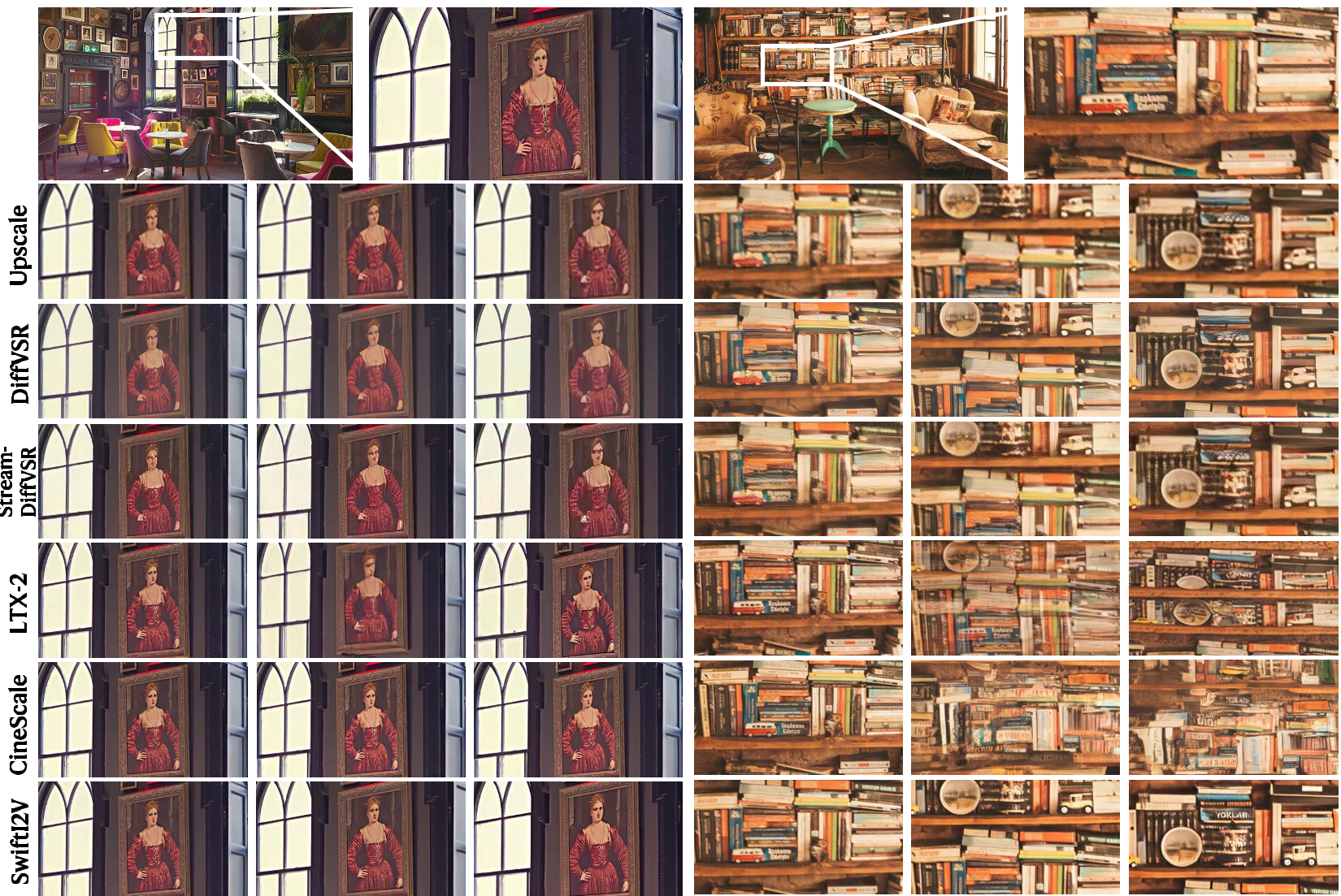
Current solutions fail on two fronts. End-to-end models (like CineScale) try to do everything at once, leading to massive memory usage and slow inference. LR+VSR pipelines generate a low-res video and upscale it, but their super-resolution stage often "hallucinates" or forgets the original high-res input's specific textures because it isn't strictly conditioned on the first frame.
Methodology: The Core of SwiftI2V
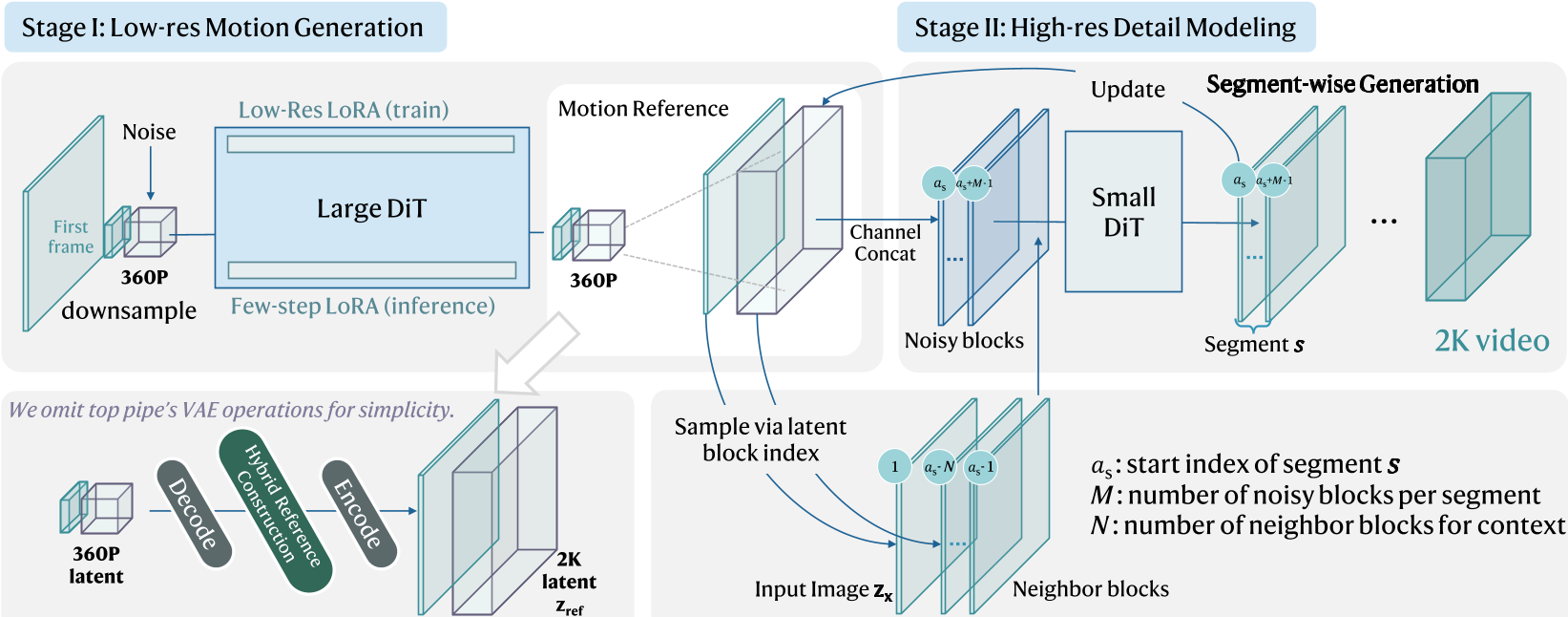
SwiftI2V's brilliance lies in its two-stage decoupled architecture. Instead of teaching a 2K model to "invent" motion, it uses a smaller model to set the stage and a dedicated refiner to paint the details.
1. Stage I: Motion Reference
A large-capacity DiT (Diffusion Transformer) operates at 360P to generate a robust motion prior. This tells the system where things move without wasting tokens on individual hairs or leaf textures.
2. Stage II: High-Resolution Detail Synthesis
This stage is the "refiner." It focuses solely on injecting high-frequency segments into the motion frame.
3. Conditional Segment-wise Generation (CSG)
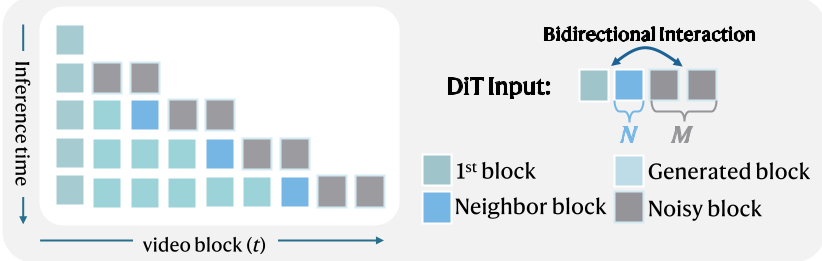
To fit 2K video into GPU memory, SwiftI2V processes the video in segments rather than all frames at once.
- The Anchor: The original high-res image is always used as a "boundary condition."
- Bidirectional Contextual Interaction: Unlike standard autoregressive (AR) models that only "look back," SwiftI2V allows current noisy blocks to bidirectionally attend to previous segments and the anchor. This eliminates the "seams" or "popping" artifacts typically seen in segment-based generation.
Experiments & Results: Desktop-Class 2K Generation
The most striking result is the efficiency gain. SwiftI2V reduces total GPU-time by 202x compared to CineScale while maintaining superior "I2V Background" consistency.
| Model | Peak Memory | Inference Time (81 frames) |
|---|---|---|
| CineScale (End-to-end) | 42.7GB (4 GPUs) | 5600s |
| SwiftI2V | 33.5GB (1 GPU) | 111s |
Persistence of Detail
Through a "Stage-Transition Training" strategy—where the model is trained on intentionally "noisy" low-res references—SwiftI2V learns to correct artifacts from Stage I. This results in 2K videos that look indistinguishable from the source quality.
Critical Analysis & Conclusion
Takeaway: SwiftI2V proves that for high-resolution video, "Divide and Conquer" is better than "Brute Force." By separating motion from texture, we can use smaller, more efficient transformers to achieve cinematic results.
Limitations: While SwiftI2V is much faster, it is not yet "real-time." Processing an 81-frame 2K video still takes about 2 minutes on a high-end H800. Furthermore, the modular design requires managing two separate model stages, which adds engineering complexity for production deployment.
Future Outlook: The CSG paradigm opens the door for long-duration video generation (e.g., minutes instead of seconds) because the memory cost is bounded per segment rather than growing quadratically with the video length.