
Syn4D: Bridging the Gap in 4D Scene Understanding with Massive Synthetic Data
Syn4D: A Multiview Synthetic 4D Dataset
The paper introduces Syn4D, a large-scale multiview synthetic 4D dataset designed to advance dynamic scene understanding. It provides 1.4 million frames with dense 3D tracking, depth maps, camera motion, and parametric human pose annotations, enabling SOTA performance in 4D reconstruction, 3D tracking, and human pose estimation.
TL;DR
Reconstructing and tracking dynamic 3D scenes (4D reconstruction) from monocular video has long been a "holy grail" of computer vision. Syn4D is a groundbreaking synthetic dataset featuring 1.4 million frames across 4.7k clips, providing the first dense, multiview 3D tracking annotations. By solving the storage bottleneck for dense 4D data, the authors enable significant performance leaps in tracking, depth estimation, and human pose recovery.
Background & Motivation: Why 4D is Hard
While feed-forward neural networks have mastered the reconstruction of static 3D scenes, the transition to dynamic 4D has been stunted. Traditional methods like Structure-from-Motion (SfM) struggle with non-rigid motion, and deep learning methods lack the ground-truth data required to learn complex motion priors. Real-world data (e.g., LiDAR) is often too sparse, and existing synthetic data like Kubric lacks realism or provides only rigid-body dynamics.
The Core Innovation: Efficient Dense Tracking
The technical standout of Syn4D is how it handles "Dense Point Maps" (DPM). Tracking every pixel in a video across time and different camera views typically leads to an exponential explosion in data size (terabytes for a single clip).
The authors circumvent this by using Barycentric Maps. Instead of storing raw coordinates for every pixel, they:
- Store the vertex trajectories of the 3D meshes.
- Store the face index and barycentric coordinates for each pixel.
This allows for efficient querying of any point's 3D position at any time () and from any camera () with a minimal memory footprint.
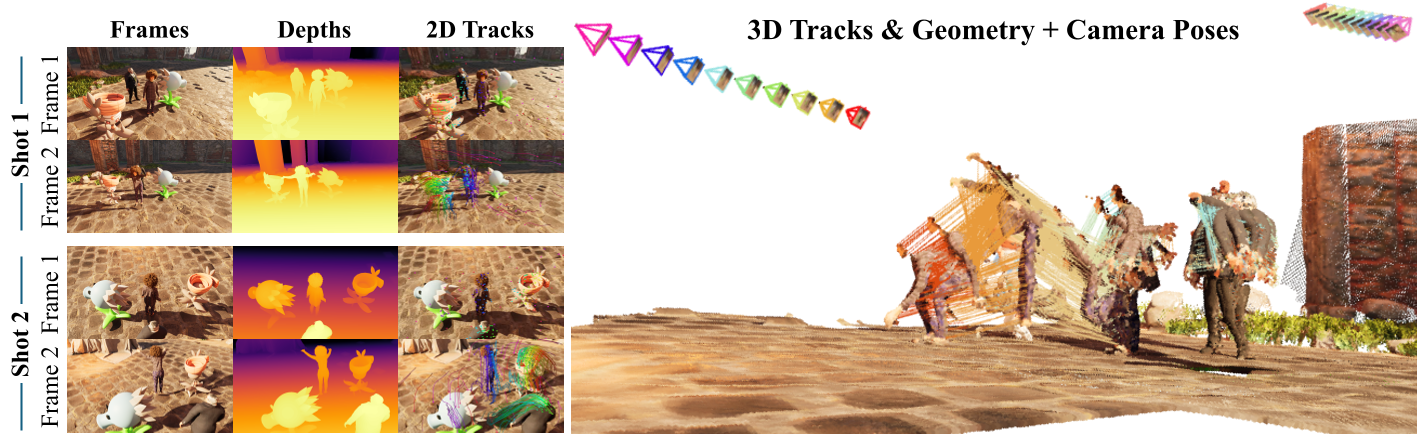 Fig 1: Syn4D provides the ability to unproject any pixel into 3D space across time and synchronized cameras.
Methodology: High-Fidelity Data Generation
Using Unreal Engine 5, the team procedurally combined:
- Environments: 30 high-quality 3D scenes from the Unreal Fab store.
- Dynamic Assets: 1,674 animated objects from Objaverse-XL and 585 simulated humans from Bedlam2.
- Camera Motion: Comprehensive trajectories including orbit, dolly, and tracking shots, augmented with Perlin-noise camera shake.
Experimental Validation: SOTA Gains
The authors integrated Syn4D into existing SOTA frameworks like 4RC (4D Reconstruction) and MA-HMR (Human Mesh Recovery).
1. 4D Reconstruction & Tracking
Adding Syn4D to the training set of 4RC resulted in dramatic improvements in video depth estimation and tracking accuracy. On the Sintel benchmark, the relative depth error (Rel) was reduced by 32%.
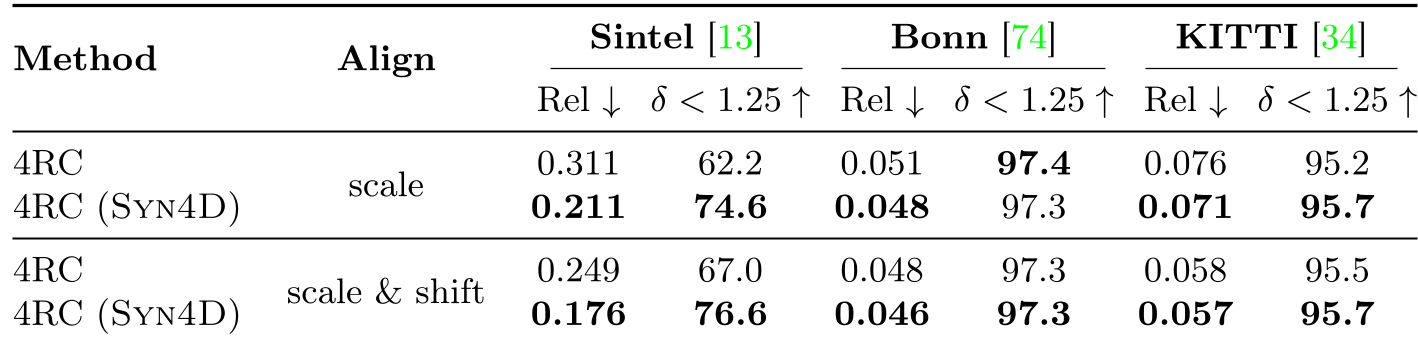 Table 1: Quantitative results showing consistent improvements in video depth estimation across multiple benchmarks when including Syn4D.
2. Geometry-Aware Novel View Synthesis
The paper introduces a new task: generating a novel view video along with its corresponding 4D geometry. Their Syn4D-trained diffusion model outperformed those trained on previous-generation datasets like Kubric, showing much better temporal and geometric consistency.
 Table 2: Syn4D vs. Kubric in Visual and Geometry quality for novel view synthesis.
Critical Insight & Future Outlook
The success of Syn4D proves that structural diversity and dense supervision are more critical for 4D vision than simple photorealism. By providing a scalable way to represent dense motion, the authors have opened the door for "Foundational Models" for 4D reconstruction.
However, a current limitation is the "single human per scene" constraint in the human pose task. Future iterations involving multi-person interactions in crowded synthetic environments would likely push the boundaries of occlusion-aware tracking even further.
Conclusion
Syn4D is more than just a dataset; it’s a framework for how we should think about temporal geometric data. It bridges the gap between 2D video generation and 3D scene understanding, providing the "perfect labels" the field has needed for decades.