
Syndrome Resampling: Breaking the QEC Threshold Barrier Without Extra Hardware
Syndrome resampling enhances quantum error correction thresholds
The paper introduces Syndrome Resampling (SR), a hardware-agnostic method to enhance Quantum Error Correction (QEC) thresholds. By biasing syndrome distributions toward more probable outcomes, it connects Renyi Coherent Information (RCI) phase transitions to achievable logical fidelities, significantly outperforming standard decoders.
TL;DR
Quantum Error Correction (QEC) just got a major upgrade that doesn't require a single new physical qubit. Researchers have introduced Syndrome Resampling (SR), a technique that uses the statistical physics of "syndrome distributions" to boost error-correction thresholds. By mathematically linking Renyi Coherent Information to syndrome probabilities, this method lowers logical error rates by up to 10,000x and works on existing experimental data—turning "trash" syndromes into high-fidelity logical outcomes.
The Motivation: The "Threshold" Wall
In the race for fault-tolerant quantum computing, the Threshold Theorem is the ultimate gatekeeper. If your physical hardware noise is above a certain percentage (the threshold), adding more qubits actually makes the logical qubit worse.
Current experiments are barely scraping past these thresholds. To get better performance, we usually have two choices:
- Better Hardware: Extremely expensive and slow.
- Post-Selection (PS): Throwing away every run where an error is detected. This works but is wasteful; as you scale up, the probability of a "clean" run drops to zero.
The authors of this paper asked a deeper question: Is there a middle ground between keeping everything (noisy) and keeping nothing (wasteful)?
Methodology: The Physics of "Likely" Errors
The core insight lies in the Syndrome Probability Distribution (SPD). In QEC, a "syndrome" tells us what went wrong. Some syndromes are very likely (caused by simple, low-weight errors), while others are rare (caused by complex, high-weight error chains).
The authors prove that if you resample your experimental data such that you prioritize syndromes with higher probabilities—specifically by raising the probability to a power —you can shift the phase transition of the entire system.
The RCI Connection
The paper establishes a rigorous link between Renyi Coherent Information (RCI) and the power-scaled syndrome distribution. In essence, by tuning , you move along a family of optimal thresholds:
- : Standard Maximum Likelihood Decoding (MLD).
- : Syndrome Resampling (the "sweet spot").
- : Traditional Post-Selection.
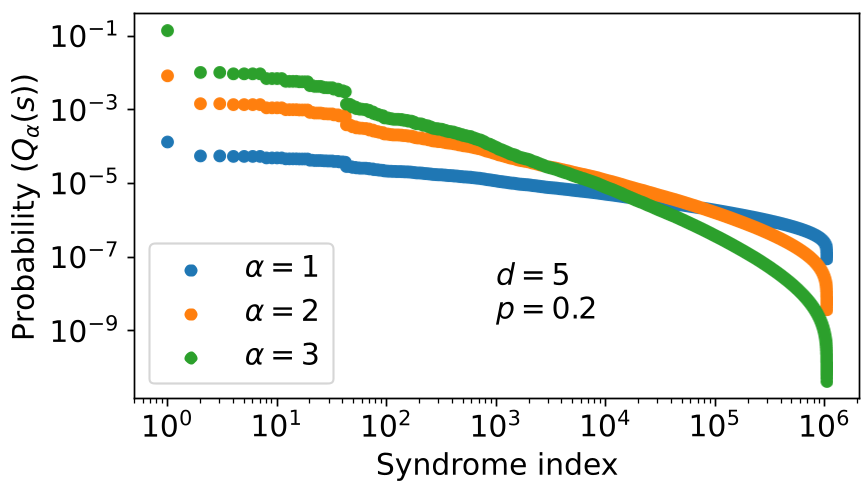 Figure 1: Visualizing how the syndrome distribution peaks as increases, effectively "filtering" the noise.
Experimental Results: Turning Theory into Reality
The researchers didn't just stop at math; they tested this on Surface Codes (the industry favorite) and real experimental data from lattice surgery.
1. Massively Improved Thresholds
Using the resampled distribution, the threshold for a surface code under bit-flip noise jumped from ~11% to over 20% for higher values. This means hardware that was previously considered "too noisy to work" can now be used for logical computation.
2. Real-World Gains
When applied to existing data from recent lattice surgery experiments (Besedin et al., 2026), the results were staggering:
- Logical Error Reduction: ~100x lower.
- Data Retention: 40% (compared to 5% for standard post-selection).
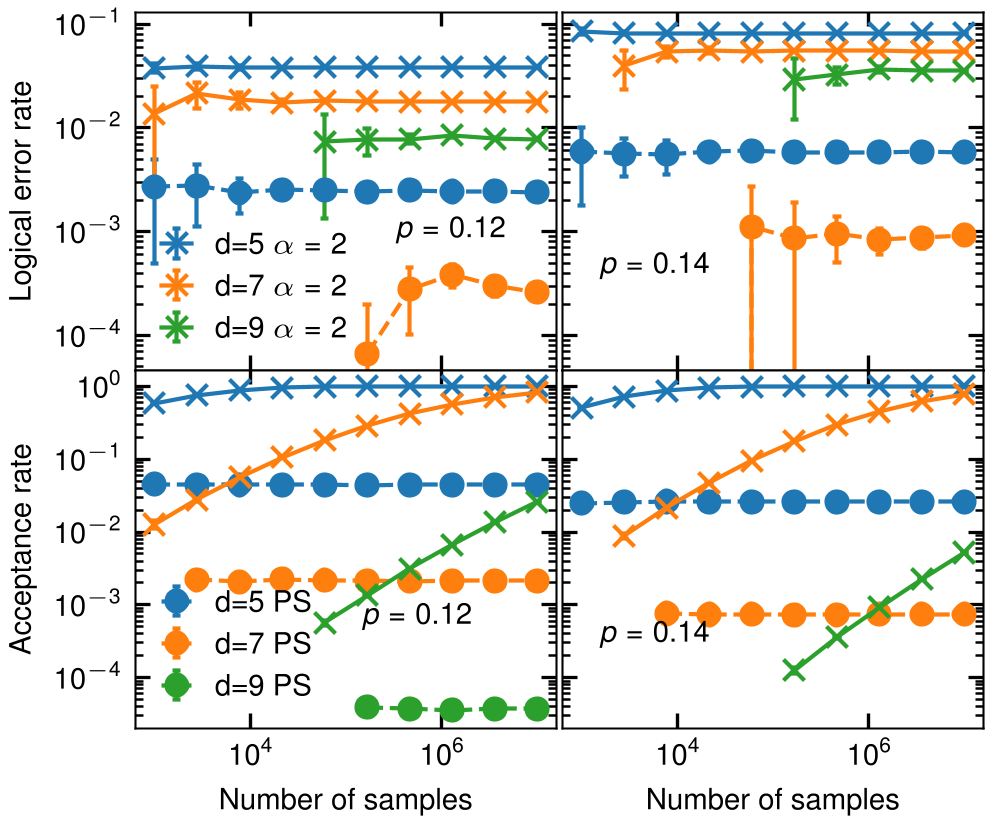 Figure 2: Performance of SR on experimental data, showing the convergence of error rates with finite samples.
Deep Insight: Why It Matters
The beauty of Syndrome Resampling is that it is decoder-agnostic. Whether you use Minimum Weight Perfect Matching (MWPM) or a state-of-the-art Neural Decoder, SR makes them all better. It treats the syndrome data as a statistical resource, extracting the "cleanest" information possible from a noisy stream of measurements.
Limitations & Future Work
The primary challenge is sampling overhead. To estimate the SPD accurately for very large codes, you need a lot of data. However, the authors suggest that for near-term "noisy" devices (the NISQ-FT transition era), the amount of data required is well within experimental reach.
Conclusion
Syndrome Resampling bridges the gap between theoretical fault tolerance and current hardware limitations. By recognizing that not all syndromes are created equal and applying a "soft" version of post-selection, we can push the boundaries of quantum reliability today, using the data we already have.
Key Takeaway: The next breakthrough in QEC might not be a better qubit, but a better way to look at the errors we already have.