
AgentFlow: Automating Multi-Agent Orchestration for Zero-Day Discovery
Synthesizing Multi-Agent Harnesses for Vulnerability Discovery
This paper introduces AgentFlow, an automated framework for synthesizing multi-agent harnesses for complex software analysis tasks. By utilizing a typed graph DSL and a feedback-driven optimization loop, AgentFlow achieved a SOTA 84.3% pass rate on TerminalBench-2 and discovered 10 zero-day vulnerabilities in Google Chrome, including two critical sandbox escapes.
Executive Summary
TL;DR: AgentFlow is a revolutionary framework that treats the "harness"—the orchestration logic of LLM agents—as a searchable program. By combining a typed graph DSL with granular runtime feedback (like AddressSanitizer and code coverage), it automatically crafts high-performance multi-agent teams.
Positioning: This work moves beyond "prompt engineering" into "architecture synthesis." It currently holds the #1 spot on the TerminalBench-2 leaderboard and has successfully breached the defensive perimeter of Google Chrome, uncovering 10 zero-day vulnerabilities that human auditors missed.
The Bottleneck: Why One Agent is Not Enough
In the realm of security research, a single LLM agent often collapses under the weight of "voluminous output." A single instrumented Chrome build can emit megabytes of data, far exceeding the 200K token context windows of frontier models. This leads to the "lost-in-the-middle" effect, where models forget their analysis or repeat fruitless strategies.
While splitting work across specialized agents (Analyst, Explorer, Verifier) helps, the Harness Design Problem arises: Who talks to whom? What tools do they use? How do they recover from failure? Historically, these harnesses were hand-written, and previous optimizers (like Meta-Harness or ADAS) were too narrow in scope to find optimal configurations.
Methodology: The Typed Graph DSL
AgentFlow solves the "narrow scope" problem by formalizing a harness as a five-component tuple: .
- (Agents): Roles, prompts, and specific LLM models.
- (Graph): The communication topology.
- (Schema): What data passes between nodes.
- (Tools): Tool allocation (e.g., read-only vs. execute).
- (Protocol): Coordination (parallel fan-out, retries).
Architecture Visualization
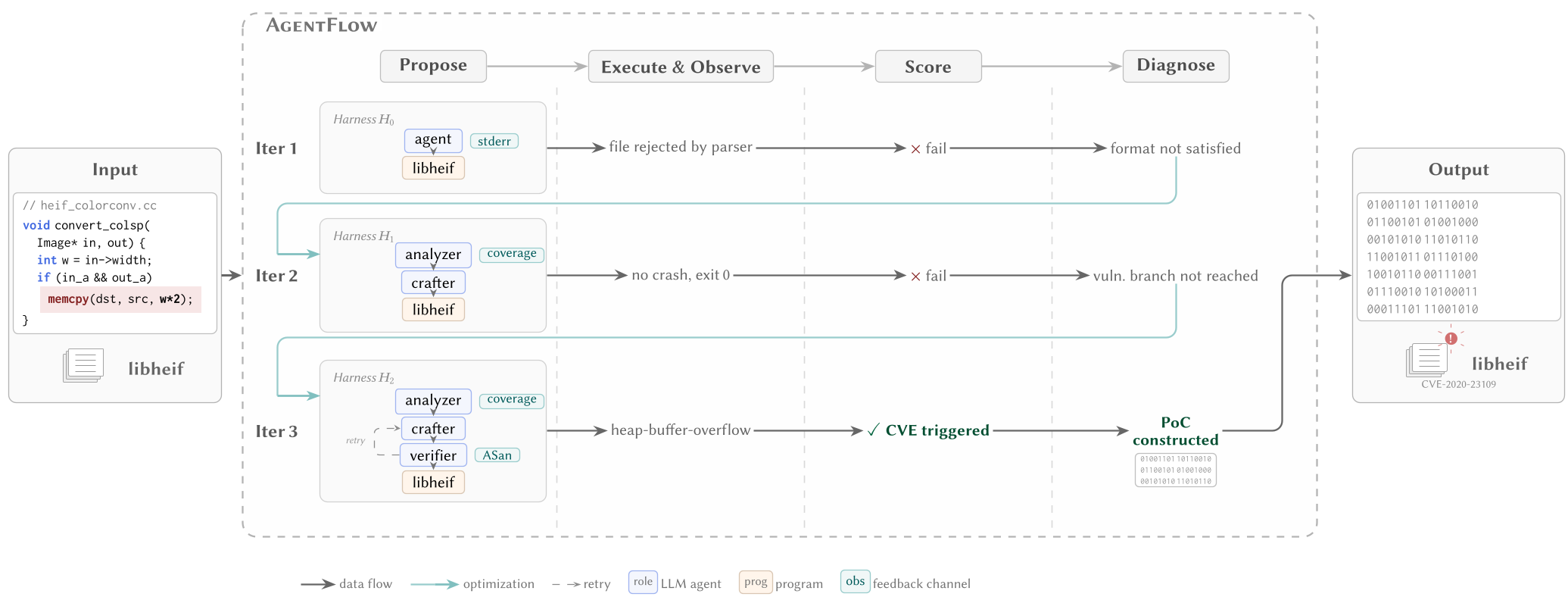 Figure 1: The iterative evolution of a harness. Note how the system moves from a single agent to a multi-stage pipeline with feedback loops.
To make searching this massive space tractable, AgentFlow uses a Type System. Before spending expensive GPU tokens on a candidate harness, it performs a structural check:
- Variable Resolution: Does the prompt reference data that will actually exist?
- Edge Validity: Do edges connect to agents that actually use the info?
- Connectivity: Is every agent part of the workflow?
Closing the Loop with Runtime Diagnostics
The "secret sauce" of AgentFlow is its use of rich feedback channels instead of binary pass/fail scores.
- Line/Branch Coverage: Tells the system if its input even reached the buggy function.
- Sanitize Reports (ASan/UBSan): Detects silent memory corruptions that don't cause an immediate crash.
- Stderr/Stdout: Provides diagnostic error strings from the target program.
When a harness fails, the Diagnoser (an LLM) analyzes these signals to pinpoint the "bottleneck agent" and suggests a "corrective edit" (e.g., "The Explorer is stuck on a format check; add a specialist Parser-Analyst").
Experimental Results & Real-World Impact
AgentFlow was validated on two grueling fronts:
1. TerminalBench-2 Mastery
On a suite of 89 long-horizon tasks, AgentFlow reached 84.3%, surpassing all competitors, including specialized production-grade harnesses like ForgeCode.
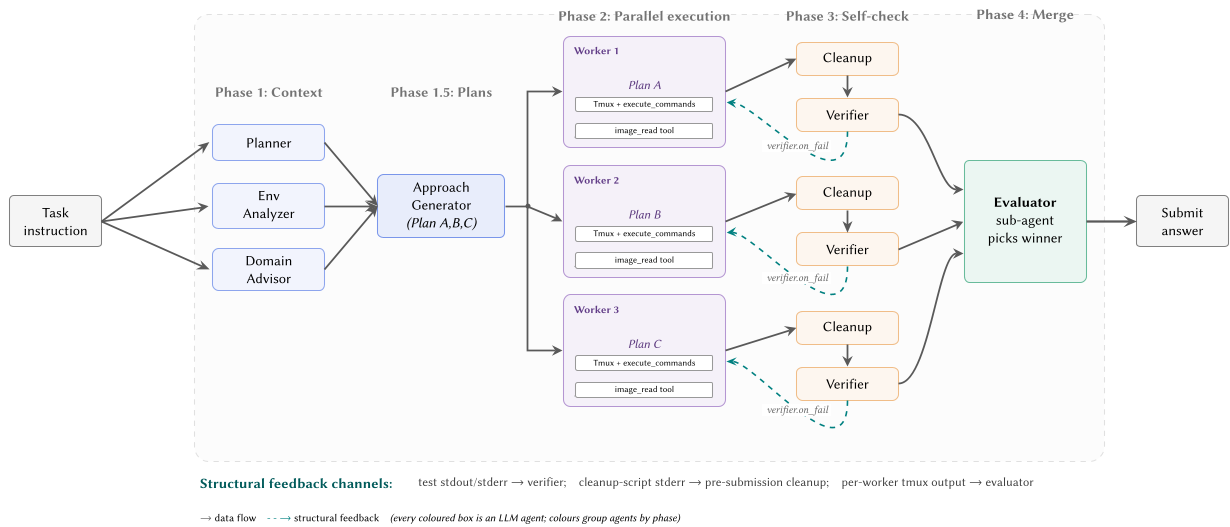 Figure 6: The final synthesized harness for TerminalBench-2, featuring nine roles and three parallel workspaces.
2. Hunting Zero-Days in Chrome
Testing on the 35M+ line Chrome codebase, AgentFlow (using the mid-tier Kimi K2.5 model) discovered ten zero-days.
- CVE-2026-5280 & CVE-2026-6297: Two critical sandbox-escape vulnerabilities.
- This demonstrates that a superior harness can empower a mid-tier model to outperform frontier models with inferior orchestration.
Critical Insight & Future Outlook
Takeaway: AgentFlow proves that the "bottleneck" in AI capability is shifting from the model itself to the System Architecture in which the model resides.
Limitations: The system currently relies on static topologies (no runtime agent spawning). Future work could explore dynamic agents that self-replicate based on task complexity.
Conclusion: By treating the multi-agent harness as a typed, synthesizable program, AgentFlow provides a blueprint for the next generation of autonomous security researchers.