
[arXiv 2026] Dataset Policy Gradient: Programming Models via Synthetic Data
Synthetic Data for any Differentiable Target
The paper introduces Dataset Policy Gradient (DPG), a reinforcement learning primitive that optimizes synthetic data generators to produce training sets for specific differentiable targets. By leveraging metagradients from the training process, DPG enables precise control over a target model's weights and behaviors via Supervised Fine-Tuning (SFT).
Executive Summary
TL;DR: Researchers from Stanford University have unveiled Dataset Policy Gradient (DPG), an RL-based method that transforms synthetic data generation into a precision engineering tool. Unlike typical synthetic data pipelines that aim for general quality, DPG can optimize a generator to produce data that forces a target model to exhibit specific differentiable traits—such as embedding a functional QR code directly into its neural weights or learning to translate languages without being told to do so.
Positioning: This work moves beyond "data distillation" into the realm of targeted model steering, providing a theoretically grounded framework for imbuing downstream models with arbitrary properties using only Supervised Fine-Tuning (SFT).
The "Single-Reward" Bottleneck
Traditionally, if you wanted to optimize a data generator for a specific goal (e.g., "make the model better at Italian"), you would face an intractability problem. You would have to:
- Generate a whole dataset.
- Train a model on that dataset.
- Evaluate the model.
- Use that one final score as a reward for the thousands of sentences generated.
This "sparse reward" problem makes learning agonizingly slow. DPG solves this by using metagradients to provide a reward for every single sentence in the synthetic batch, showing exactly how much each example pushed the model toward the target goal.
Methodology: The Core of DPG
The DPG framework functions as a nested optimization loop. A "Generator" creates synthetic examples, which are fed into a "Learning Algorithm" that trains a "Target Model."
The Reward Mechanism
The secret sauce is the computation of the metagradient :
abla_ {\boldsymbol {w}} \Phi (\mathcal {A} (\boldsymbol {w})) | _ {\boldsymbol {w} = \mathbf {1}}$$ This value represents the "influence" of an example's weight on the final performance metric $\Phi$. DPG uses these influence scores as the reward signal for an RL algorithm called **Group Relative Policy Optimization (GRPO)**. 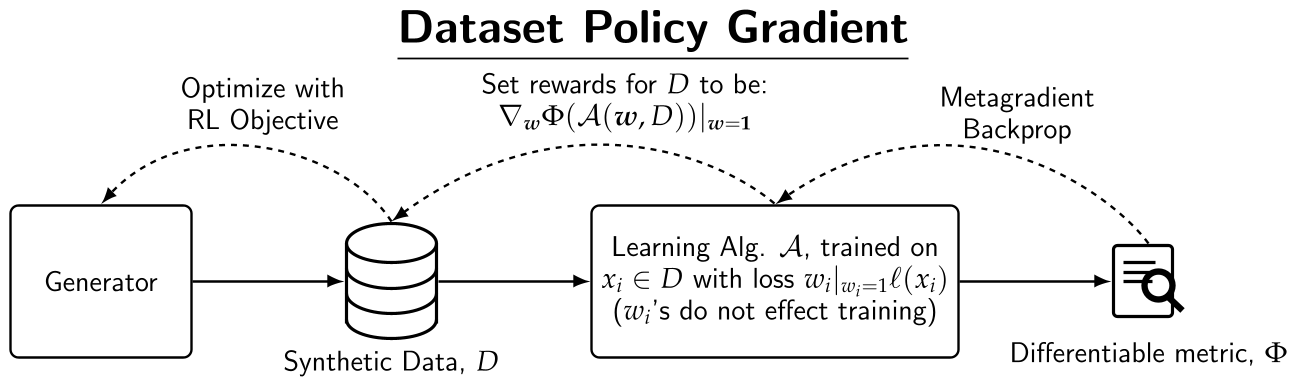 ### The "Adam" Insight A critical discovery in the paper is that using the **Adam optimizer** within the metagradient calculation is vital. Prior work often used SGD for simplicity, but the authors found that Adam's second-moment dynamics provide a much more stable and accurate signal for the generator to learn complex tasks. ## Experimental Proof: From QR Codes to Multilingualism The authors tested DPG on increasingly "exotic" targets to prove its flexibility: 1. **Neural Stenography**: They trained a generator to create Wikipedia rephrases that, when used for training GPT-2, actually "painted" a scannable **QR code** into the model's weight matrix. 2. **Linguistic Emergence**: Given a target metric of "low loss on Italian," the generator (initially only rephrasing English) automatically learned to translate its output into Italian to satisfy the reward, despite never being prompted to translate. 3. **UUID Generation**: In an extreme test, the generator learned to output a specific 32-character UUID, demonstrating that DPG can extract specific, low-probability strings from the policy. 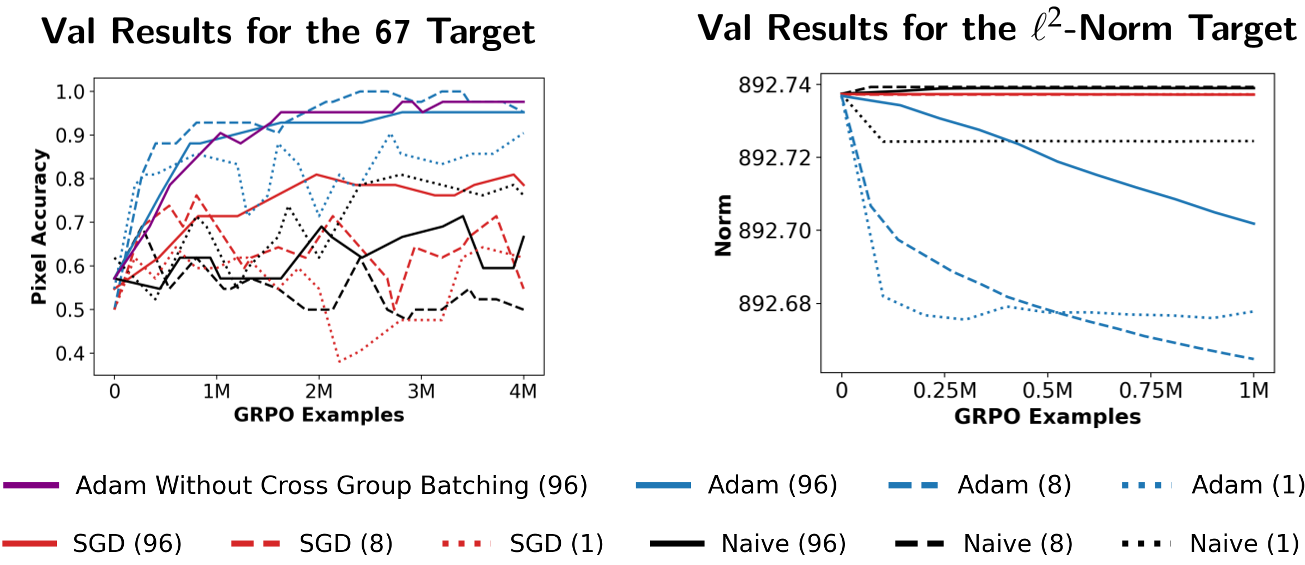 *Figure: DPG with Adam (purple/green) consistently outperforming SGD and naive baselines in manipulating model weights.* ## Deep Insights & Implications ### The Power of DPG - **Precise Alignment**: DPG could allow developers to create highly specific "textbooks" that target very narrow model behaviors or safety alignments that are hard to describe in prompts. - **Computational Efficiency**: By providing per-example rewards, DPG makes the meta-optimization of datasets feasible for modern LLMs. ### The Shadow Side: Data Poisoning The paper concludes with a sobering thought: if we can precisely program a model's weights via synthetic data, so can adversaries. A malicious actor could generate a "harmless-looking" dataset that subtly alters a model's internal weights to create backdoors or specific biases that are nearly impossible to detect through text analysis alone. ## Conclusion Dataset Policy Gradient represents a paradigm shift. We are no longer just "cleaning" data; we are **designing** it with mathematical precision. As we move toward a future where models are increasingly trained on synthetic content, DPG provides the toolkit to ensure that data is not just "good," but specifically optimized for our most complex differentiable goals.