
TabEmbed: Bridging the Gap Between Structured Tables and Vector Search
TabEmbed: Benchmarking and Learning Generalist Embeddings for Tabular Understanding
The paper introduces TabEmbed, the first generalist tabular embedding model that unifies classification and retrieval within a single vector space. Supported by a new comprehensive benchmark, TabBench, the model leverages large-scale contrastive learning to create schema-agnostic representations for structured data.
TL;DR
Despite the dominance of Foundation Models in NLP, tabular data remains a "siloed" domain where classification and retrieval require different architectures. TabEmbed shatters this boundary by providing the first generalist embedding model that understands numerical magnitude and tabular structure. By reformulating tabular tasks into a semantic matching problem, a 0.6B model can now outperform 8B giants in understanding structured data.
Background: The "Modality Gap" in Tabular AI
For years, practitioners have faced a dilemma. If you want high-accuracy classification, you use tree-based models (XGBoost/LightGBM), but these are "blind" to external knowledge and cannot perform vector search. If you use LLMs, you get reasoning, but you lose the efficiency of dense embeddings. General-purpose text embeddings (like OpenAI's or BGE) fail here because they treat Revenue: 100M as just another string, ignoring the mathematical reality of the number.
The Core Innovation: TabEmbed
The authors identify a fatal flaw in prior tabular self-supervision (like SCARF): Row-to-Row alignment. Simply pulling rows of the same class together forces the embedding space to collapse into coarse clusters, losing fine-grained details.
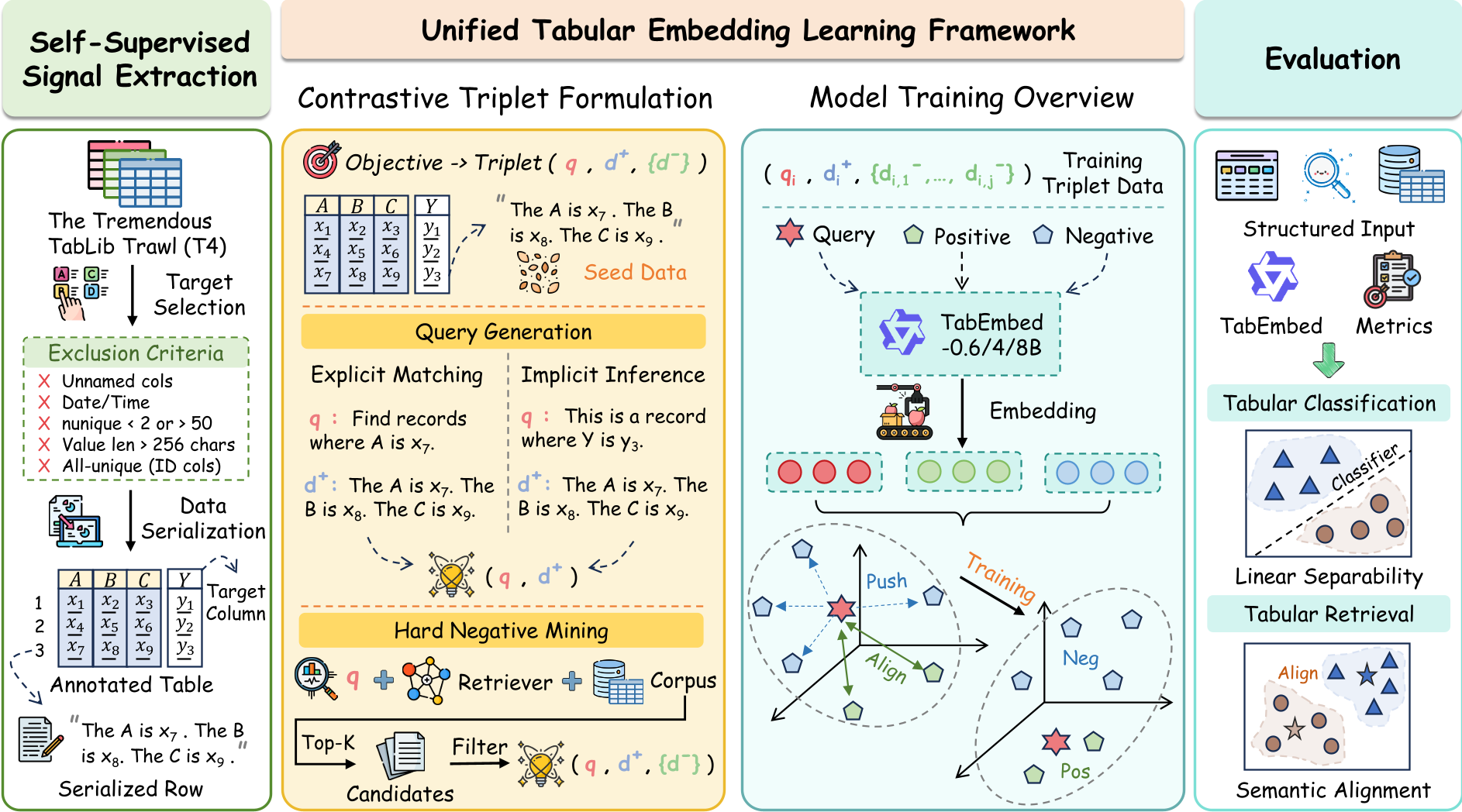
1. Language-to-Row Contrastive Learning
TabEmbed introduces a Unified Framework that uses natural language queries as anchors. Instead of comparing rows to rows, it compares:
- Retrieval Queries: "Find records where Status is Active and Price < 50.25" vs. the serialized row.
- Classification Queries: "This is a record where Target is X" vs. the masked row.
2. Positive-Aware Hard Negative Mining
To solve the "numerical sensitivity" problem, the model is trained with hard negatives—samples that look semantically similar (e.g., same category) but violate a specific numerical constraint (e.g., Price is 51 instead of < 50).
Performance: Efficiency Over Scale
The most striking result from the TabBench evaluation is parameter efficiency. TabEmbed-0.6B achieves an overall score of 65.27, handily beating GTE-Qwen2-7B (51.27).
| Model | #Params | Classification Acc | Retrieval MRR@10 |
|---|---|---|---|
| Qwen3-Embedding-0.6B | 0.6B | 62.81 | 36.00 |
| TabEmbed-0.6B | 0.6B | 67.16 | 71.72 |
| TabEmbed-8B | 8B | 69.88 | 80.58 |
Numerical Sensitivity: Can it "Count"?
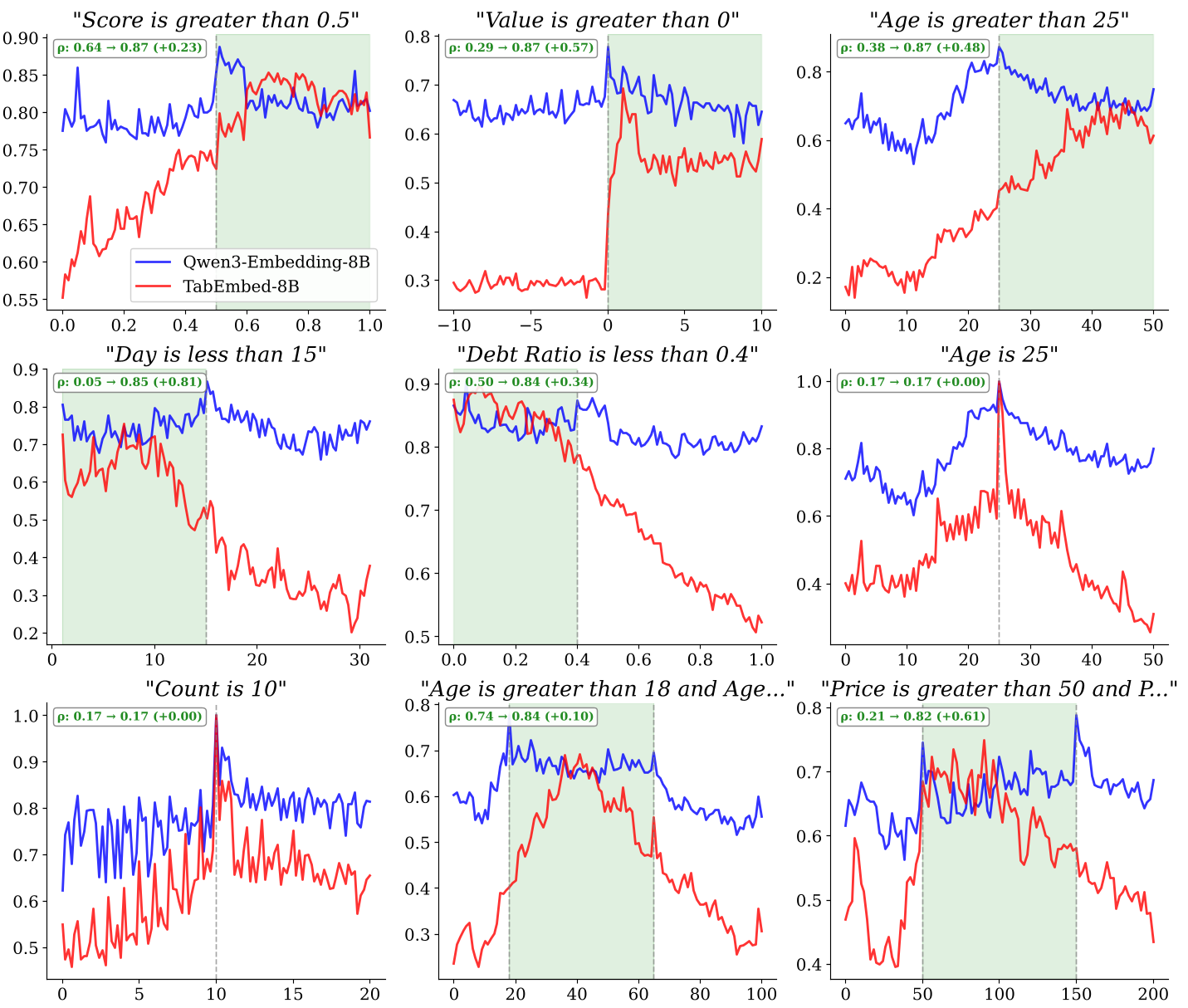
A standard embedding model often has zero correlation between its similarity scores and numerical order. As shown in the sensitivity curves, TabEmbed successfully approximates a Step Function for inequalities (>, <) and a Dirac Delta for equalities (=), proving it has internalized mathematical logic.
Why It Matters: Real-World Applications
- Agentic RAG: Acts as a high-speed "Foundational Retrieval Layer" for LLM agents to find the right data rows before reasoning.
- Dark Data Discovery: Allows users to find relevant spreadsheets in massive data lakes using vague, natural language intent.
- Schema-Agnostic Integration: Joins tables from different sources without manual column mapping, as the "embedding" captures the entity's soul regardless of the header.
Conclusion
TabEmbed demonstrates that we don't necessarily need bigger models for structured data—we need smarter alignment. By training on the "logic" of tables rather than just the "text" of tables, we can finally bring the power of RAG and semantic search to the world of SQL and CSVs.
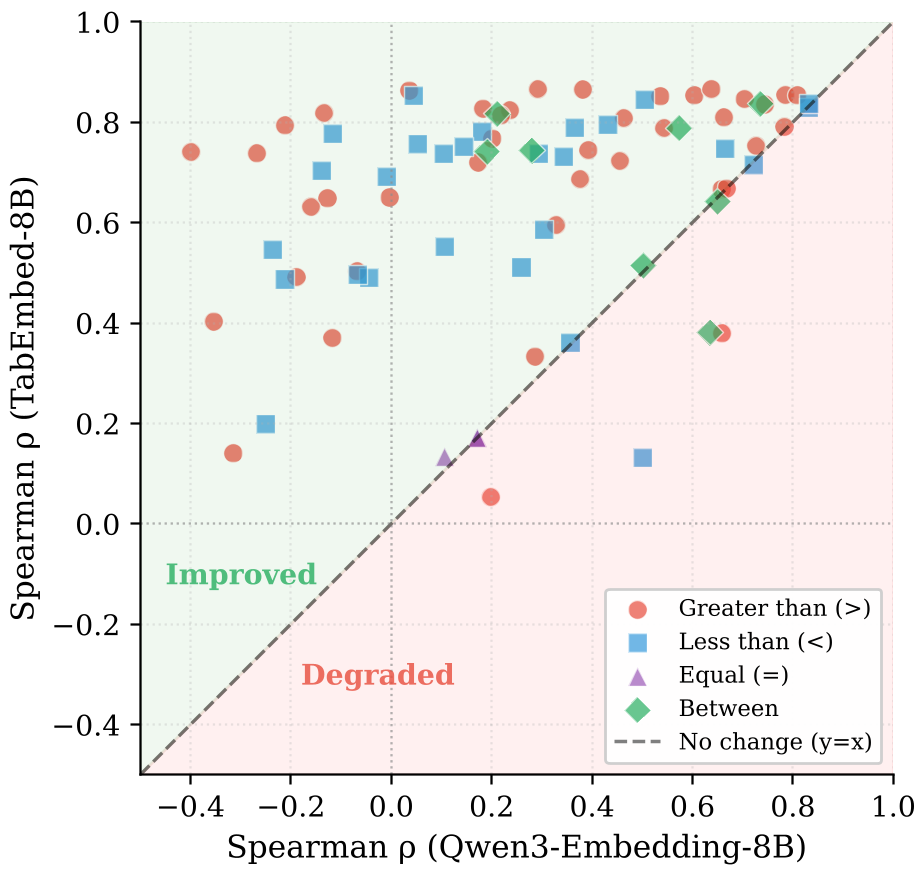 The visualization above shows how TabEmbed (right) successfully disentangles messy data into clear, searchable clusters compared to traditional LLM embeddings (left).