
[2026] Tangent Equations of Motion: A Scalable Paradigm for High-Order Nonlinear Response
Tangent equations of motion for nonlinear response functions
The paper establishes a systematic framework called Tangent Equations of Motion (TEOM) for computing high-order nonlinear response functions (Volterra kernels) directly from real-time dynamics. By evolving directional Gateaux derivatives alongside the system state, it achieves order-resolved extraction of spectra up to the 49th order without the combinatorial explosion of multipoint correlators or the numerical instability of finite-difference methods.
TL;DR
Computing how a system responds nonlinearly to external stimuli (like light or force) has historically been a choice between two evils: the "analytical hell" of factorial-scaling diagrams or the "numerical noise" of finite-difference simulations. This paper introduces Tangent Equations of Motion (TEOM), a framework that propagates the sensitivity of a system's trajectory as a primary dynamical variable. This allows researchers to extract genuine, frequency-resolved nonlinear response functions up to incredibly high orders (e.g., 49th order) with unprecedented stability.
Background: The Curse of Complexity
Nonlinear spectroscopy is the "microscope" of modern physics, revealing Higgs modes in superconductors and berry-curvature dipoles in quantum materials. However, calculating the -th order response function (the Volterra kernel) is notoriously difficult.
- Diagrammatic Methods: At high orders, the number of Feynman-like diagrams or time-orderings grows factorially.
- Real-Time Simulations: While they capture all orders naturally, "unmixing" them requires running simulations at different field strengths and subtracting them—a process that amplifies numerical noise until the signal is lost.
Methodology: The Tangent Space Intuition
The core insight of the TEOM framework is to shift from finite variations to infinitesimal ones via the Gateaux derivative.
If the system state evolves via a Liouville operator , the derivative of that state with respect to an external field along a perturbation direction follows a "Tangent" equation:
By evolving a hierarchy of these equations, the -th order response is isolated exactly. This bypasses the need for large field amplitudes and avoids the "subtraction problem" entirely.
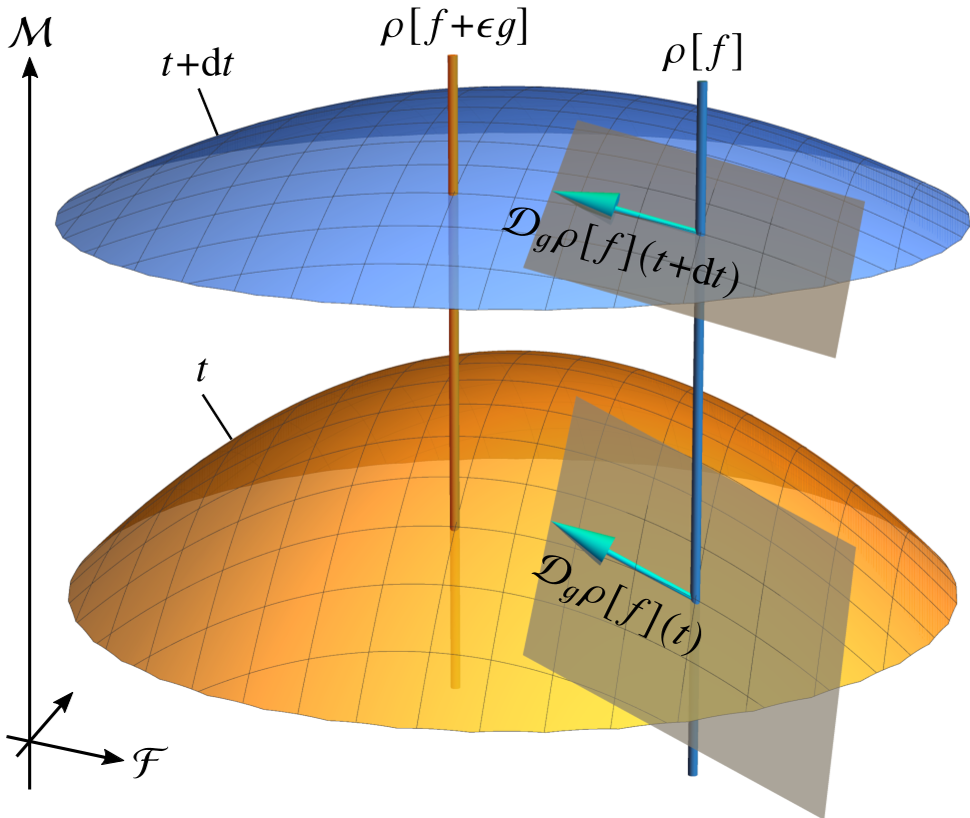 Figure 1: Comparison between the standard trajectory (top) and the tangent trajectory representing the functional derivative (bottom).
Key Results: From Electrons to Oscillators
1. Breaking the 5th Order Barrier in Solids
The author applied TEOM to a 2D four-band model representing electrons in topological spin textures. For the first time, we see full 2D frequency-resolved slices of a 5th-order response function (). The results perfectly predict the complex polarization-angle dependence of high-harmonic generation (HHG) in the perturbative regime.
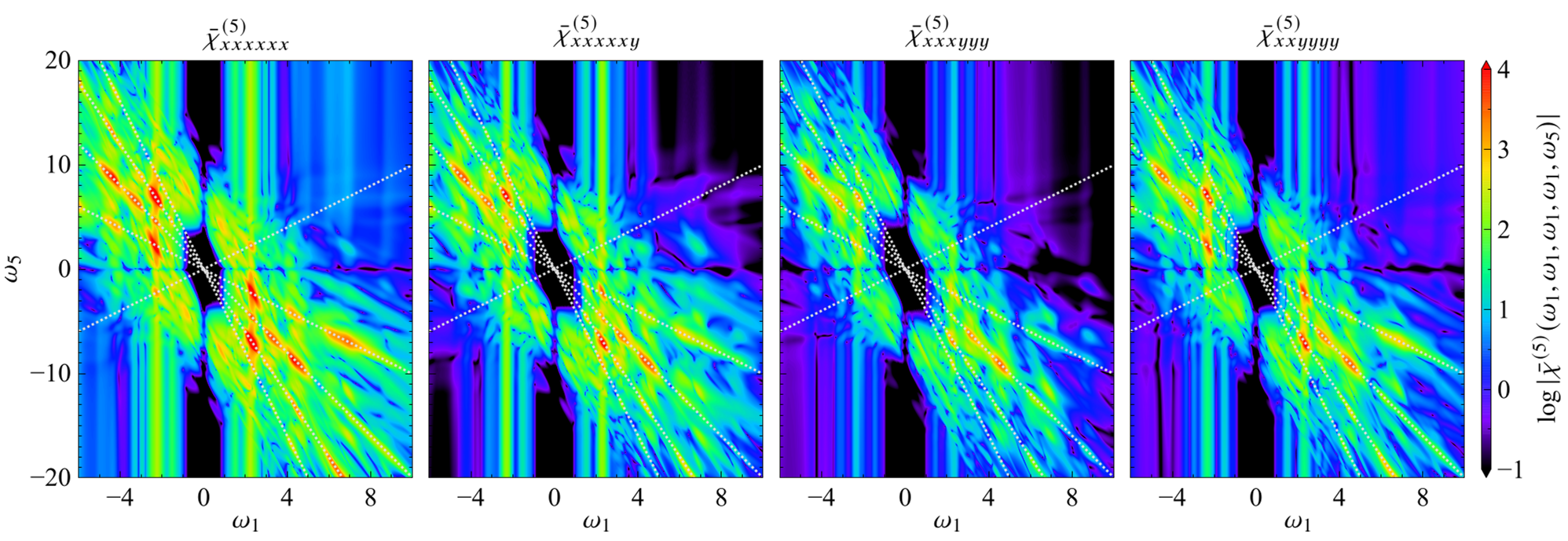 Figure 2: Color maps of the 5th-order response kernels. The ability to resolve off-diagonal frequency components (beyond simple harmonics) is a major breakthrough.
2. Pushing the Limits: 49th Order Accuracy
In a classical Duffing oscillator, the TEOM framework achieved a relative error of less than for responses up to the 49th order. The computational cost in "diagonal" configurations was shown to scale polynomially (), a massive improvement over the or exponential scaling of traditional approaches.
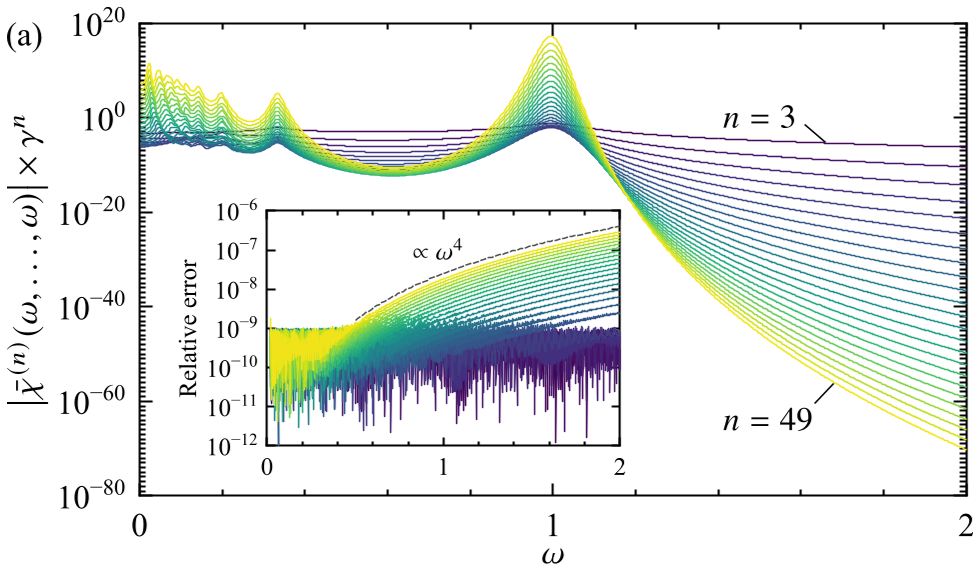 Figure 3: Accuracy vs. Order. The TEOM maintains precision where finite-difference methods would have long since failed.
3. Solving the Zero-Frequency Singularity
A subtle but vital contribution of the TEOM is its handling of optical conductivity () in the velocity gauge. Traditional methods face singularities as frequency approaches zero. By differentiating at the EOM level, TEOM provides stable, well-defined results at dc (), essential for studying the bulk photovoltaic effect.
Critical Analysis & Future Outlook
Why does this work? TEOM succeeds because it moves the complexity of the response theory into the structure of the differential equations themselves, which modern solvers handle efficiently, rather than into the number of discrete simulations or the complexity of the algebraic derivation.
Limitations:
- In fully general, multivariable settings, the number of auxiliary variables still grows as . While better than , it still poses a challenge for extremely high-order quantum many-body tasks.
- It requires a "sufficiently smooth" EOM, meaning it may need adaptation for systems with sharp discontinuities.
Conclusion: TEOM is poised to become a standard tool for tech editors and researchers in computational physics. It transforms high-order response from a theoretical exercise into a practical diagnostic tool for the next generation of nonlinear materials and devices.