
TC-JEPA: Reducing Visual Uncertainty via Fine-Grained Text Conditioning
Text-Conditional JEPA for Learning Semantically Rich Visual Representations
This paper introduces Text-Conditional JEPA (TC-JEPA), a novel self-supervised learning paradigm that extends the Joint-Embedding Predictive Architecture (JEPA) by incorporating fine-grained text conditioning. By modulating masked patch feature prediction with image captions, the model achieves SOTA performance in semantic representation learning and fine-grained visual understanding.
TL;DR
The "Joint-Embedding Predictive Architecture" (JEPA) just got a semantic upgrade. By leveraging synthetic captions to guide the prediction of masked image features, TC-JEPA solves the inherent uncertainty of visual reconstruction. It outperforms contrastive models (like CLIP/SigLIP) on dense tasks and traditional MIM models on semantic ones, creating a "best of both worlds" representation.
Context: The Uncertainty of the "Mask"
Self-supervised learning has traditionally split into two camps: Invariance-based (e.g., DINO), which learns global semantics but loses local detail, and Generative/MIM (e.g., MAE, I-JEPA), which captures fine details but often struggles with semantic coherence.
The fundamental problem in I-JEPA is uncertainty. If you mask a section of a room, it is mathematically difficult to predict whether that space contains a dog, a chair, or a plain wall based solely on surrounding pixels. This "multimodal" visual distribution often forces models to learn low-level textures instead of high-level concepts.
Methodology: Guiding Vision with Language
TC-JEPA introduces a "Text Conditioner" into the predictor branch. Unlike previous methods that might use a single global text vector, TC-JEPA uses fine-grained word tokens.
1. Attentive Modulation
The model uses a T5 text encoder to produce token-level embeddings. At multiple layers of the predictor, patch features act as Queries to cross-attend to these text Keys/Values. This allows a specific patch (e.g., the top-left corner) to "look up" relevant words (e.g., "sky", "cloud") to refine its feature prediction.
2. Sparsity and Consistency
To ensure the model doesn't just "cheat" by looking at all text tokens, the authors apply:
- : Forces the attention to be selective.
- : Ensures that the semantic meaning of a patch remains stable across the predictor's layers.
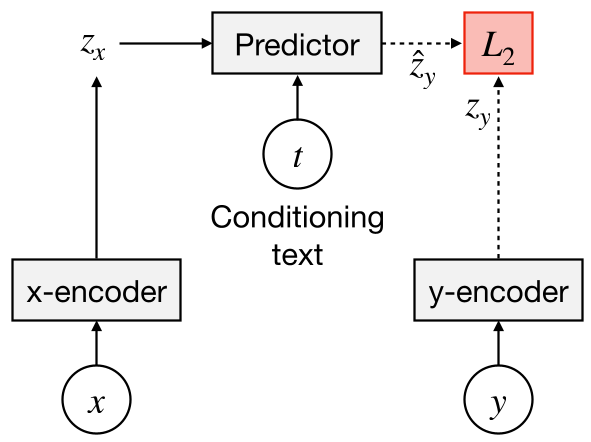 The Figure above illustrates how the predictor is augmented by text to facilitate the mapping from context to target .
Experimental Results: Breaking the Scaling Barrier
The performance of TC-JEPA is particularly striking in its efficiency and dense task performance.
SOTA Comparisons
- Semantic Segmentation: On ADE20k (Linear), TC-JEPA (41.2 mIoU) matches or beats DINOv2 while using significantly less data. It absolutely crushes SigLIP (20.5 mIoU) because contrastive models tend to "wash out" the local spatial features needed for segmentation.
- Training Speed: TC-JEPA reaches competitive accuracy in 5x fewer epochs than MAE.
 The table showcases that TC-JEPA bridges the gap between invariance-based SSL and MIM methods.
Visualizing the Intuition
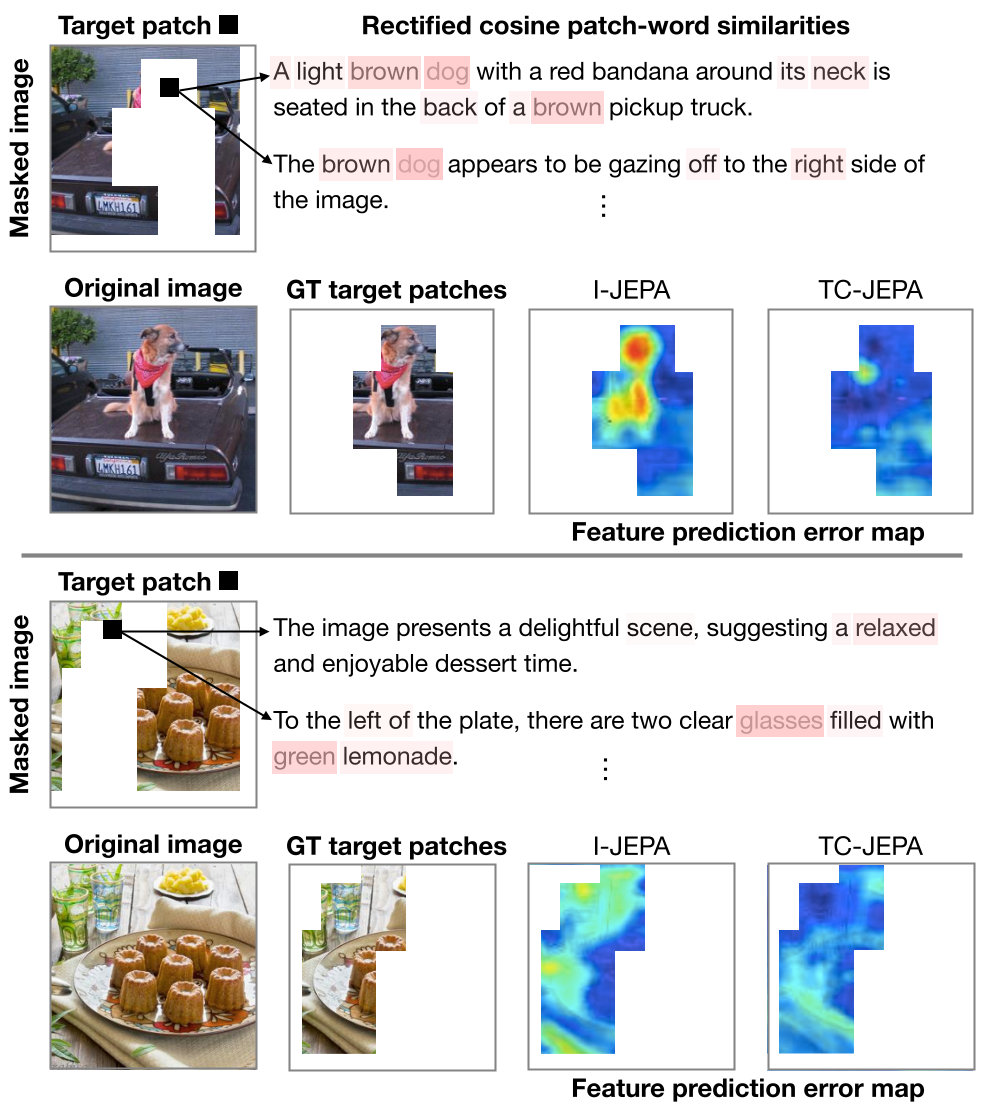
Visualizations show that the "unsupervised correspondence" learned by the model actually aligns with human logic. When predicting a masked area containing a "dog," the high-attention weights from the predictor layers align perfectly with the word "dog" in the caption. This reduces the L2 prediction error and forces the encoder to produce features that are "language-compatible."
Deep Insight & Conclusion
TC-JEPA represents a shift in how we think about Vision-Language Pretraining (VLP). While CLIP taught us that contrastive learning is great for zero-shot classification, TC-JEPA suggests that predictive learning (conditioned on text) is better for creating general-purpose visual "backbones" that need to understand both what an object is and where it is.
Limitations: The reliance on synthetic captions (ShareGPT4V) introduces a dependency on the quality of the captioning model. However, the authors' ablation studies show that as long as the diversity of captions is high (N=8), the model is robust to individual "hallucinations" in the text.
Future work could involve applying this to Video-JEPA, where text could describe actions or temporal changes, further reducing the massive uncertainty in future-frame prediction.