
TextLDM: Bridging the Gap Between Visual Diffusion and Language Modeling
TextLDM: Language Modeling with Continuous Latent Diffusion
TextLDM is a continuous latent diffusion framework for language modeling that adapts the successful visual Diffusion Transformer (DiT) recipe to text. By combining a Transformer-based VAE, Flow Matching, and Representation Alignment (REPA), it achieves state-of-the-art results among diffusion language models and matches the performance of GPT-2 in sequence continuation tasks.
TL;DR
For years, visual generation (Stable Diffusion, Sora) and language generation (GPT-4, Llama) have lived in different worlds: Diffusion vs. Autoregression. TextLDM finally brings the visual "DiT recipe" to text. By aligning a continuous latent space with a pretrained LLM, TextLDM matches GPT-2 quality while offering the massive potential of constant-time parallel generation and a unified architecture for all modalities.
The "Representation" Bottleneck
Why has text diffusion lagged behind? The core issue isn't the Transformer itself—it's the discrete nature of language. Previous attempts at latent text diffusion focused on reconstruction: "Can we turn tokens into vectors and back again?"
The authors of TextLDM discovered a critical insight: Reconstruction fidelity is a lie. A VAE can have 99.9% accuracy but a "messy" latent space that a diffusion model cannot navigate. Without semantic structure, the denoiser doesn't know how to move from "noise" to "meaningful text."
Methodology: The Visual Recipe for Text
TextLDM adopts the Diffusion Transformer (DiT) framework with a two-stage pipeline:
1. The REPA-Enhanced TextVAE
To fix the "messy" latent space, the authors introduced Representation Alignment (REPA). During VAE training, they don't just minimize reconstruction loss; they force the VAE encoder to match the hidden states of a frozen, pretrained LLM (Qwen3-1.7B).
- Insight: This "borrows" the semantic geometry of a model that already understands language, preparing the "ground" for the diffusion "seeds" to grow.
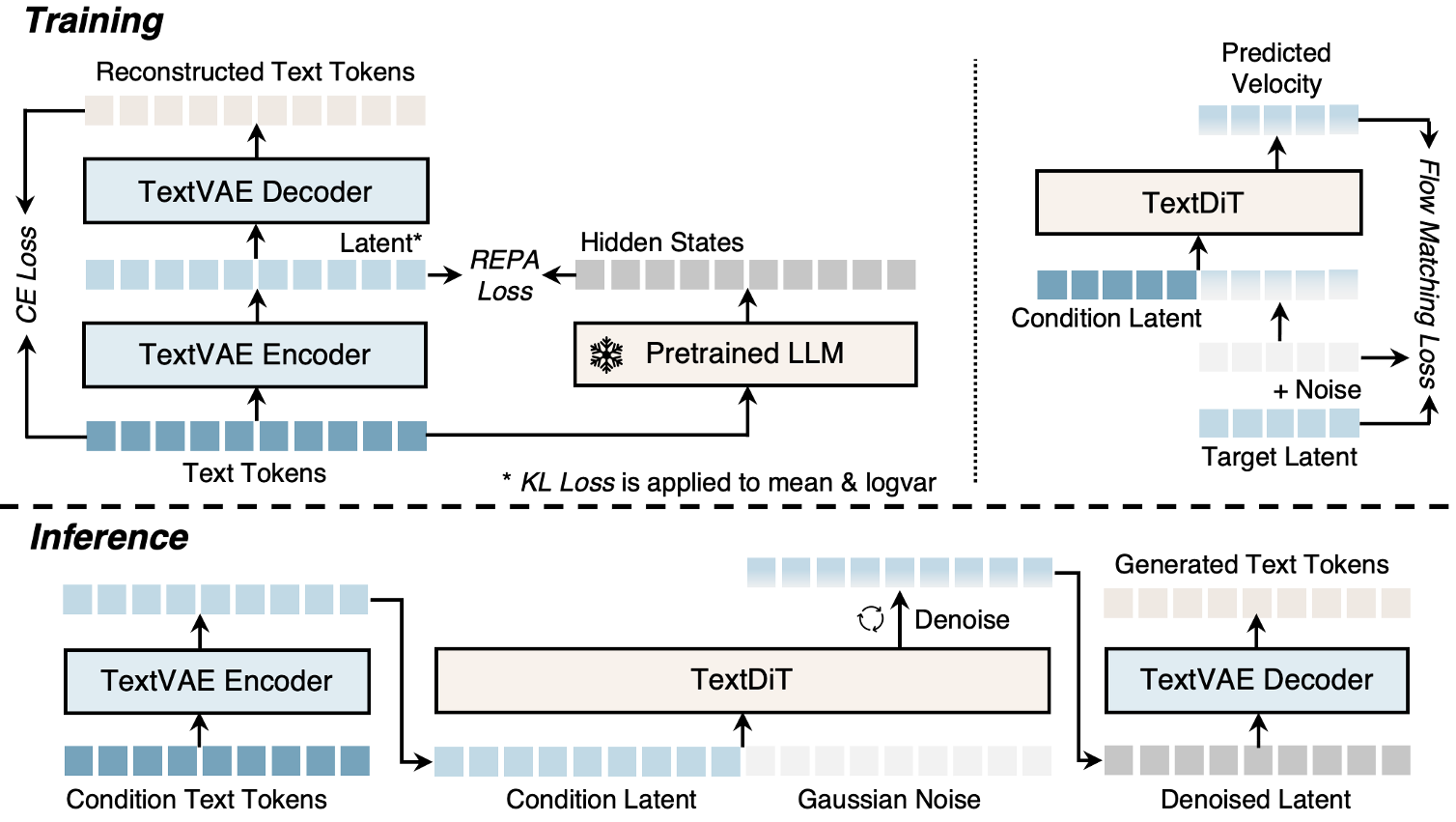 Figure 1: The TextLDM pipeline. Note how the REPA loss aligns the encoder with a frozen LLM teacher.
2. Flow Matching & DiT
Once the latent space is ready, they train a standard DiT using Flow Matching. Unlike traditional diffusion which predicts noise, Flow Matching learns the "velocity" to transform a Gaussian distribution into the data distribution along a straight path. They also use Logit-Normal Scheduling, a technique from Stable Diffusion 3 that focuses training on the most difficult parts of the denoising process.
Experiments: Crossing the AR Performance Gap
The results are striking. TextLDM isn't just "good for a diffusion model"—it is competitive with the gold-standard Autoregressive models.
- SOTA among Diffusion: It crushes previous models like SSD-LM and Block Diffusion across all benchmarks (WikiSource, Wikipedia, TinyStories).
- Matching GPT-2: In many settings, TextLDM (768M) outperforms or matches GPT-2 Large.
- Efficiency: Because diffusion generates the whole sequence in parallel, the Number of Function Evaluations (NFE) remains constant, while AR models get slower as the text gets longer.
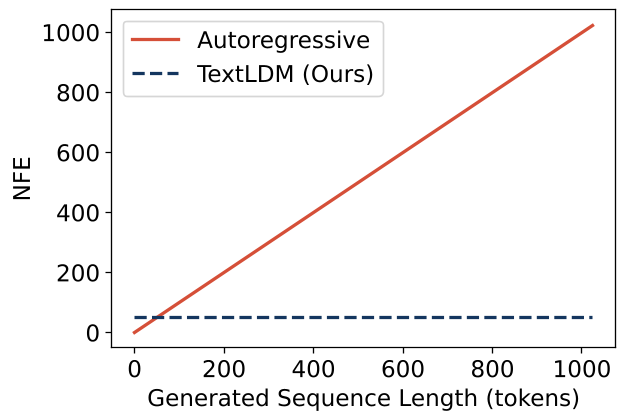 Figure 2: TextLDM provides length-invariant inference speed, a massive advantage for long-context generation.
Why This Matters: The Path to "Omni" Models
The industry is moving toward "Omni" models that can see, hear, and speak. Having separate architectures (AR for text, DiT for video) makes this integration messy. TextLDM demonstrates that the same DiT backbone can handle both.
By proving that text can be modeled as a continuous flow in a latent manifold—just like pixels—the authors have provided a blueprint for a truly unified Multimodal Diffusion Transformer.
Limitations & Future
The model current relies on a "teacher" (REPA) to help shape its latent space. A major open question is: Can a diffusion model eventually surpass its teacher? Currently, TextLDM also requires a two-stage training process, which is more complex than the end-to-end simplicity of Next-Token Prediction. However, for those seeking the holy grail of unified, parallel multimodal intelligence, TextLDM is a massive leap forward.
Key Takeaway: The wall between "understanding" and "generation" is crumbling. If you can diffuse a video, you can diffuse a story.