
Deciphering the Plateau: A New Theory of Saddle Escape in Deep Nonlinear Networks
A Theory of Saddle Escape in Deep Nonlinear Networks
This paper presents a theoretical framework for "saddle escape" in deep nonlinear networks, characterizing the stagewise feature acquisition during training. It derives an exact layer-imbalance identity and identifies a critical-depth escape law, , where is the number of layers at the bottleneck scale.
In the training of deep neural networks, behavior often seems "staircase-like." We observe long periods of stagnation (plateaus) followed by rapid bursts of feature acquisition. While this phenomenon is iconic in deep learning, the mathematical "why" and "how" have remained largely confined to deep linear models.
This paper, "A Theory of Saddle Escape in Deep Nonlinear Networks," bridges that gap. It provides an exact identity that governs weight evolution across layers for smooth, nonlinear activations, revealing that the time it takes to "escape" a plateau is dictated by a specific subset of layers called the bottleneck.
The Core Insight: The Imbalance Identity
In deep linear networks, there is a known conservation law: the difference between the squared Frobenius norms of adjacent weight matrices remains constant ().
The authors extend this to any smooth activation through a new functional:
This functional measures how much an activation function deviates from Euler's identity for homogeneous functions. Based on this, they classify activations into four groups, with Class B (odd functions like tanh and erf) being the most common. The transition from linear to nonlinear dynamics is captured by the drift in this identity.
The Critical-Depth Law:
The most striking contribution is the Critical-Depth Escape Law. Contrary to intuition, the total depth of the network () does not always determine the length of the plateau. Instead, it is the number of layers initialized at the small scale (the "bottleneck").
- r = 1: Escape is fast (), similar to the "get-rich-quick" phenomenon where one narrow layer triggers fast learning.
- r = 2: Escape is logarithmic (), mirroring deep linear theory.
- r ≥ 3: Escape is polynomial (), meaning the plateau grows significantly longer as more layers are added to the bottleneck.
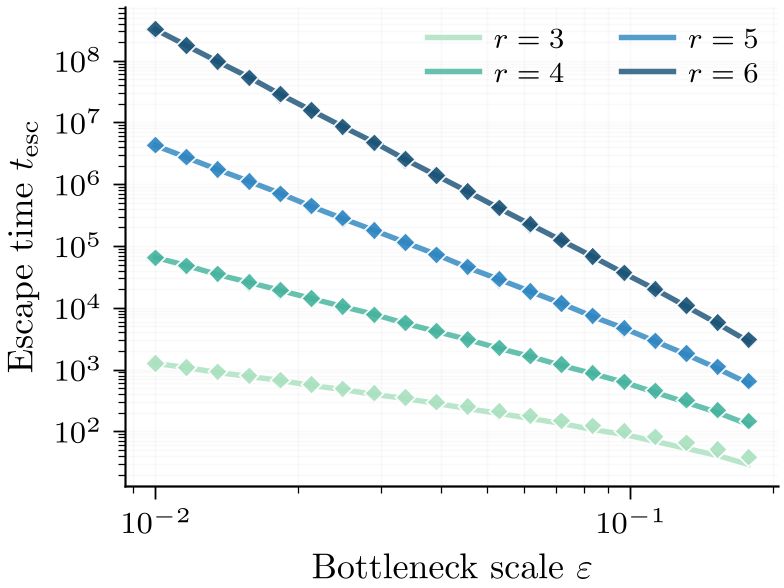 Figure: Empirical validation showing that escape time follows the law as the number of bottleneck layers varies.
Universality and Collapse
The theory suggests that while activations differ, their escape dynamics are "universal." By rescaling the time axis with a specific constant , the trajectories for tanh, erf, and sin all collapse onto a single master curve.
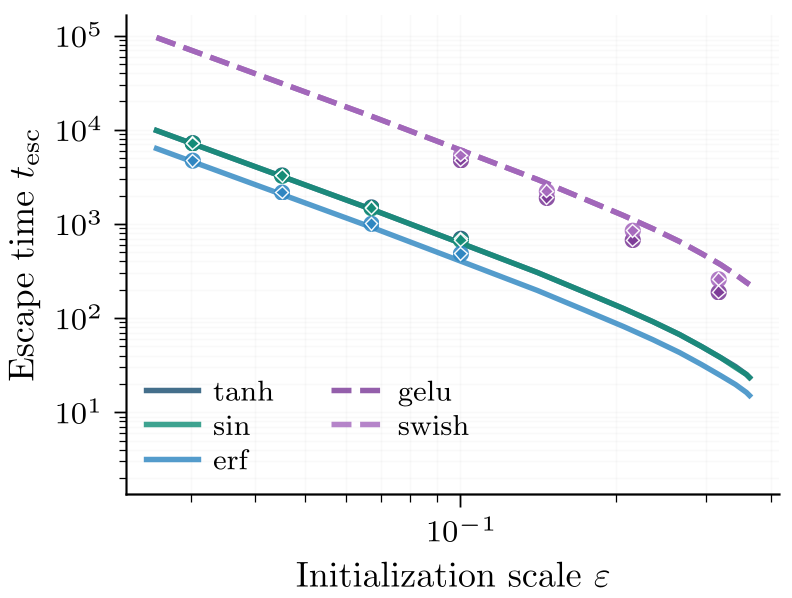 Figure: Different activations (Class B and C) show a universal collapse in escape dynamics after rescaling, confirming the structural predictions of the ODE reduction.
Methodology: From Matrix Flow to Scalar ODE
The authors achieve their results by reducing the high-dimensional gradient flow onto a permutation-symmetric submanifold. On this manifold, neurons in the same layer behave similarly, allowing the entire network's dynamics to be described by a few scalar variables ().
They prove this reduction is valid both:
- On-Manifold: Using the symmetric balanced ansatz.
- Off-Manifold: Using a "signal-energy" argument that holds even under standard
He-normalinitialization, proving the exponent is a fundamental property of the gradient flow itself.
Why This Matters
This research is a major step toward an ab initio theory of deep learning. It tells us that:
- Initialization is key: How many layers you initialize at a small scale directly controls the "waiting time" for feature learning.
- Architecture Bottlenecks: Adding layers to a bottleneck creates a polynomial increase in training time, whereas adding "pretrained" or large-scale layers does not.
- Activation Matters: The "homogeneity deficit" () is the fundamental metric to judge how an activation function will influence training speed.
Conclusion
The "Theory of Saddle Escape" provides a rigorous mathematical lens to view the stagewise learning behavior of AI. By identifying the critical depth , the authors have given us a "speedometer" for feature acquisition in deep nonlinear networks.
Note on Limitations: The current theory is asymptotic (as ) and primarily focuses on the first mode's escape. Future work is needed to fully characterize successive escapes in complex multi-mode teacher-student setups.