
TIDE: Why Every Layer in a Transformer Needs to Know Which Token It's Processing
TIDE: Every Layer Knows the Token Beneath the Context
This paper introduces TIDE (Token Identity Delivered Everywhere), a novel Transformer architecture that injects context-free token identity signals into every layer. By augmenting the standard Transformer with an "EmbeddingMemory" ensemble, the model maintains superior performance in language modeling and zero-shot tasks, effectively achieving state-of-the-art results for models in the 350M to 3B parameter range.
TL;DR
Standard Transformers look up a token's identity once at the very beginning and then "forget" it, relying entirely on the floating-point hidden states to carry that identity through dozens of layers. This leads to under-trained rare tokens and contextual collapse. Apple researchers have introduced TIDE (Token Identity Delivered Everywhere), a method that keeps a parallel "memory" of token identities and injects it into every single layer, resulting in significant accuracy boosts, especially for the "long tail" of language.
The Problem: The "Single-Injection" Fallacy
In a standard Transformer, the token index (e.g., the ID for the word "asynchronously") is used only once to fetch the initial embedding. After that, the index is discarded. The model assumes that the attention mechanism and FFNs will perfectly preserve and evolve this identity.
The authors identify two fatal flaws in this assumption:
- The Rare Token Problem: Because language follows Zipf’s Law, rare tokens appear so infrequently that their embeddings never receive enough gradient updates—they are literally "starved" of training signal.
- Contextual Collapse: When two different words (like "their" and "there") appear in the same grammatical context, the attention mechanism produces nearly identical hidden states. Because FFNs are continuous functions (constrained by Lipschitz continuity), they cannot "un-mix" these flattened representations once they've collapsed.
Methodology: Token Identity as a Persistent Signal
TIDE fixes this by introducing EmbeddingMemory. Instead of one embedding table, it uses independent MemoryBlocks.
- The Mechanism: The token index is used to fetch context-free vectors.
- The Injection: At every layer, a lightweight router looks at the current hidden state and decides how much of this "pure" token identity to mix back into the residual stream.
- The Null Bank: The router can also choose a "Null" slot, effectively turning off the injection if the context is already clear enough.
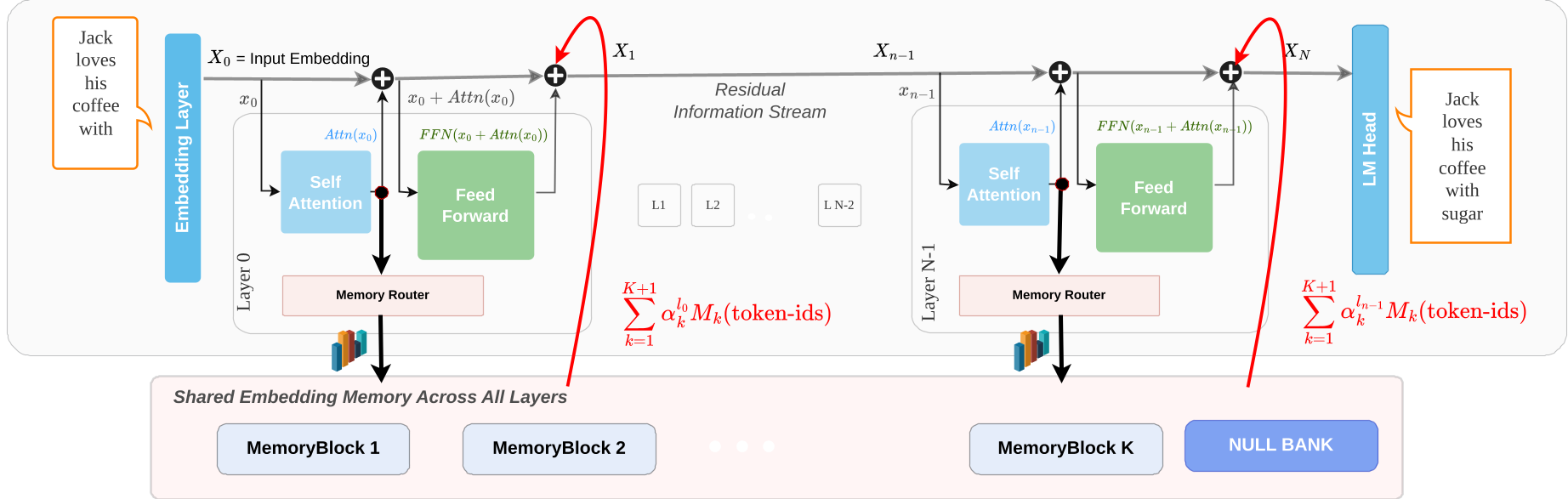 Figure 1: The TIDE architecture adds a parallel EmbeddingMemory pathway that bypasses the contextual mixing of the standard layers.
Mathematically, this provides a K-fold gradient amplification. Since the token identity is injected into every layer, the gradient for a rare token now has pathways to flow back to the weights, rather than just one.
Experimental Results: Rescuing the Long Tail
The results prove that "Identity Injection" is most powerful where standard models are weakest: rare words.
- Loss Reduction: TIDE reduced the loss for the rarest tokens by 9.0%, compared to only 2.4% for common tokens.
- Downstream Performance: At a 1B parameter scale, TIDE improved zero-shot performance across benchmarks like HellaSwag and PIQA by an average of +2.3%.
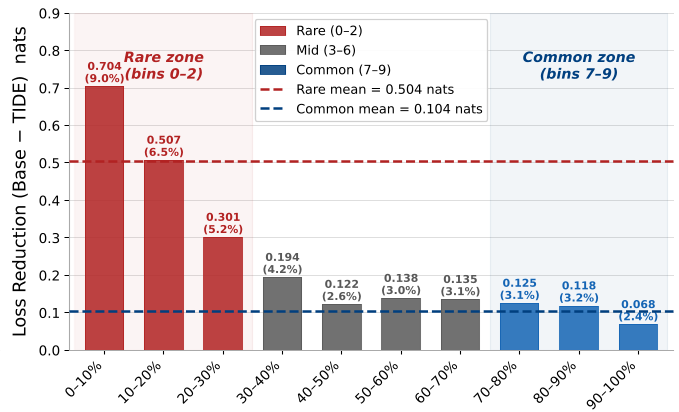 Figure 2: Performance gains are heavily concentrated in the rare token deciles, solving the gradient starvation issue.
Interestingly, the researchers found that TIDE does not just replicate the main embedding. The MemoryBlocks learn complementary semantic neighbors. While the main embedding might group "fred" with other names like "Larry," the TIDE memory blocks learn to group "fred" with its orthographic variations like "Frederick" or "Freddy," which the base model usually fails to connect.
Critical Insight: Routing Around the FFN
The most profound takeaway is that TIDE doesn't try to make FFNs "smarter." Instead, it recognizes that FFNs have a mathematical "blind spot" caused by their continuity. By injecting a discrete token index directly into deep layers, TIDE provides a coordinate system that the network can use to re-anchor itself when the context becomes too muddy.
Conclusion & Future Outlook
TIDE proves that context isn't everything. For a model to be truly robust, it needs a balance between contextual understanding (Attention) and lexical memory (TIDE).
Limitations: The primary cost is storage. Adding 24 MemoryBlocks increases the model's footprint. However, the authors demonstrate that these blocks are highly compressible (via 4-bit quantization or SVD), suggesting that in future edge-device deployments, these "identity buffers" could be stored on SSD and fetched only when needed.
As we scale models further, TIDE suggests that the next frontier isn't just "more layers," but "better memory" of the fundamental units of language: the tokens themselves.