
[CVPR 2024] Tinted Frames: Why Your VLM Is "Selective Blind" and How to Fix It
Tinted Frames: Question Framing Blinds Vision-Language Models
The paper identifies "Selective Blindness" in Vision-Language Models (VLMs), where models underutilize visual inputs specifically when questions are constrained (Multiple Choice or Yes/No) compared to open-ended formats. To address this, the authors introduce a lightweight prompt-tuning method that realigns attention patterns, achieving performance gains such as +2.5% on the V* benchmark.
TL;DR
Do Vision-Language Models (VLMs) actually "see" the image, or are they just lucky guessers? This paper reveals a startling phenomenon: VLMs are selectively blind. A model might correctly answer an open-ended question but fail the exact same task when presented as a Multiple Choice Question (MCQ). The culprit? The linguistic "framing" of the question causes the model to physically withdraw its attention from the image. The authors fix this using a clever Attention Realignment technique that uses soft-prompt tuning to restore sight.
Problem & Motivation: The Illusion of Understanding
We often assume that if a VLM understands a scene, it should be robust to how we ask the question. However, the authors found a massive Cross-Framing Inconsistency. On the GQA benchmark, top-tier models like Qwen2.5-VL and GLM4.1V exhibit over 15% inconsistency.
The researchers' core insight is that as questions become more constrained (Yes/No or MCQ), the model relies more on its language backbone's "priors" and "disengages" from the visual tokens. It’s not that the model can't see; it's that the prompt tells it that it doesn't need to see.
Methodology: Mapping the "Blindness"
To prove this, the authors used Attention Rollout—a technique to trace how information flows from the image pixels to the final word generated by the model.
The F→A→Y Pathway
The paper models the VLM process as a chain: Framing (F) → Attention (A) → Prediction (Y).
- F→A: They found that MCQs trigger a shift where attention is redirected toward "sink tokens" (uninformative background) and away from the actual objects (Bounding Boxes).
- A→Y: By manually "steering" attention back to the correct objects during inference, they proved that accuracy recovers. This confirms that the attention shift is the cause of the errors, not just a symptom.
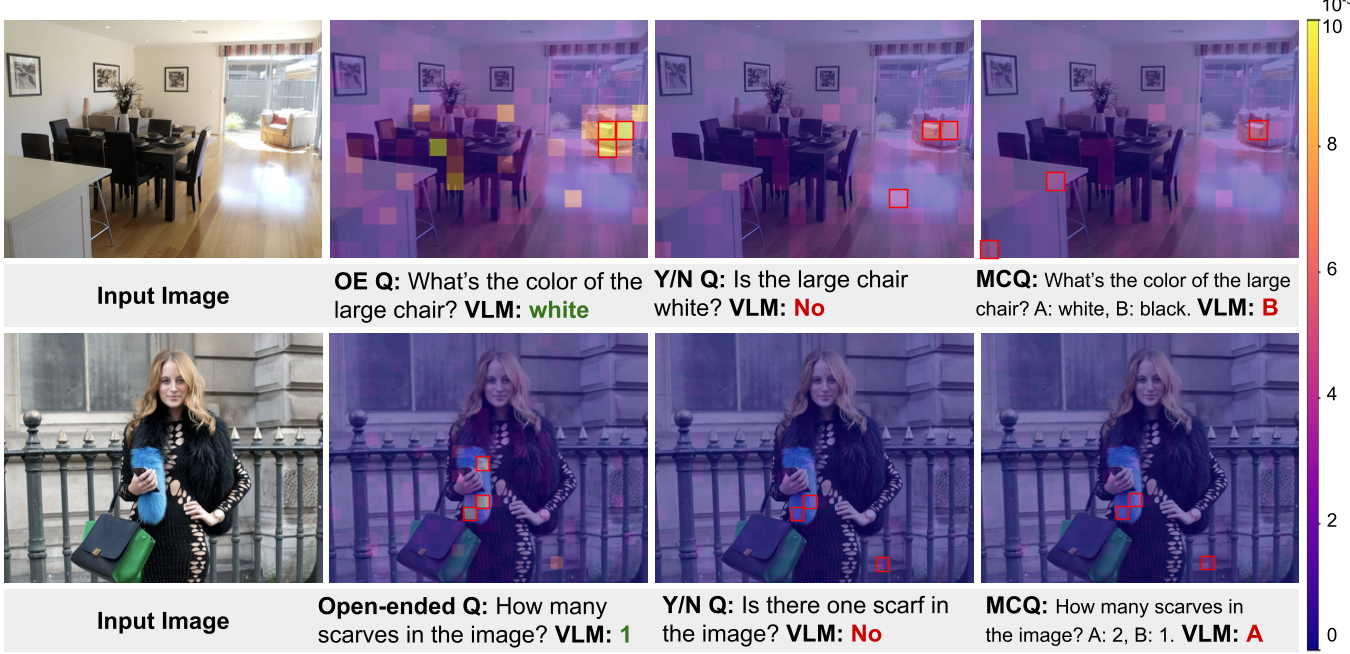 Figure 1: The proposed hypothesis showing how Framing (F) impacts visual Attention (A), which in turn degrades the final Prediction (Y).
The Solution: Attention Realignment via Prompt Tuning
The authors propose a lightweight fix that doesn't require retraining the whole model (which is expensive). Instead, they use 8 learnable soft tokens (infix) placed between the question and the instruction.
The Training Recipe:
- Dual Loss: They use standard Cross-Entropy (to keep the answer correct) plus an Attention Alignment Loss.
- Teacher-Student Setup: The attention pattern from the open-ended prompt (which is usually the most "honest" and visually grounded) acts as the teacher for the MCQ and Yes/No prompts.
- Spatial Alignment: They use KL divergence to ensure the spatial distribution of attention in constrained prompts matches the open-ended ones.
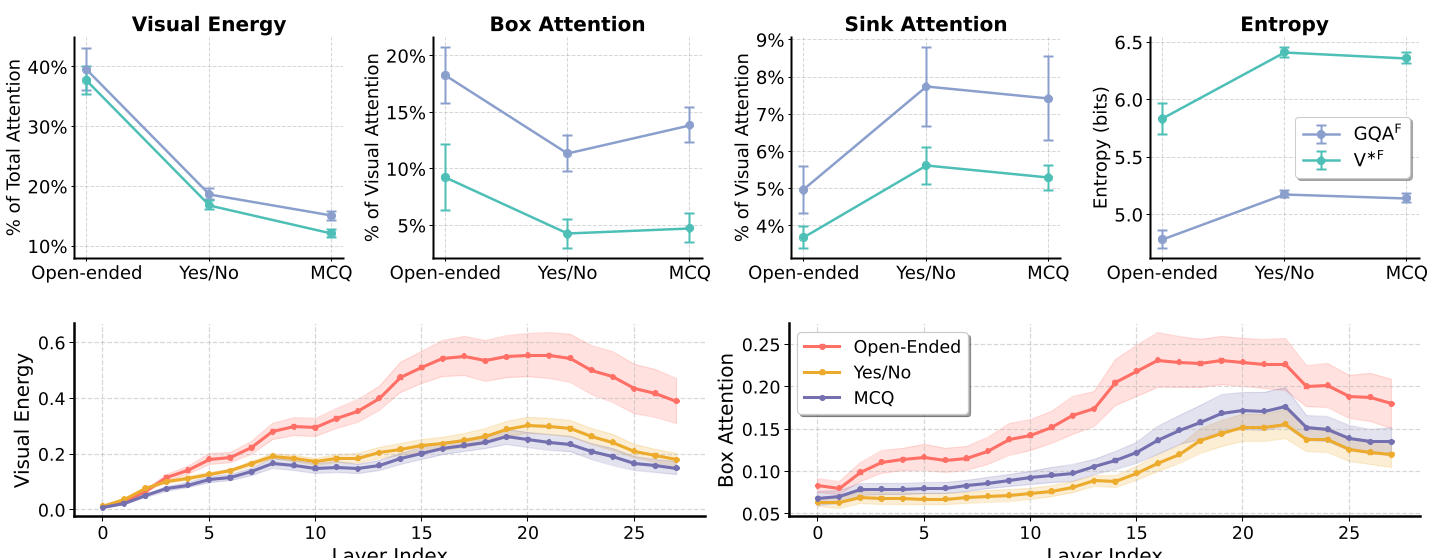 Figure 2: Visual Evidence. Note how open-ended questions focus on the target, while MCQ attention is scattered and focused on background "sink" tokens.
Experiments & Results: Restoring Sight
The results across 5 major VLM families (Qwen, LLaVA, Gemma, GLM) are impressive:
- Consistency: Inconsistency rates dropped significantly, especially in "grounding-heavy" tasks like counting and spatial relations.
- Accuracy: On the V* benchmark (designed for hard visual search), Qwen2.5-VL improved by 2.5 percentage points.
- Efficiency: The fix only adds ~60K trainable parameters and takes only a few hours to train on a single GPU.
 Table 1: Performance gains across various benchmarks using the "Ours" realignment method.
Critical Insight & Conclusion
This paper changes the narrative on VLM failures. We shouldn't just say "the model is small" or "the encoder is weak." Instead, we must recognize that linguistic structure acts as a filter for visual perception.
Takeaway for Developers: When building VLM-based products, be wary of Multiple Choice formats. If accuracy matters, use open-ended prompts for reasoning, or implement an attention-alignment layer like the one proposed here to ensure the "tinted frames" of the question don't blind your AI.