
Decoding the Language of Matter: The "Topological Word" for Non-Abelian Insulators
Topological Word for Non-Abelian Topological Insulators
The paper introduces a unified framework called "Topological Word" for multigap non-Abelian topological insulators (TIs). By decomposing global homotopy classification into an ordered sequence of non-Abelian charges (letters), this method establishes a complete bulk-boundary correspondence (BBC) that predicts exact edge-state patterns across multiple gaps in both static and Floquet systems.
TL;DR
Researchers have developed a "Topological Word" framework that finally completes the puzzle of Non-Abelian Bulk-Boundary Correspondence (BBC). By treating topological charges as an ordered sequence of letters rather than a single sum, this method precisely predicts where edge states will appear in complex multi-band systems, including static crystals and time-driven Floquet states.
The "Broken" Map of Non-Abelian Topology
In standard topological insulators, we usually look at a single gap. However, in three-band systems with Parity-Time (PT) symmetry, the physics is governed by the Quaternion Group ().
The problem? The global charge is too "blunt." Two different materials might both have a quaternion charge of , but one shows edge states in the first gap while the other shows them in the second. This happens because the global charge forgets the band-adjacency information—the history of which bands "crossed" to create the topology.
Methodology: From Charges to Words
The core insight of this paper is that topology should be read like a sentence, not just a result.
The authors propose the Topological Word: Each letter corresponds to a specific "twist" between adjacent bands.
The Dirac Singularity Connection
To find these letters, the authors use a "cylindrical manifold" to interpolate between a trivial state and the topological state. As you move along this path, the "Dirac points" (where the energy bands touch) act as the source of these letters. The sequence in which you encounter these points forms the word.
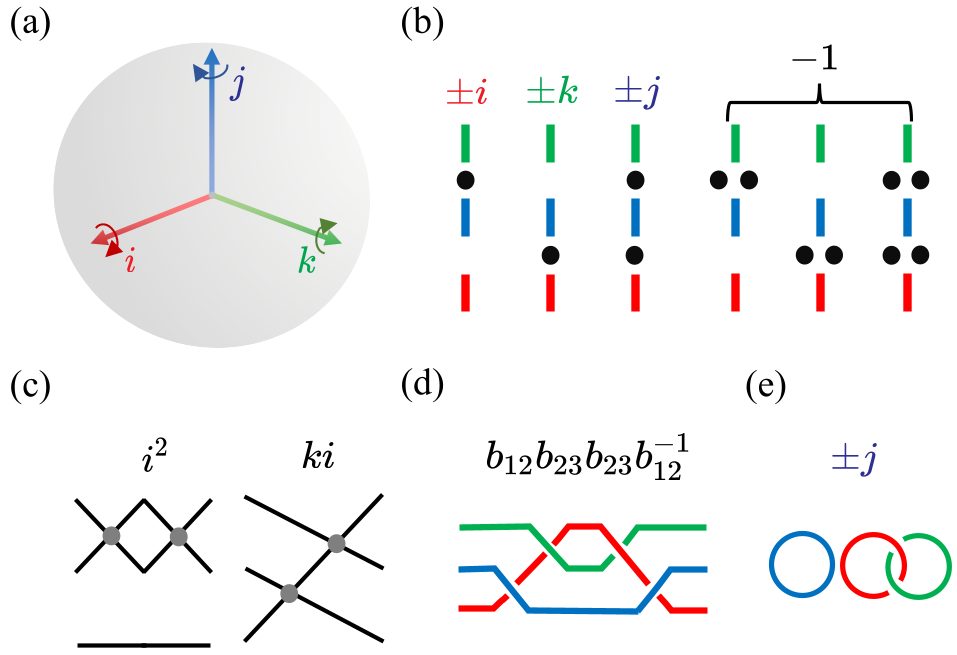 Figure 1: Comparison between quaternion charges and the edge-state configurations they produce.
Experimental Validation: Static vs. Floquet
The strength of this framework lies in its universality:
- Static Systems: It explains why , , and (all resulting in ) look different physically. A word like means two pairs of edge states in the lower gap, while spreads them across gaps.
- Floquet Systems: In periodically driven systems, you can have "anomalous" states. The word "kji" results in a global charge of 1 (mathematically trivial), but because the word is non-empty, the system still hosts robust edge states in every gap.
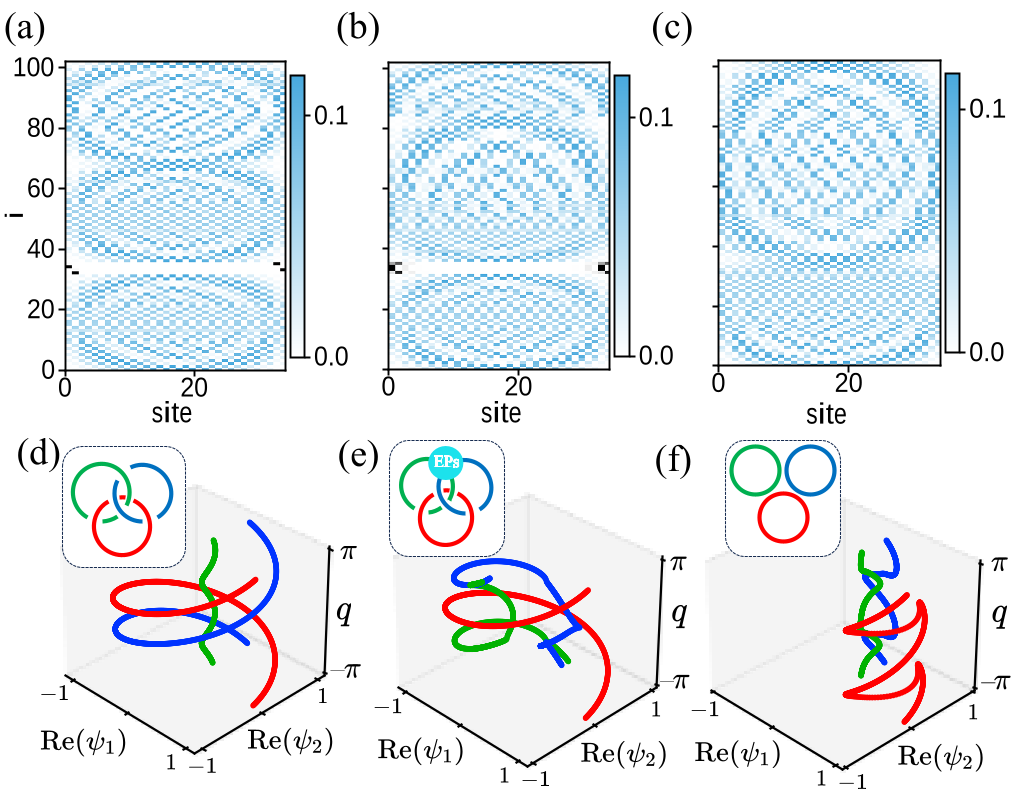 Figure 2: Distribution of edge modes under different topological word configurations.
Beyond Symmetry: The Non-Hermitian Frontier
What happens if we break the PT-symmetry? Usually, non-Abelian topology collapses. However, the authors discovered that the Topological Word continues to provide insight. Even when the system becomes non-Hermitian and the global charge is ill-defined, the edge states often persist as long as the "word" indicates the relevant gap remains open. This points to a deeper "remnant topology" that outlasts the symmetry itself.
Critical Insight & Conclusion
The Topological Word moves us from "Topological Arithmetic" to "Topological Linguistics." By preserving the order of band interactions, we can now design materials with specific edge-state configurations for quantum computing or advanced photonics.
Limitations: While powerful for three and four-band models, scaling this to systems with dozens of bands may lead to "word explosion," requiring more advanced gauge-reduction techniques to remain practical.
Future Outlook: This framework is set to be a cornerstone for analyzing higher-dimensional TIs and could lead to new types of "topological switches" where changing the word (path) without changing the final charge alters the device's conductivity.