
Shaping the Hidden Path: Topology-Enhanced Alignment for LLMs
Topology-Enhanced Alignment for Large Language Models: Trajectory Topology Loss and Topological Preference Optimization
The paper introduces a topology-enhanced alignment framework for LLMs consisting of Trajectory Topology Loss (TTL) for SFT and Topological Preference Optimization (TPO) for DPO. By utilizing 0-dimensional persistent homology to extract "prompt-answer bridges," it regularizes the semantic trajectories of hidden states to follow a global data skeleton, achieving SOTA alignment on Qwen2.5-7B and Llama-3-8B.
TL;DR
Standard LLM alignment is often "blind" to the internal geometry of the model. While we optimize for word likelihoods, we ignore the paths the model takes in its representation space. This paper introduces TTL (Trajectory Topology Loss) and TPO (Topological Preference Optimization)—techniques that use 0D Persistent Homology to build a "global skeleton" for the model, ensuring that hidden state transitions follow semantically meaningful topological bridges.
The Problem: The "Point-wise" Blind Spot
Most alignment techniques (SFT, RLHF, DPO) treat data as isolated points or pairs. They focus on what the model should output (tokens) or how much a response should be valued (scalar rewards). However, they ignore the How: the trajectory from a prompt embedding to an answer embedding. Without geometric constraints, the model's internal representations can become disorganized, leading to alignment that is brittle and lacks global consistency.
Methodology: Bridging the Topological Gap
The authors propose viewing LLM generation as tracing a semantic trajectory through hidden space. To guide these trajectories, they borrow a tool from Topological Data Analysis (TDA): 0-dimensional Persistent Homology.
1. SFT Stage: Trajectory Topology Loss (TTL)
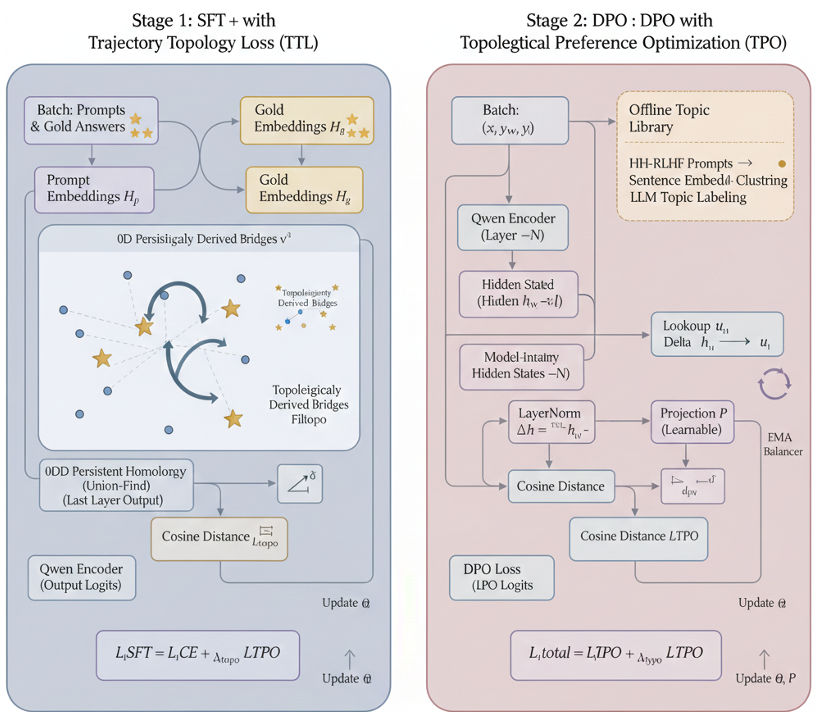
During Supervised Fine-Tuning, the model doesn't just learn to predict tokens. TTL treats a batch of prompts and gold answers as a "point cloud." It uses a Union-Find algorithm to identify "Topological Bridges"—edges that connect prompt clusters to answer clusters.
- The Insight: Instead of moving toward any gold answer, the model is regularized to align its internal trajectory with these global "bridges," which represent the most natural connectivity in the data manifold.
2. Preference Stage: Topological Preference Optimization (TPO)
In the DPO/RLHF stage, the goal is to shift representations from "Rejected" to "Chosen." TPO goes beyond scalar rewards by:
- Topic-specific Vectors: Identifying the topic (e.g., "Medical Advice") and using a pre-computed "improvement vector" for that specific domain.
- Dynamic Weighting: Using an Exponential Moving Average (EMA) to balance the standard DPO loss with the topological direction loss, preventing the geometry from over-powering the text generation.
Experiments: More Than Just Scalar Gains
The authors tested their framework on Qwen2.5-7B and Llama-3-8B using UltraChat and Anthropic HH-RLHF.
- Superior SFT: TTL increased Reward Model scores significantly and improved instruction-following (IFEval) by ~3 points.
- Better DPO: TPO showed a higher win-rate and better "Harmlessness" scores than standard DPO, proving that directing the direction of the preference update is better than just pushing the score.
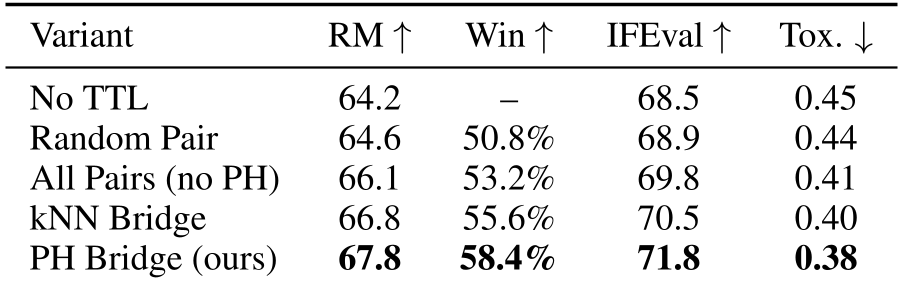 Table 6: Comparison of TTL against baselines like kNN and Random pairing.
Critical Insight & Conclusion
The true beauty of this work lies in its computational efficiency. While "Topological Data Analysis" sounds expensive, 0D persistent homology (equivalent to building a Minimum Spanning Forest) is surprisingly fast—adding only about 5-10% to training time.
Takeaway: The future of LLM alignment may lie in "Geometry-Aware" training. By treating the model's hidden states as a continuous manifold rather than a discrete token machine, we can build models that are not only more accurate but more structurally robust.
Limitations
The current approach relies on 0D homology. Higher-order topology (1D loops, 2D voids) could potentially capture even more complex relationships like "ambiguity" or "multi-modal" reasoning paths, though at a higher computational cost.