
LENSEs: Refined Geometric Latents for High-Fidelity 3D Molecule Generation
Toward Better Geometric Representations for Molecule Generative Models
The paper introduces LENSEs, a framework designed to enhance 3D molecule generation by refining the geometric representation space of pretrained encoders. It achieves state-of-the-art results on the GEOM-DRUG dataset, reaching 97.28% validity and 98.51% molecular stability using three novel latent enhancement mechanisms.
Executive Summary
TL;DR: LENSEs (Latent Enhancement for Non-smooth Structural Encodings) addresses the "roughness" and underutilized semantics of pretrained molecular encoders. By introducing a variational representation head, perceptual losses, and unit-level representation alignment, the framework transforms a jittery latent space into a smooth, semantically rich manifold.
Academic Context: This work represents a shift from "frozen representation" conditioning to "active latent refinement." It pushes the SOTA on GEOM-DRUG and QM9 benchmarks, proving that high-quality molecule generation is as much about the geometry of the latent space as it is about the architecture of the generator.
Problem & Motivation: The Non-Smoothness Bottleneck
Despite the success of Geometric Representation-Conditioned Generation (GeoRCG), a fundamental issue remains: Pretrained encoders are often optimized for coordinate denoising, not representation generation.
The authors identify two critical failures:
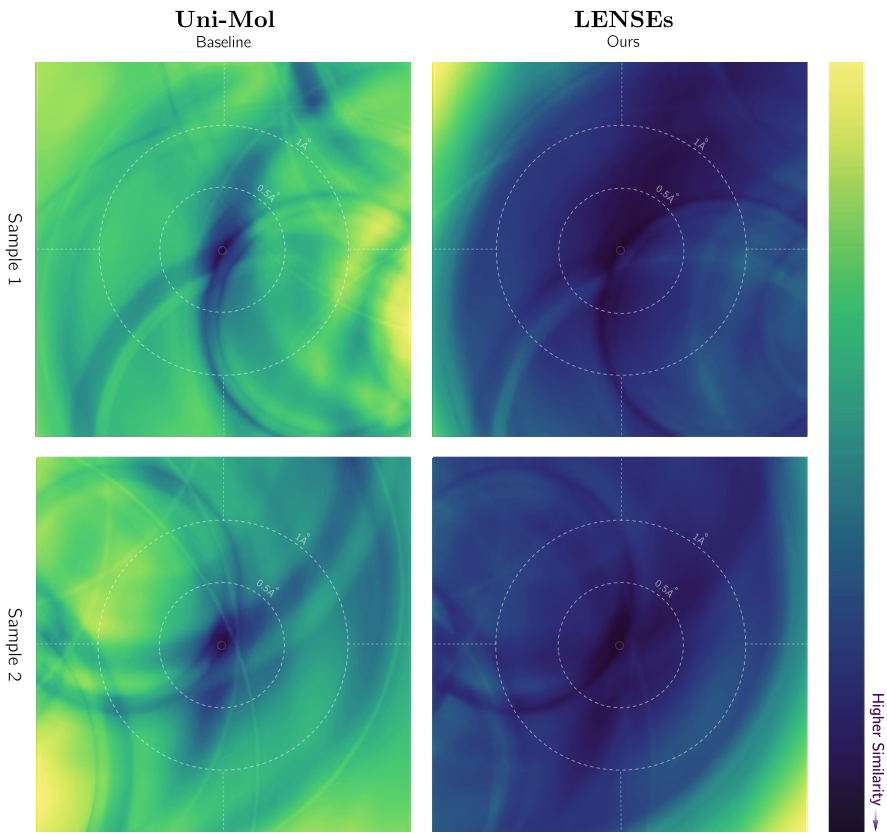
- High Lipschitz Constants: The latent space is non-smooth. As shown in the paper's analysis, small perturbations in atomic coordinates lead to disproportionately large jumps in the latent vector, making it nearly impossible for a Diffusion Model (RDM) to sample effectively.
- Discarded Hierarchical Semantics: While early layers of encoders (like UniMol or Frad) capture local motifs (e.g., amino or hydroxyl groups), existing pipelines only use the final-layer pooling, effectively throwing away the "chemical alphabet" the model learned in its shallow layers.
Methodology: Unlocking latent potential
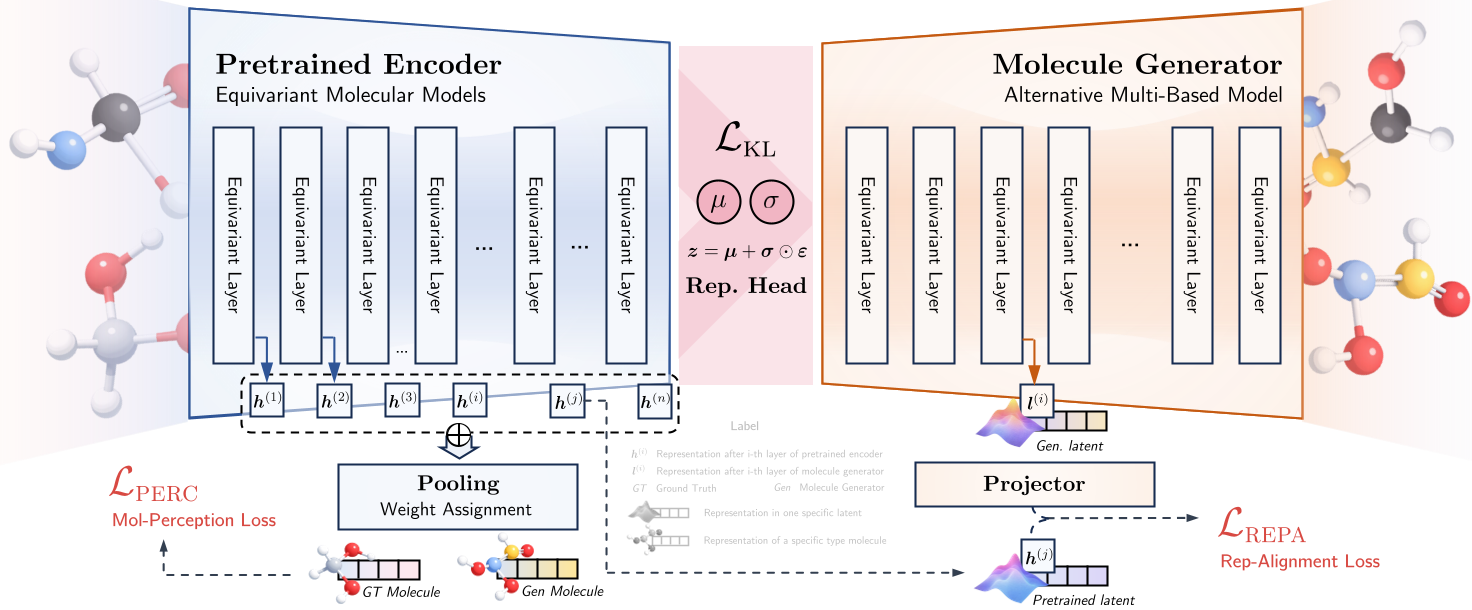
LENSEs introduces a tripartite strategy to repair the latent space während (during) training:
1. The Variational Representation Head
Instead of using a deterministic final-layer vector, LENSEs uses Learnable Layer Pooling. It aggregates features across all encoder layers and maps them into a diagonal Gaussian posterior. This KL-regularized space ensures a compact, "sampleable" distribution for the RDM.
2. Molecule Perceptual Loss ()
Inspired by Computer Vision, this loss ensures that the denoised molecule matches the ground truth molecule in the semantic space of the encoder. By backpropagating through the frozen encoder, the generator learns to respect global molecular patterns rather than just local coordinate distances.
3. Node-level Representation Alignment (REPA)
LENSEs explicitly aligns the generator's internal hidden states with the encoder's node features using a projection head and cosine similarity. This "knowledge transfer" prevents the generator from having to relearn chemical physics from scratch.
Experiments & Results: Smoother and Stronger
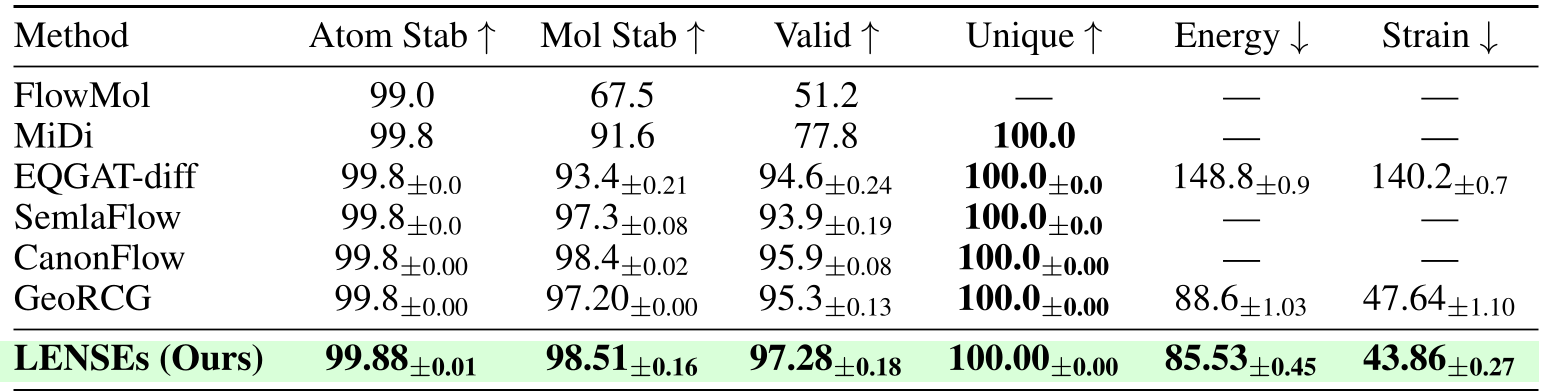
The results on GEOM-DRUG are definitive. LENSEs achieves a Validity of 97.28% and Molecular Stability of 98.51%, significantly outperforming baseline GeoRCG and competitive equivariant models like CanonFlow.
Quantifying "Smoothness"
The paper provides a deep dive into the latent manifold's geometry. By comparing the raw UniMol encoder to the LENSEs-refined space:
- Lipschitz Reduction: The mean Lipschitz constant dropped from 2659.81 to 570.49 (a 4.6x improvement).
- Effective Rank: Increased from 65.32 to 88.42, indicating that the model successfully fought "dimensional collapse" and is utilizing a richer representation space.
Visual Evidence
The visualization of the latent space (Figure 4) clearly shows that the refined manifold is "flatter" around stable conformations, providing a Much larger "basin of attraction" for generative sampling.
Critical Analysis & Conclusion
Takeaway: LENSEs proves that molecular generation and property prediction are two sides of the same coin. By forcing a generator to align with an encoder, the encoder itself becomes better. In fact, LENSEs-refined representations outperformed the original pretrained Frad encoder on QM9 downstream regression tasks.
Limitations:
- The training cost is slightly higher (approx. 20% more GPU hours) due to the triple-loss objective and multi-layer feature hooks.
- The dependency on a frozen "perceptual" encoder means the method is still bounded by the initial pretraining quality of that encoder.
Future Outlook: The success of LENSEs suggests a future where Generative Pretraining becomes a standard paradigm for molecular foundation models, creating representations that are not just discriminative, but fundamentally structural and smooth.