
VISER: Bridging the Sim-to-Real Gap with Physically-Based Realism
Toward Visually Realistic Simulation: A Benchmark for Evaluating Robot Manipulation in Simulation
VISER is a visually realistic benchmark for evaluating robot manipulation policies in simulation, featuring over 1,000 high-fidelity 3D assets with PBR (Physically-Based Rendering) materials. It achieves a high sim-to-real correlation (Pearson r=0.92) for Vision-Language-Action (VLA) models.
TL;DR
The reliability of evaluating robots in simulation is often undermined by a "cleanliness" that doesn't exist in the real world. VISER (VISually realistic benchmark for Evaluating Robot manipulation) introduces a high-fidelity dataset of 1,000+ PBR-textured assets and a rigorous analysis showing that specular highlights and soft shadows are not just visual flair—they are essential depth and shape cues for modern Vision-Language-Action (VLA) models.
The "Visual" is Physical: Why Modern Simulators Fail
Traditionally, the sim-to-real gap was blamed on physics (friction, torque, etc.). However, with the rise of VLA models (like OpenVLA or Octo), the visual domain gap has become the primary bottleneck. Most existing simulators (MuJoCo, SAPIEN) use simplified rasterization or "green-screening" (SimplerEnv) that removes shadows and simplifies materials.
The authors' central insight is that these "simplifications" remove critical information:
- Specular Highlights: Provide geometric priors that allow a model to perceive the curvature of a metallic pot.
- Soft Shadows: Provide grounding cues. Without them, an object appears to "float," making the contact point between a gripper and a surface ambiguous.
Methodology: MLLM-Driven Asset Refinement
To build a benchmark that actually correlates with the real world, the authors moved away from 3D generation models that "bake" lighting into textures. Instead, they proposed an automated pipeline:
- Material-Aware Segmentation: Using MLLMs to identify parts of an object (e.g., the metal body vs. plastic handle).
- PBR Retrieval: Mapping these segments to high-quality material libraries.
- Automated Layouts: Using LLMs to transform natural language descriptions into valid 3D spatial scene graphs.
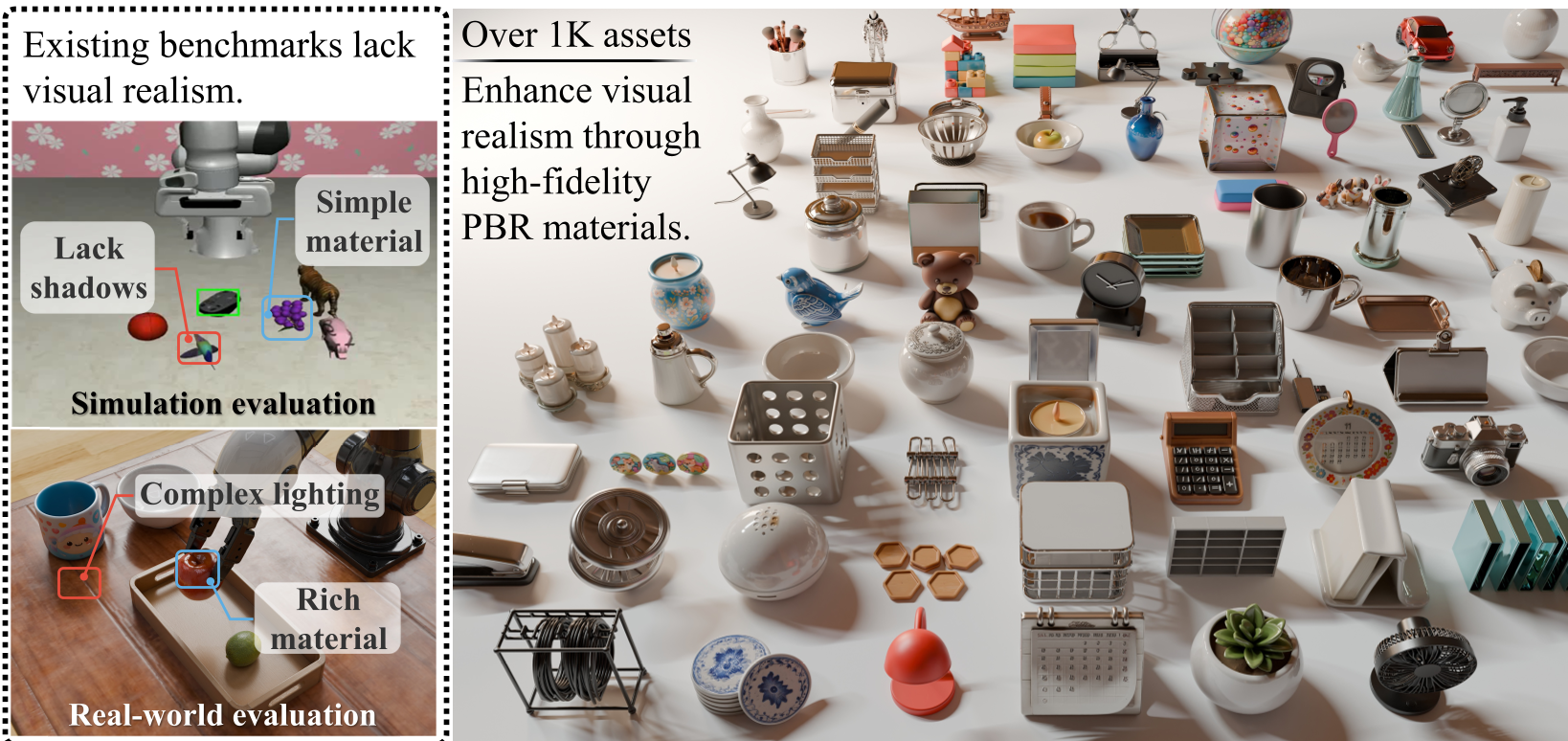 Figure 1: The VISER pipeline—from raw 3D assets to high-fidelity, material-aligned simulation scenes.
Experiments: Proving the Correlation
The true test of a simulator is whether a "Success" in the sim predicts a "Success" in the real lab. VISER achieves a Pearson correlation coefficient of 0.92, a massive leap over previous baselines.
The Cost of Over-Simplification
In a "Put Eggplant in Pot" task:
- With Specular: VLA succeeds 90% of the time.
- Without Specular (Diffuse only): Success drops to 10% because the model cannot localize the pot's cavity without light reflections.
Similarly, the study found that Hard Shadows (common in low-end simulators) act as noise, confusing the model and dropping success rates to near 0%, whereas Soft Shadows align perfectly with real-world indoor lighting.
 Table 2: Ablation study on specular highlights. Note the catastrophic failure in geometry-heavy tasks when highlights are removed.
Critical Insight & Future Work
VISER proves that for the next generation of generalist robots, Rendering is Reasoning. If the simulator doesn't respect the laws of optics (PBR), the model won't learn the laws of spatial grounding.
Limitations: While the visual fidelity is SOTA, the benchmark currently focuses on tabletop manipulation. Future extensions will need to address more diverse "embodiments" (multi-arm, mobile bases) and even more complex, long-horizon causal reasoning tasks.
Conclusion
VISER sets a new standard for what we should expect from a robot simulator. By treating material science and light transport as first-class citizens in the training loop, it paves the way for VLA models that can transition from the GPU-cluster to the kitchen counter with zero-shot reliability.