
TrajRAG: Mastering Zero-Shot Navigation by Retrieving "Embodied Experience"
TrajRAG: Retrieving Geometric-Semantic Experience for Zero-Shot Object Navigation
TrajRAG is a novel Retrieval-Augmented Generation framework for zero-shot Object Goal Navigation (ObjectNav). It utilizes a hierarchical "Long-Term Memory" system to accumulate and retrieve "geometric-semantic" experiences from past trajectories to guide large language model (LLM) reasoning, achieving new SOTA performance on MP3D and HM3D benchmarks.
TL;DR
TrajRAG (Trajectory Retrieval-Augmented Generation) is a breakthrough framework that gives AI agents a "long-term memory" for 3D navigation. Instead of forgetting everything after a task, the agent stores paths as structured topo-polar trajectories. When faced with a new, unseen room, it retrieves similar past experiences to help an LLM decide the best way to find a target (like a "bed" or "chair"), reaching a new State-of-the-Art (SOTA) in navigation efficiency.
The Problem: The "Amnesia" of Modern Embodied AI
Current zero-shot ObjectNav agents suffer from a fundamental flaw: they are "experience-poor." While they use LLMs (like GPT-4) for general logic, these models know about the world through internet text, not 3D movement.
Furthermore, most agents treat every mission as an isolated event. They build a temporary map, find the object, and then delete the map. They never learn that "bathrooms are usually near bedrooms" through actual 3D experience. This lack of lifelong memory leads to myopic decisions and repetitive mistakes.
Methodology: Structuring the "Experience"
The core innovation of TrajRAG is how it transforms messy, redundant sensor data into a compact, retrievable format called the Topological-Polar (Topo-Polar) Trajectory.
1. The Topo-Polar Representation
To save memory, TrajRAG doesn't store every frame. It:
- Skeletonizes the navigable area into a topological graph.
- Discretizes the view around each node into 12 polar sectors (30° each).
- Records what is in each sector (e.g., "chair at 60°", "wall at 90°").
This creates a "fingerprint" for a location that is independent of the agent's initial orientation, making it much easier to match against different scenes later.
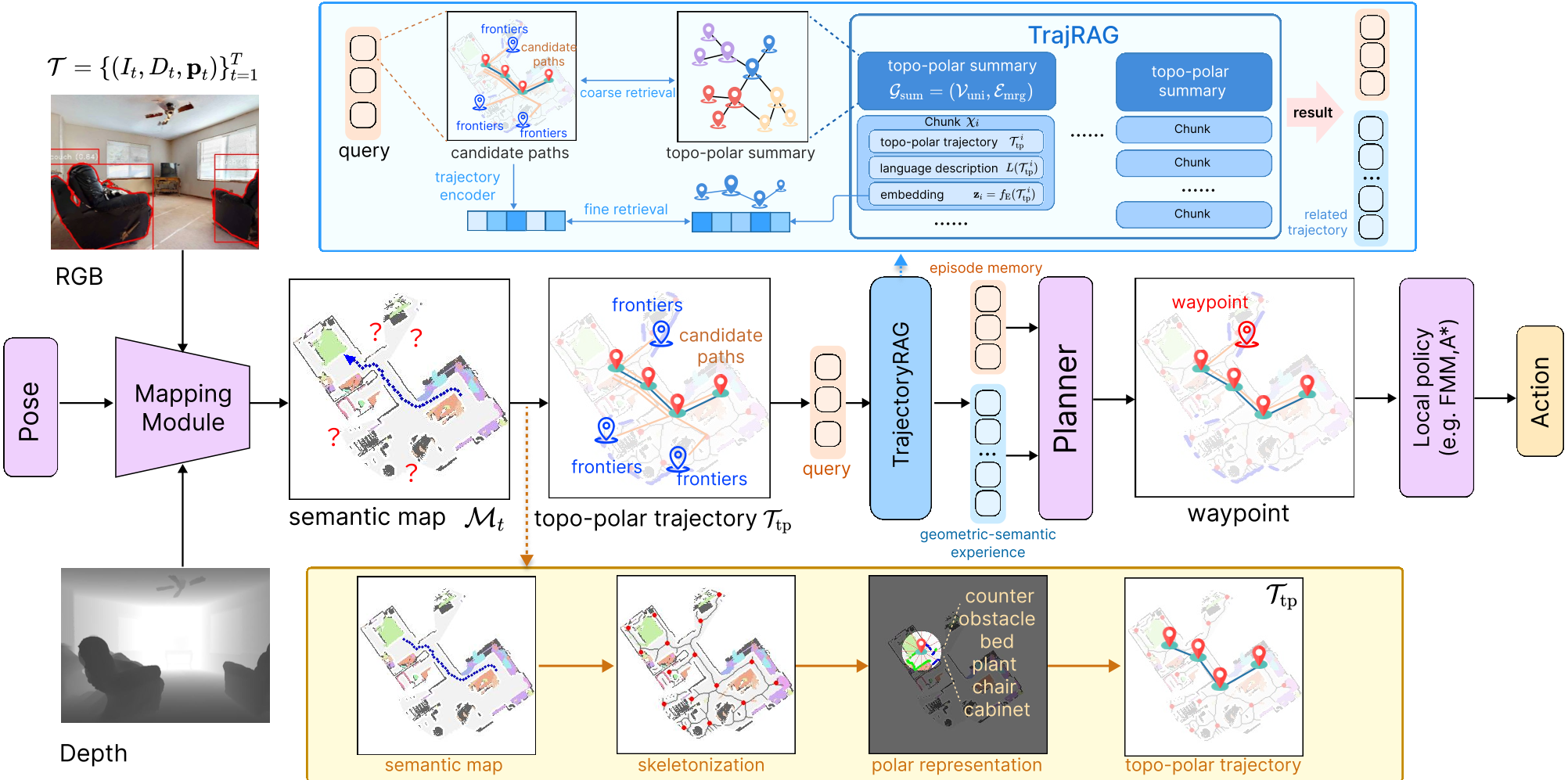
2. Hierarchical Retrieval (Coarse-to-Fine)
Searching through millions of past steps in real-time is impossible. TrajRAG uses a two-step process:
- Coarse Index: It first finds "Groups" of scenes that have similar overall layouts using the topological summaries.
- Fine Index: Within those groups, a specialized Trajectory Encoder (based on Transformers) identifies the specific path that most closely matches the agent's current goal.
Experiments & Results: Setting New Benchmarks
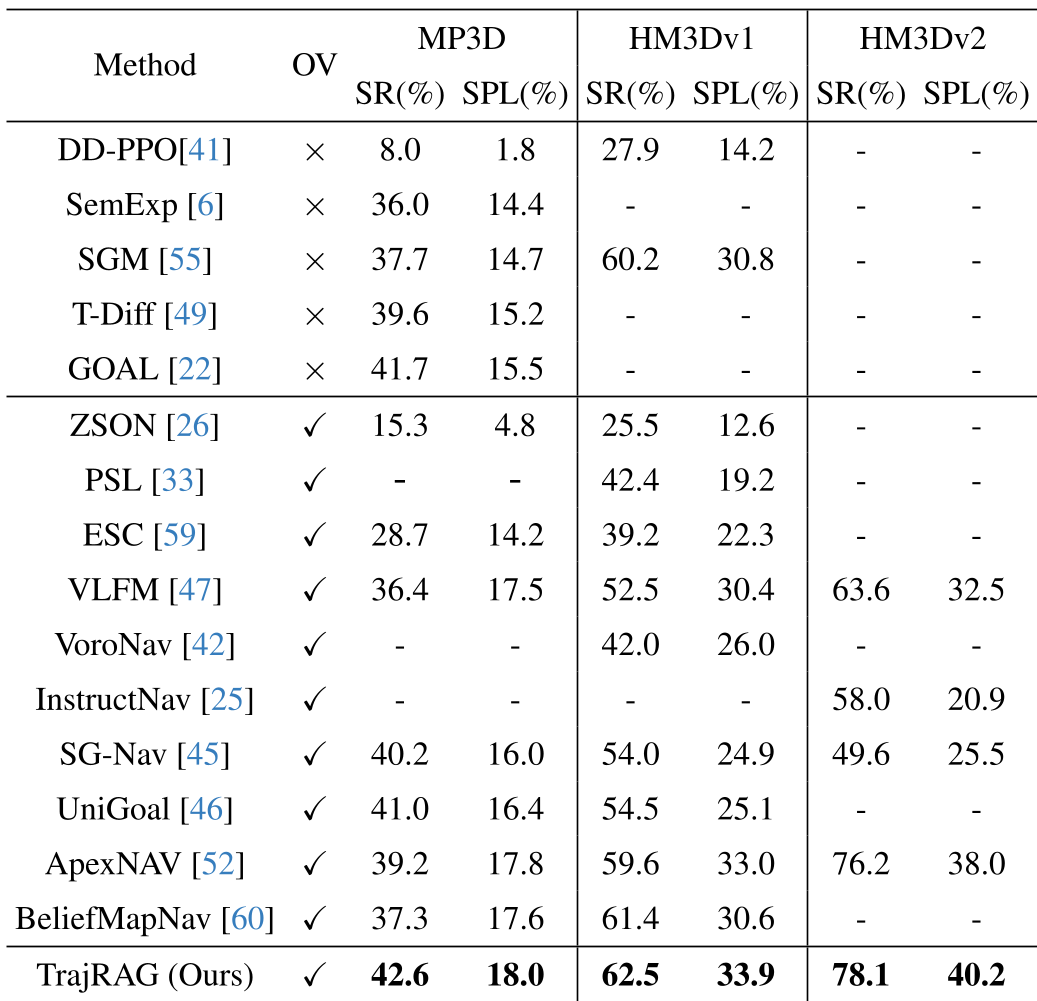
TrajRAG was tested on the most rigorous datasets in the field: HM3D and Matterport3D (MP3D).
Performance Highlights
- Success Rate (SR): TrajRAG hit 78.1% on HM3Dv2, outperforming the previous best (ApexNAV) by nearly 2%.
- Efficiency (SPL): On HM3Dv1, it reached 33.9%, indicating not just that it finds objects, but it finds them via shorter, smarter paths.
Why it Works (Ablation Insights)
When the researchers removed the "Polar" semantic information and relied only on text (TrajTextRAG), performance plummeted. This proves that spatial geometry matters. An LLM can't navigate well just by reading descriptions; it needs to "see" the relative positions of objects as encoded in the topo-polar format.
Critical Analysis & Conclusion
Impact
TrajRAG bridges the gap between scene-agnostic reasoning (LLMs) and scene-specific experience (3D data). Its ability to work across datasets (e.g., training on HM3D and successfully navigating MP3D) suggests that it has captured universal "rules" of indoor layouts.
Limitations
While powerful, TrajRAG still relies on external modules like GroundingDINO for object detection. If the detection fails, the "experience" stored in the memory becomes corrupted. Additionally, the computational cost of real-time RANSAC for geometric matching could be a bottleneck as the memory grows to "lifelong" scales.
Future Outlook
The "Retrieval-Augmented" paradigm is moving from text-only chatbots to the physical world. TrajRAG is a major step toward robots that actually learn from their mistakes and get smarter the more they explore. We expect future iterations to integrate this memory directly into the weights of an end-to-end policy.