
TTV-Not-So-Fast: Deconstructing the Myth of Unique Neptune-mass Discoveries
TTV-Not-So-Fast: Uniqueness and Degeneracy in Perturbing Planet Parameters
The paper "TTV-Not-So-Fast" presents a systematic audit of 12 exoplanet systems where nontransiting planets were claimed to be uniquely characterized via Transit Timing Variations (TTVs). Using rigorous N-body modeling and a targeted search strategy, the authors demonstrate that only a fraction of these claims hold up, with many systems exhibiting severe degeneracies or insignificant evidence for perturbations.
TL;DR
Transit Timing Variations (TTVs) are often hailed as a "gravitational telescope" capable of detecting unseen planets. However, a comprehensive audit of all 12 "uniquely characterized" TTV planets reveals that in most cases, the data is a Rorschach test. Scientists are often seeing one solution where many—often radically different ones—exist. Only 2 out of 12 systems stood the test of rigorous re-analysis.
The "Super-Period" Trap: Why TTVs are Deceptive
In planetary dynamics, a perturber near a Mean-Motion Resonance (MMR) induces a long-period sinusoidal variation known as the "super-period." The problem is that a small, nearby planet and a massive, distant planet can sometimes induce identical sinusoids.
The authors point out that many previous claims of discovering "unique" planets relied on these long-period signals. But without detecting the "chopping" signal—fast, low-amplitude variations that happen during planetary conjunctions—the inverse problem is biologically insolvent.
Methodology: Brute-Forcing the Likelihood Surface
The researchers didn't just re-run a standard MCMC. They used a "targeted search strategy" involving:
- N-body simulations via
TTVFast. - Massive Scale: Over optimizations and CPU hours per system.
- TRF Optimization: Using the Trust Region Framework to navigate the narrow, "needle-in-a-haystack" minima characteristic of resonant systems.
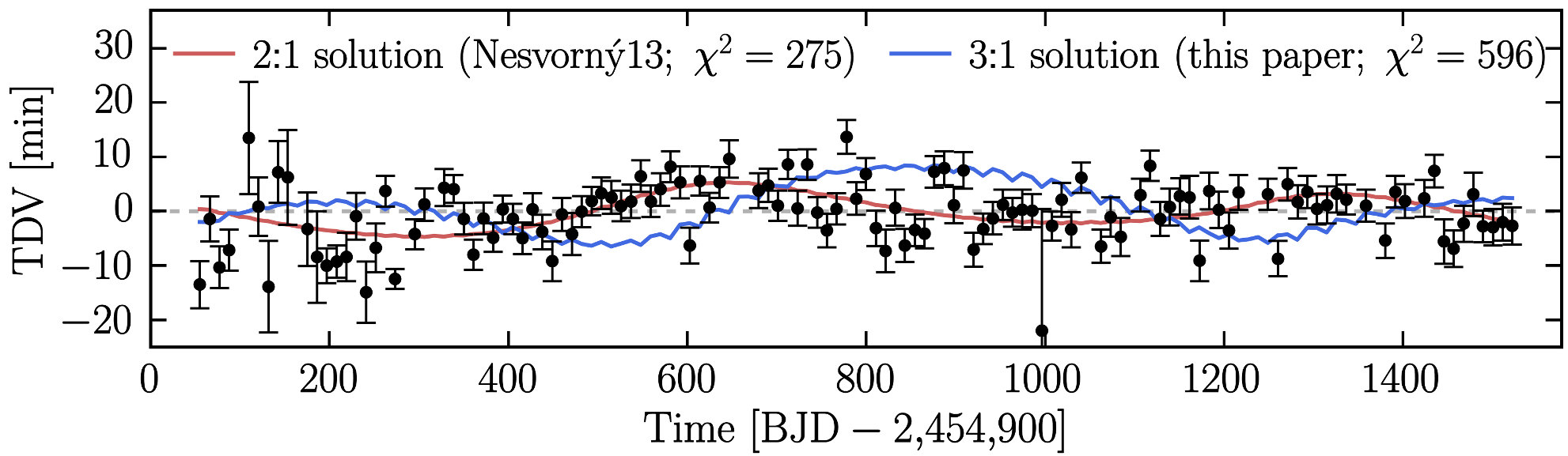 Figure 1: KOI-142 (Kepler-88) represents the "King of TTVs." Notice how the high-pass-filtered data (third panel) shows clear "chopping" that specifically favors the 2:1 resonance over the 3:1 alternative.
Case Studies in Degeneracy
The Janus of Kepler-82
Freudenthal et al. (2019) claimed a unique 20 perturber. However, this re-analysis shows two distinct families (3:2 and 3:1 resonances) fit the data almost equally well. The difference in is a measly 10 units—far too slim to claim uniqueness given the likelihood of underestimated timing errors.
The Myth of the Habitable Zone around Kepler-725
One of the most exciting claims was a 10 planet in the habitable zone of Kepler-725. This audit effectively "demotes" this planet. By re-extracting transit times and accounting for starspots, the authors found that a 20-day interior planet fits just as well as the 208-day "habitable" candidate.
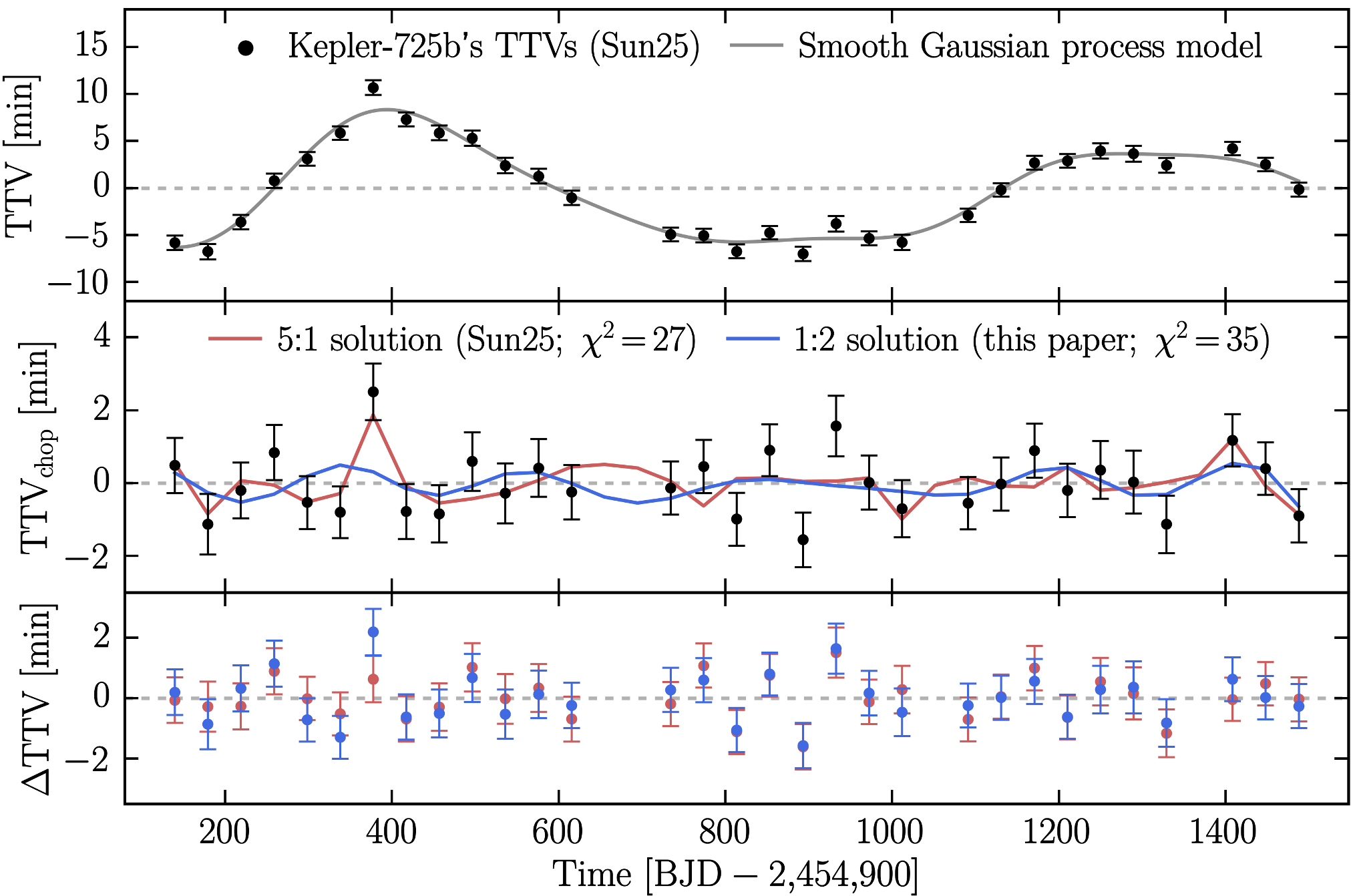 Figure 2: The landscape for Kepler-725. The wide valley shows that many different period ratios (and thus different planet types) provide statistically indistinguishable fits.
The Aliasing Ghost
A critical insight of this paper is aliasing. Because we only measure TTVs when a planet transits (sampling at the orbital period ), fast signals like conjunctions (synodic period ) can be aliased to look like entirely different physical timescales. This is what happened in KOI-884, where a 3:2 solution (newly found here) actually outperforms the published 3:1 solution.
Critical Insights: What Makes a Solution Unique?
The authors identify two necessary (but not sufficient) conditions for a unique TTV inversion:
- Detection of Conjunction Structure: You must see the "chopping."
- Ambiguity Resolution: You must prove the detected fast timescale isn't an alias of a different synodic frequency.
Conclusion: A High Bar for Future Missions
As we look toward the PLATO and Earth 2.0 missions, this paper serves as a sobering reminder. Higher precision is not enough; we need smarter dynamical searches.
The ultimate takeaway? If you don't see the chopping, you don't have the planet. Most TTV "discoveries" are likely to remain "candidates" unless accompanied by high-cadence data or Radial Velocity confirmation.