
Quantum Bursts: How Oscillations Supercharge Tunneling
Tunneling from an oscillating initial state in quantum mechanics
The paper presents a novel analytical framework for calculating quantum tunneling rates from general, non-vacuum initial states. By decomposing initial states into a basis of resonant (Gamow-Siegert) states and applying WKB semiclassical approximations, the authors derive a closed-form expression for the time-dependent probability current. The method successfully predicts the "spiky" tunneling behavior of coherently oscillating states, which matches numerical Schrödinger simulations with high precision.
TL;DR
Researchers have finally cracked the code for tunneling from "non-vacuum" states—like a particle bouncing back and forth in a trap. By using a clever mathematical basis called Resonant States, they've shown that tunneling isn't always a slow, steady leak; if the particle is oscillating, it escapes in "spikes" of probability every time it hits the wall. This work bridges the gap between high-level theory and actual numerical simulations with startling precision.
Background: Beyond the Static Vacuum
Standard quantum mechanics textbooks teach us how a particle in its ground state leaks through a barrier. This is the "Fate of the False Vacuum" problem, famously solved by Sidney Coleman using instantons. But what if the particle is moving?
In fields like Cosmology (e.g., axion dark matter oscillating in a potential well) or Superconducting Circuits (Josephson junctions), the system is rarely sitting still. Historically, calculating the tunneling rate for these "excited" or "oscillating" states has been a mess—different methods led to different exponents, and researchers often had to resort to "fudge factors" to match numerical simulations.
The Core Insight: Resonant State Expansion
The authors move away from standard Hermitian physics to the world of Gamow-Siegert (resonant) states. By imposing "outgoing-only" boundary conditions, the Hamiltonian becomes non-Hermitian, and the energy levels become complex: The imaginary part represents the decay rate. The genius of this paper lies in expanding a time-dependent wave packet as a sum of these resonances.
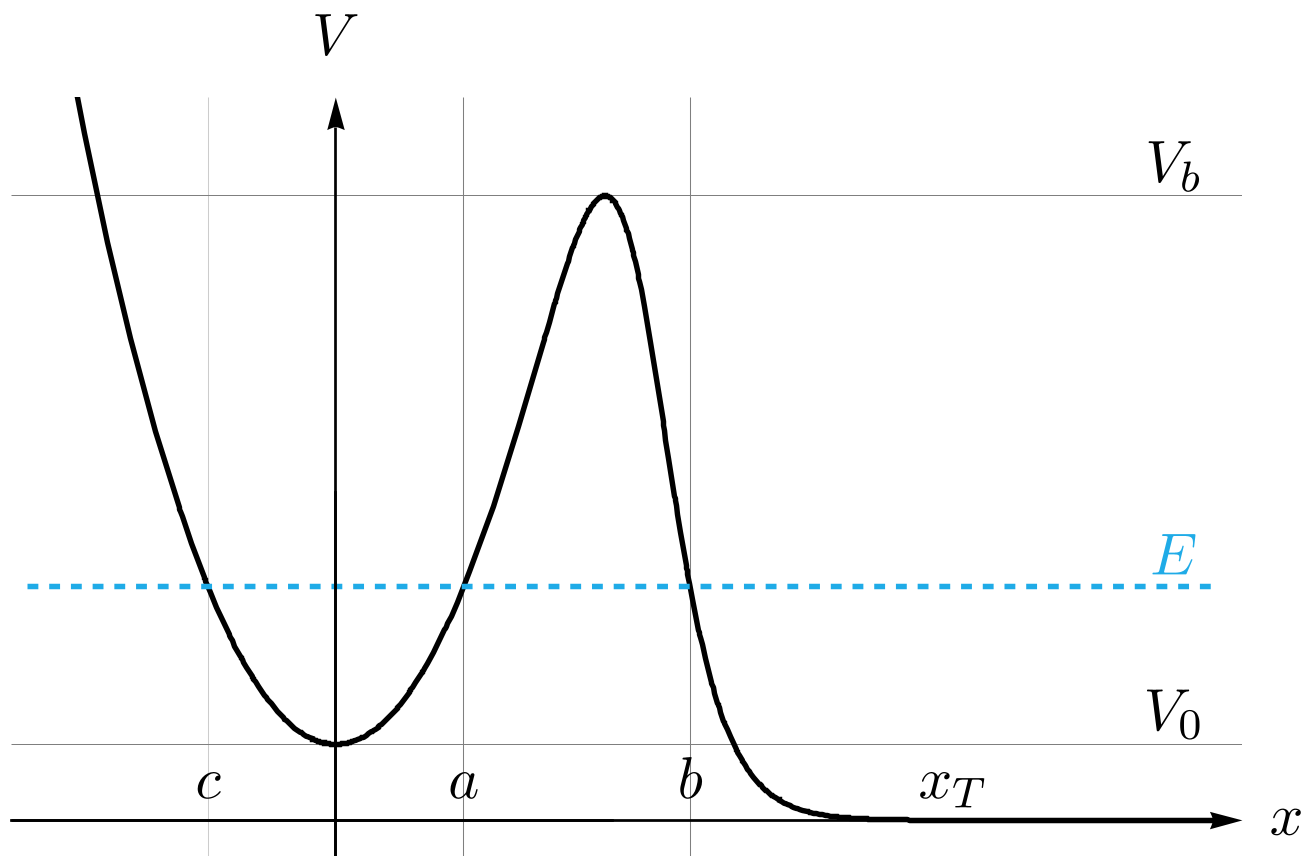 Figure 1: The generic potential setup. The particle is trapped in the well (left) but can tunnel through the barrier to the free region (right).
Methodology: The Analytical Breakthrough
The researchers derived a closed-form expression for the probability current . Crucially, the current is not just a sum of individual decay rates. It includes interference terms:
When you start with a coherent state (a quantum state that behaves like a classical bouncing ball), these interference terms add up constructively at specific moments. Using a saddle-point approximation, the authors proved that the tunneling current looks like a series of Gaussian spikes.
Why does this happen? Semiclassically, the particle "attempts" to tunnel once per bounce. The tunneling probability is exponentially higher when the particle is at the turning point nearest the barrier ().
Experimental Verification & Numerics
To prove their math worked, the team used a Complex Absorbing Potential (CAP) to simulate an open system on a computer.
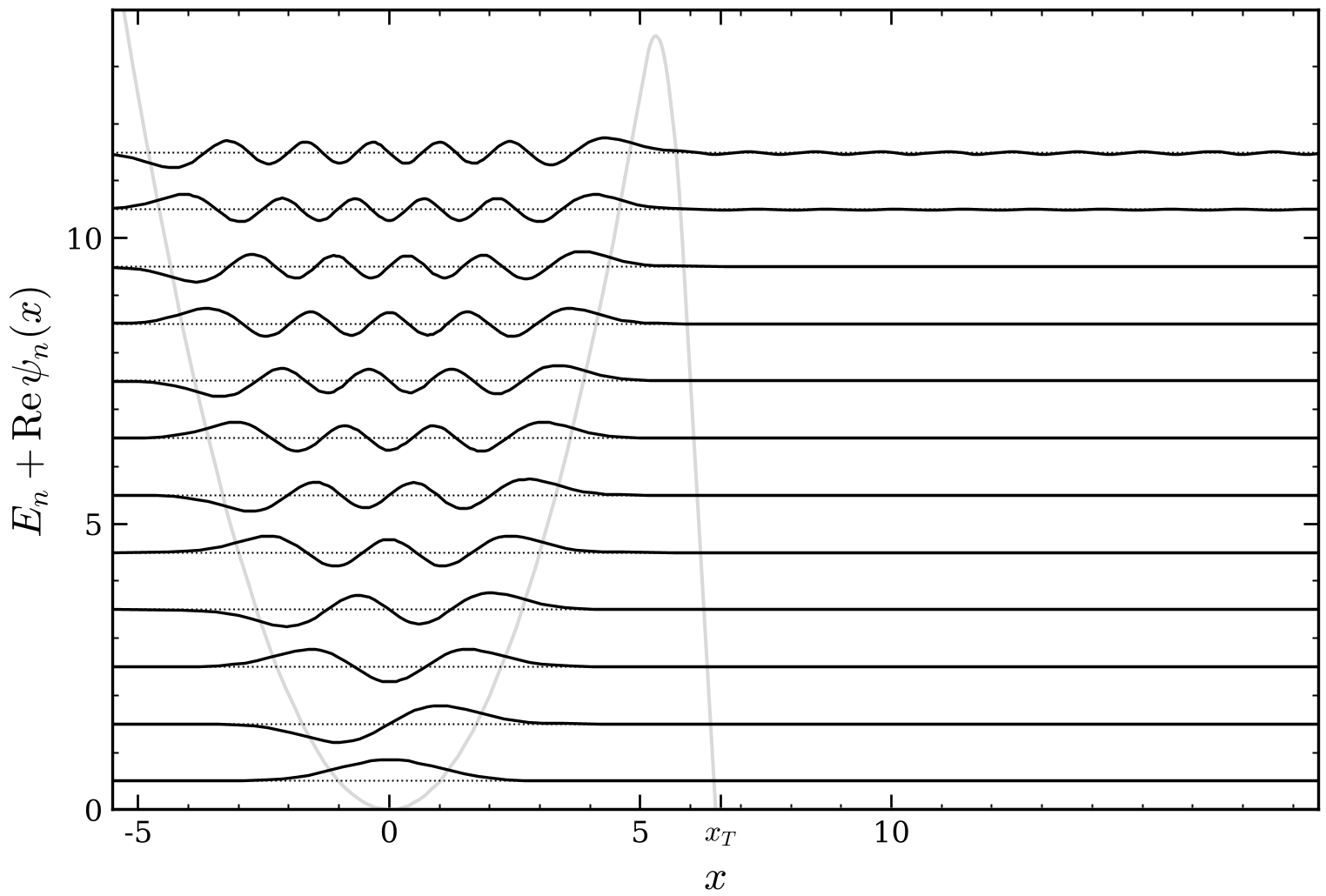 Figure 2: The first 12 resonant states. Notice how higher energy states have more "wiggles" and extend further into the barrier.
The results were nearly perfect. As shown in the comparison below, the analytical WKB prediction (blue dashed line) tracks the full numerical Schrödinger evolution (black solid line) with incredible fidelity.
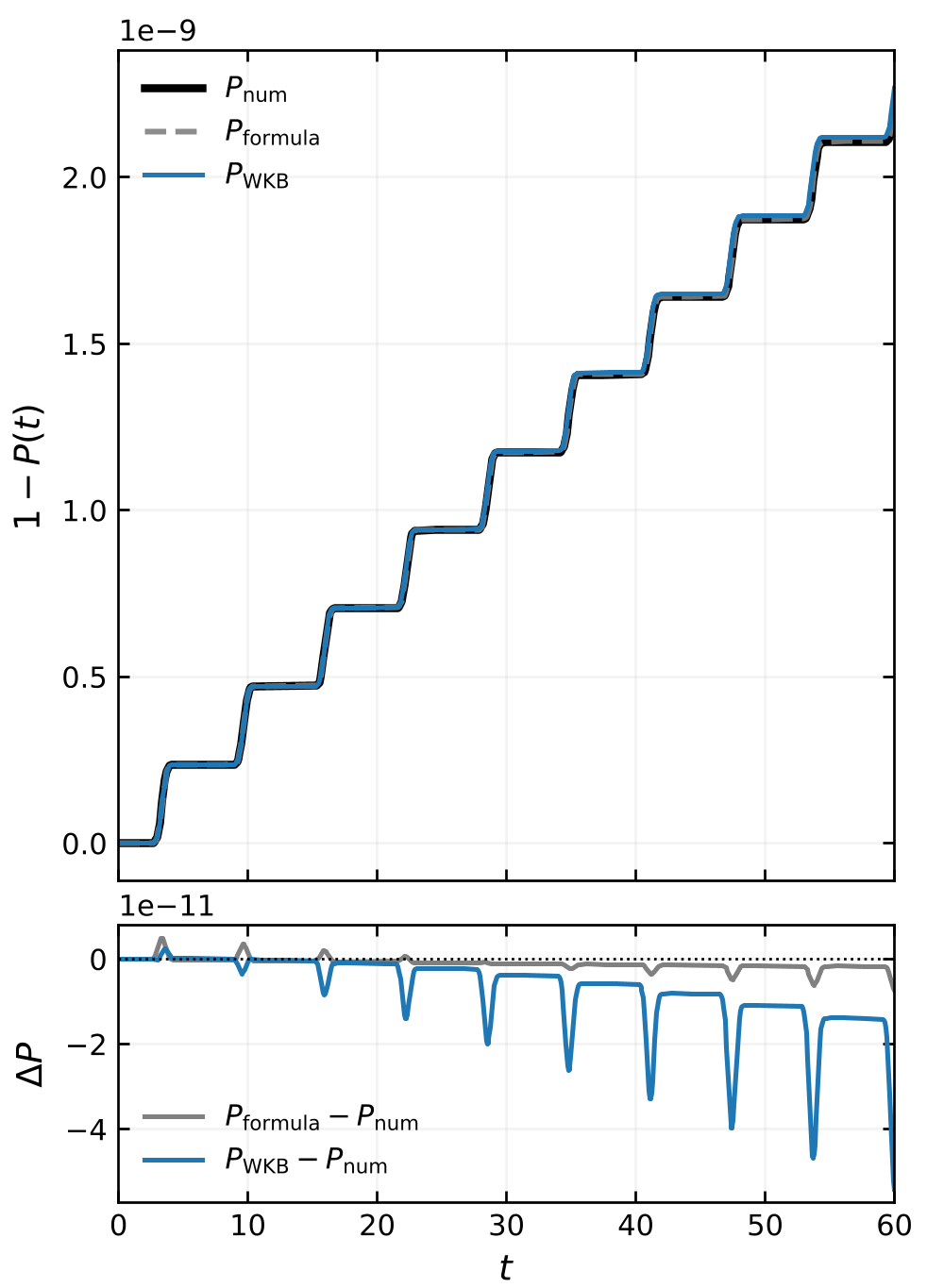 Figure 3: Left: The "staircase" of cumulative tunneling probability. Right: The "spikes" in the current. Each spike corresponds to one bounce against the barrier.
Conclusion and Outlook
The study demonstrates three vital points:
- Coherence Matters: If you randomize the phases of the states, the spikes disappear and you get a dull, average decay.
- Timing is Everything: Tunneling from oscillating states is localized in time ().
- WKB is Robust: The semiclassical approximation remains accurate until the energy gets very close to the top of the barrier.
What's next? The authors are looking toward Quantum Field Theory. In the early universe, if a scalar field was oscillating when it "tunneled" to create a new vacuum, it would have produced bubbles in a periodic, structured way rather than a random one. This could have left unique imprints on gravitational waves or the distribution of matter in our universe.