
[ICLR 2025] U-Cast: Escaping the Complexity Trap in AI Weather Forecasting
U-Cast: A Surprisingly Simple and Efficient Frontier Probabilistic AI Weather Forecaster
U-Cast is a surprisingly simple probabilistic weather forecasting model that utilizes a standard U-Net backbone. By employing a deterministic-to-probabilistic training curriculum and Monte Carlo Dropout, it achieves performance competitive with SOTA models like GenCast and IFS ENS while reducing training compute by over 10x.
TL;DR
U-Cast shatters the assumption that "frontier" AI weather forecasting requires exotic architectures and massive compute. By using a standard U-Net, MC Dropout, and a clever two-stage training curriculum, it matches the skill of SOTA graph-based and diffusion models while being 10x cheaper to train and 10x faster at inference.
Background: The Complexity Trap
The field of AI Weather Prediction (AIWP) has recently shifted from deterministic models (which produce "blurry" forecasts) to probabilistic ensembles (which capture the atmosphere's chaotic nature). However, this progress has come at a steep price. Current leaders like GenCast and FGN utilize complex Graph Transformers or Diffusion processes, requiring hundreds of TPU-days and specialized engineering. This "Complexity Trap" has centralized frontier research in a few elite, well-resourced labs.
The authors of U-Cast ask a refreshing question: Is this complexity actually necessary?
Methodology: The Power of Simplicity
U-Cast proves that a streamlined design can reach the Pareto frontier of efficiency and accuracy. Its architecture is built on three surprisingly simple pillars:
1. The U-Net Comeback
Instead of modeling the Earth as a graph, U-Cast reverts to a U-Net backbone (specifically the DhariwalUnet used in image diffusion). The logic is simple: atmospheric dynamics are predominantly local at short time scales, a property perfectly captured by the inductive bias of convolutions. Bottleneck self-attention is used only at the coarsest resolutions to handle long-range dependencies.
2. A Two-Stage Curriculum
Rather than training on the expensive Continuous Ranked Probability Score (CRPS) from scratch, U-Cast uses a "Physic-to-Uncertainty" curriculum:
- Stage 1 (Deterministic): Pre-train the model to predict the mean state using Mean Absolute Error (MAE).
- Stage 2 (Probabilistic): Fine-tune for only 8 epochs using CRPS to learn the spread/uncertainty.
- Stage 3 (Deep Ensembling): Repeat Stage 2 with independent seeds to further boost skill.
3. MC Dropout & Muon Optimizer
Instead of specialized noise-injection layers, U-Cast uses Monte Carlo Dropout to generate ensemble members. This reduces parameter count by ~10%. Furthermore, it replaces the ubiquitous AdamW with the Muon optimizer, which the authors found to be the "secret sauce" for reaching a strong optimum during the brief probabilistic fine-tuning stage.
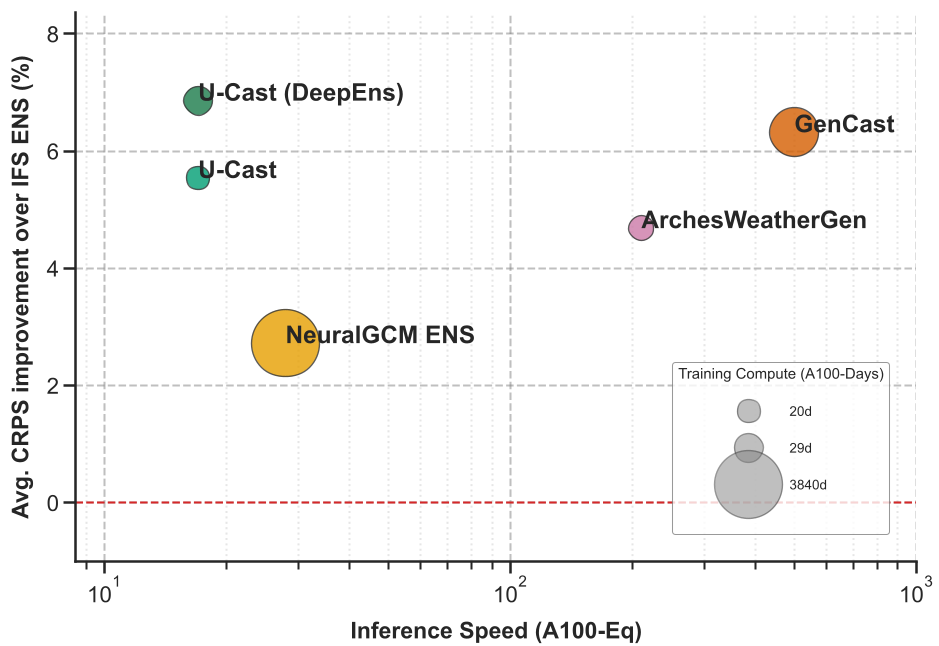 Figure 1: The Efficiency-Accuracy Pareto Frontier showing U-Cast's superior position in skill vs. latency.
Experimental Results: SOTA at a Fraction of the Cost
Benchmarked on WeatherBench 2 at 1.5° resolution, U-Cast delivers impressive results:
- Versus IFS ENS: Outperforms the gold-standard physics ensemble on nearly all metrics, with up to 23.7% improvement in short-range sea-level pressure.
- Versus GenCast: Remains highly competitive despite GenCast having the advantage of being regridded from a higher (0.25°) native resolution.
- Inference Speed: Generates a 60-step forecast in 11 seconds—an order of magnitude faster than iterative diffusion models.
- Training Cost: The entire pipeline runs in <3 days on 4 H200 GPUs.
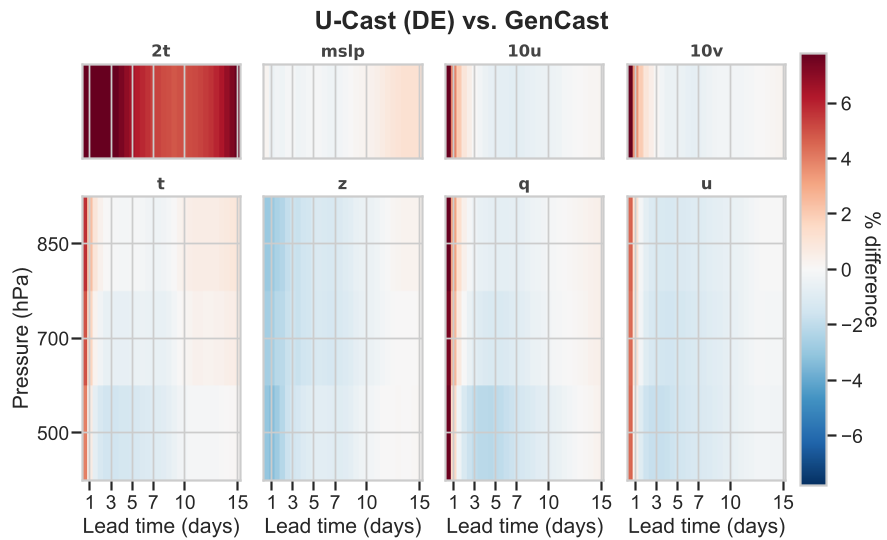 Figure 2: CRPS score card comparison against GenCast and IFS ENS. Blue indicates U-Cast superiority.
Critical Insight: Democratizing the Frontier
The most significant contribution of U-Cast isn't just a lower CRPS score—it's the democratization of AIWP. By proving that a single H200 GPU can fine-tune a frontier-grade probabilistic model in one day (given a pre-trained backbone), the authors open the door for academic researchers and smaller organizations to participate in weather AI.
Limitations
While highly efficient, the model does show some polar artifacts and under-dispersion (overconfidence) in the short range. This suggests that while specialized "spherical" architectures aren't needed for general skill, they may still be useful for handling the Earth's unique topology at the poles.
Conclusion
U-Cast serves as a powerful "Occam’s Razor" for the weather community. It suggests that before reaching for the most complex new architecture, we should first ensure we are efficiently optimizing the general-purpose tools we already have.
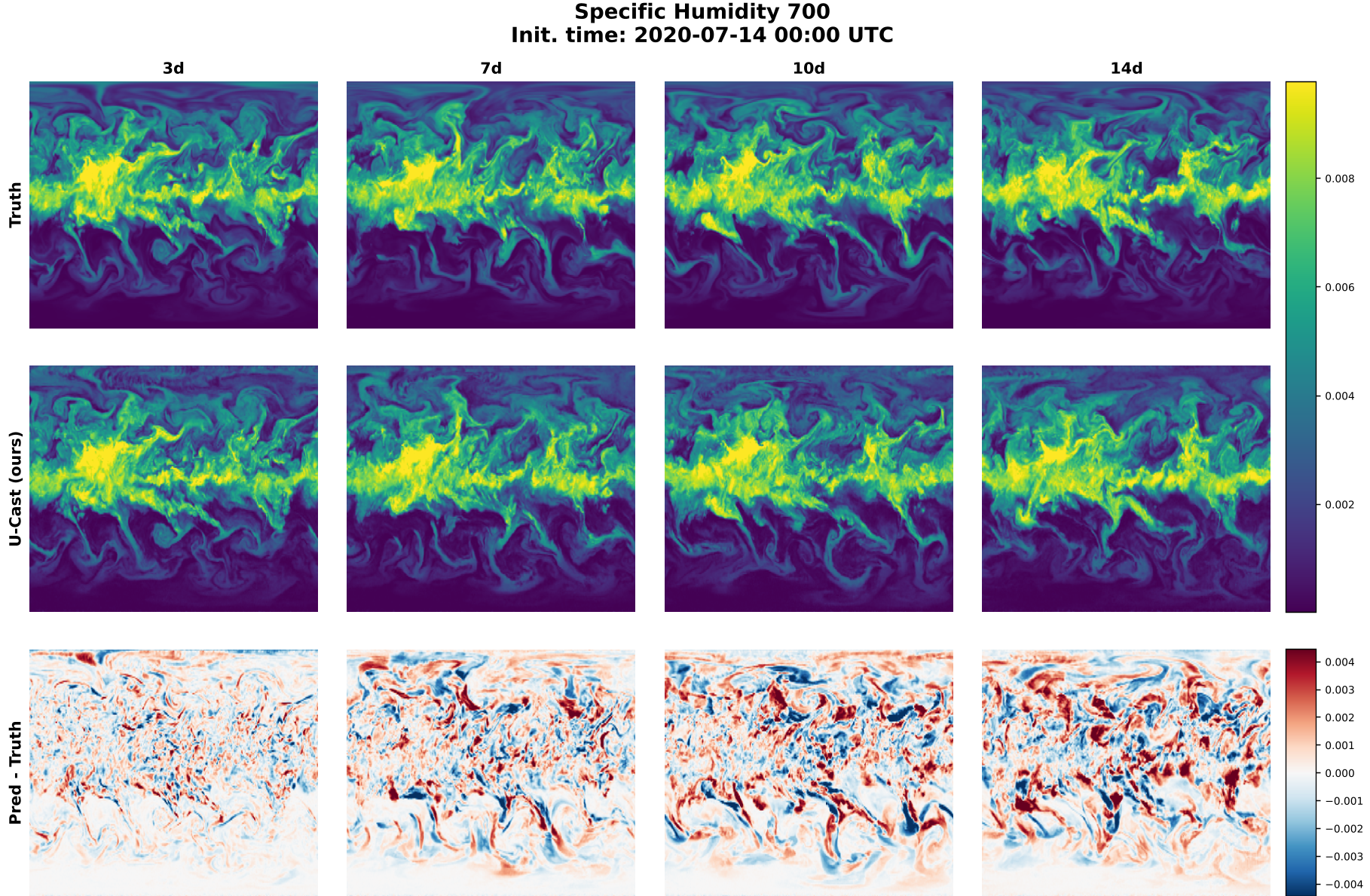 Figure 3: Qualitative visualization of U-Cast humidity forecasts (q700) showing realism over 14 days.