
[arXiv 2026] U(2) CSGL Theory: Bridging the Gap in Fractional Quantum Hall Hierarchies
$\mathrm{U}(2)$ Chern-Simons-Ginzburg-Landau Theory of Fractional Quantum Hall Hierarchies
The paper develops a unified U(2) Chern-Simons-Ginzburg-Landau (CSGL) field theory framework to describe both Abelian and non-Abelian fractional quantum Hall (FQH) hierarchies. It successfully maps categorical and wavefunction-based constructions to effective field theories, reproducing filling fractions and topological orders for states like the Read-Rezayi and Pfaffian sequences.
TL;DR
Researchers have formulated a unified U(2) Chern-Simons-Ginzburg-Landau (CSGL) theory that finally provides a solid field-theoretic foundation for the complex "hierarchy" of fractional quantum Hall (FQH) states. By treating anyon condensation as a symmetry-breaking (or preserving) process within a non-Abelian gauge theory, the authors successfully derive the properties of exotic states like the Read-Rezayi and Pfaffian sequences, matching results previously only seen in trial wavefunctions.
Problem & Motivation: Beyond Trial Wavefunctions
For decades, the "Hierarchy Construction" has been the gold standard for organizing FQH plateaus. The idea is simple: as the magnetic field changes, quasiparticles of a "parent" state condense to form a new "daughter" state.
While Abelian hierarchies (like the Jain sequence) are well-described by U(1) gauge theories, the non-Abelian transitions—where a Pfaffian state might produce an Abelian daughter, or an Abelian state leads to a non-Abelian one—have remained stuck in the realm of trial wavefunctions (Moore-Read, Read-Rezayi) or abstract category theory. The field lacked a Ginzburg-Landau approach that captures the "physics" of the transition via a local Lagrangian.
Methodology: The Power of U(2)
The core insight of the paper is that a U(2) gauge field can "parent" both Abelian and non-Abelian daughters depending on the representation and fusion channel of the condensed anyon.
1. From Non-Abelian to Abelian
Starting with a Pfaffian-type parent, the authors represent anyons as scalar fields in the fundamental representation of U(2).
- Ferromagnetic Channel: If the condensation favors a specific "spin" direction, the U(2) symmetry breaks down to . This reduces the complex non-Abelian theory into a standard K-matrix (Abelian) formulation.
- This explains why the Pfaffian state can produce Abelian sequences like .
2. From Abelian to Non-Abelian
Conversely, the authors show how starting from a Jain state (Abelian), one can generate the Anti-Read-Rezayi sequence. This involves:
- Attaching U(2) flux to the quasiparticles.
- Higgsing the gauge field through anyon condensation.
- If the U(2) symmetry remains unbroken, the daughter state inherits non-Abelian statistics.
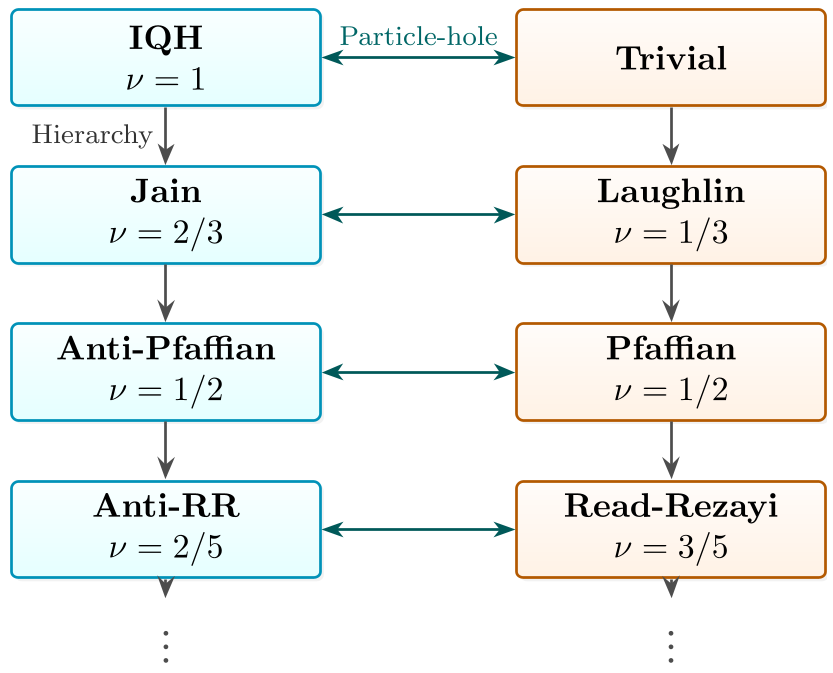 Figure 1: Schematic of the hierarchy sequences and their particle-hole symmetric relationships.
Experiments & Results: Precise Alignment
The authors validated their theory by calculating the Topological Data for multiple sequences and comparing them against established SOTA (wavefunction and categorical) results.
The Moore-Read Pfaffian Quasiparticle Hierarchy
Using the K-matrix formalism derived from their U(2) theory, they computed the following for the quasiparticle sequence:
- Filling Fraction:
- Chiral Central Charge:
- Total Quantum Dimension:
These values perfectly match the categorical predictions of Zhang et al. (2025) and previous wavefunction analyses by Levin & Halperin.
K-Matrix Comparisons
Below is a snapshot of the results for various parent states, demonstrating the versatility of the U(2) framework:
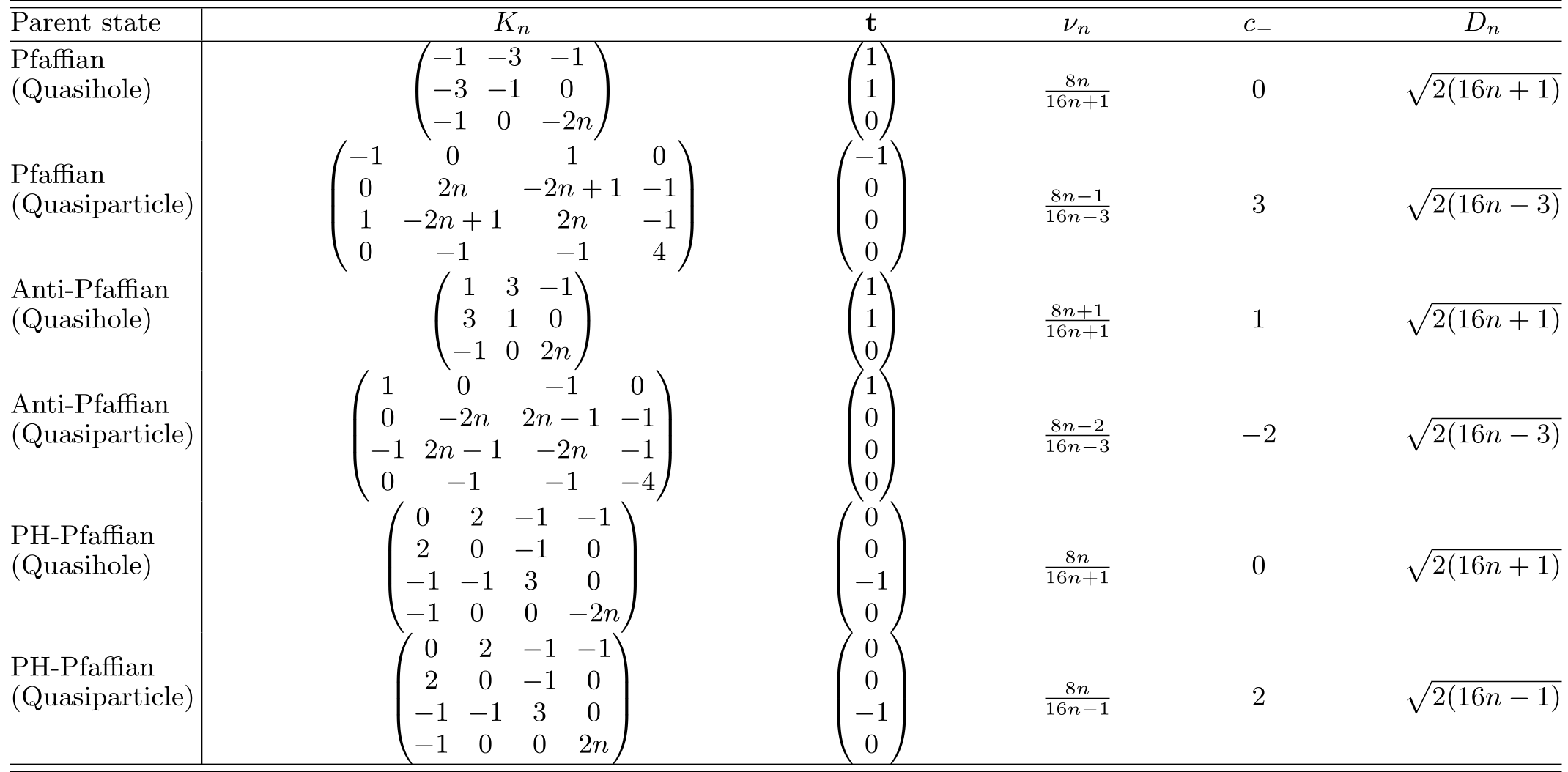 Table 1: Comparison of K-matrices, filling fractions, and topological spins across different hierarchy sequences.
Deep Insight: Particle-Hole Symmetry
A striking discovery in this paper is the explicit Particle-Hole (PH) symmetry between hierarchies. The authors demonstrate that the Read-Rezayi states (non-Abelian) arise naturally as a hierarchy from a trivial insulator (), making them the PH conjugates of the hierarchies emerging from the integer quantum Hall state (). This dual relationship provides a satisfying geometric symmetry to the "Zoo" of quantum Hall states.
Conclusion & Future Outlook
This U(2) CSGL theory is more than just a calculation—it's a unifying framework. It simplifies the study of anyon-driven phases by turning abstract "stack-and-condense" operations into the familiar language of symmetry breaking and Higgs mechanisms.
Limitations: Currently, the model focuses on U(2), which covers a vast array of the most interesting states (Pfaffian, Read-Rezayi), but more exotic non-Abelian states might require higher-rank gauge groups ().
Future Directions: This framework opens the door to studying anyon superconductivity and transitions in Fractional Chern Insulators (FCI), where non-Abelian anyons could be engineered in moiré materials for topological quantum computing.