
Unconventional Criticality in Long-Range Spin-1 Chains: Beyond the Conformal Paradigm
Unconventional Quantum Criticality in Long-Range Spin-1 Chains: Insights from Entanglement Entropy and Bipartite Fluctuations
This study investigates the ground-state phase diagram of a long-range (LR) spin-1 Heisenberg chain using a specialized split-spin representation in Quantum Monte Carlo (QMC). The authors identify an unconventional quantum critical point (QCP) at separating a gapped Haldane phase from a gapless antiferromagnetic Néel phase, achieving precise finite-size scaling on systems up to .
TL;DR
Researchers have mapped the phase diagram of a spin-1 Heisenberg chain with long-range (LR) interactions . By employing a high-precision split-spin Quantum Monte Carlo (QMC) approach, they discovered a unique Quantum Critical Point (QCP) at . This transition is non-conformal (), challenging the standard 1D conformal field theory framework and bridging the gap between topological Haldane phases and long-range ordered magnetic states.
Back to Basics: Why Long-Range Spin-1 Matters?
In the world of 1D magnetism, the Haldane phase is a legendary concept—a gapped, topologically ordered state found in integer spin chains. Traditionally, these systems are studied with short-range interactions where the Mermin-Wagner theorem prevents continuous symmetry breaking.
However, when we introduce long-range interactions (decaying as ), the rules of the game change. These interactions can "overpower" 1D fluctuations, allowing for a true Néel-ordered phase. The big question addressed here is: What happens at the intersection of topological protection (Haldane) and long-range magnetic order (Néel)?
Methodology: The Split-Spin Trick
Directly simulating spin-1 systems in QMC is computationally expensive. To bypass this, the authors used a Split-Spin Representation.
- The Intuition: Each spin-1 site is treated as two auxiliary spin-1/2 particles.
- The Constraint: A projection operator () is applied to ensure the auxiliary spins remain in the triplet (symmetric) sector, effectively mimicking a spin-1 particle.
- The Advantage: This allows the use of the highly efficient "Directed Loop Algorithm," enabling simulations of massive system sizes () that would be impossible with exact diagonalization.
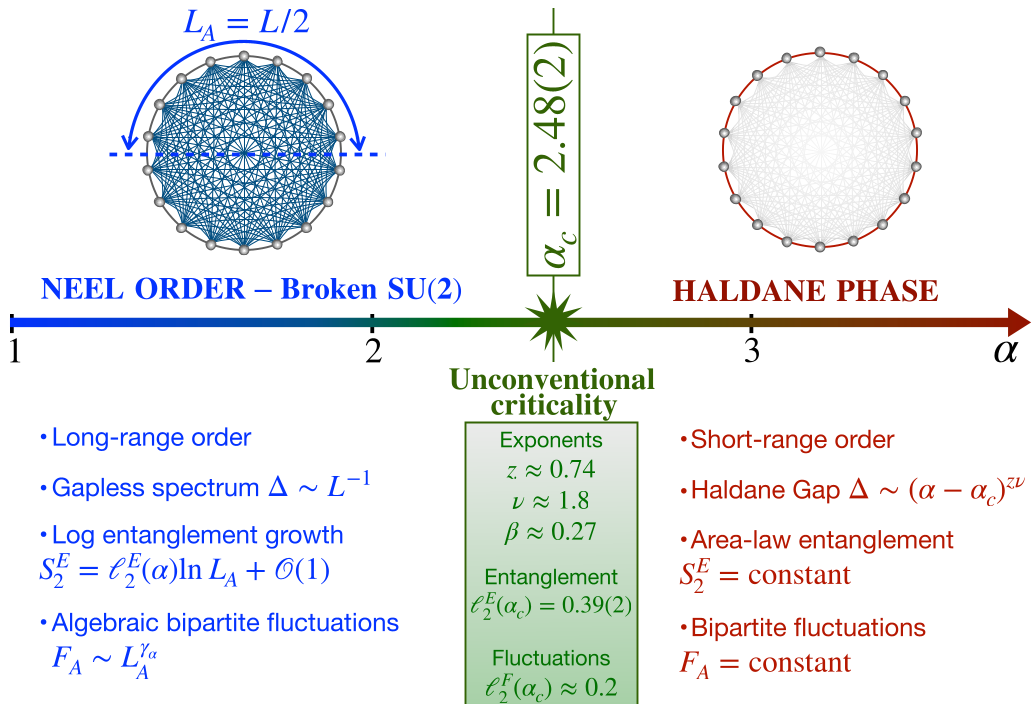
Breaking Lorentz Invariance: Non-Conformal Criticality
One of the most striking findings is the dynamical exponent . In typical 1D quantum transitions, , meaning space and time scale the same way (Lorentz invariance). Here, the long-range forces warp this relationship.
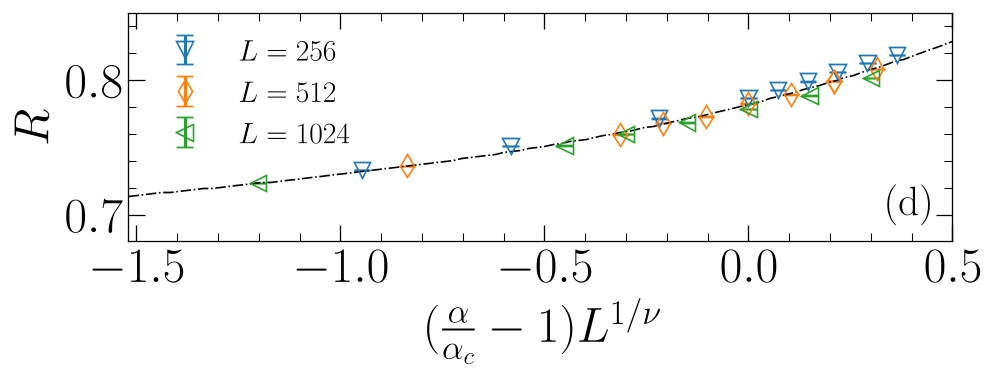
The authors tracked the "closing" of the Haldane gap (). As approaches the critical value , the gap vanishes following the scaling . The deviation from is a "smoking gun" for unconventional criticality that cannot be described by standard Conformal Field Theory (CFT).
Entanglement and Fluctuations
The study dives deep into the "Entanglement Content" of the chain:
- Haldane Phase (): Follows the Area Law. Entanglement is local and bounded.
- Néel Phase (): Exhibits Logarithmic Scaling. Entanglement grows with the size of the block, driven by long-range correlations.
- At the QCP: The entanglement entropy prefactor is . In a surprising twist, this is very close to the SU(2) WZW theory value of , suggesting that while the dynamics () are non-conformal, the ground state might still share "structural DNA" with traditional conformal theories.
Critical Insight & Future Outlook
This paper successfully locates the QCP at and provides a roadmap for experimentalists. With the rise of Rydberg atom arrays and trapped ion simulators, we can now "tune" the exponent in the lab.
The discovery of and the specific scaling of bipartite fluctuations () provides clear signatures for experimentalists to look for. While the researchers note a small discrepancy in the correlation length exponent compared to some Matrix Product State (MPS) works, the overall robustness of the QMC data suggests a significant leap in our understanding of 1D long-range quantum magnetism.
Takeaway table of Exponents
| Parameter | Value (S=1) | Significance |
|---|---|---|
| 2.48(2) | Transition Point | |
| 0.74(1) | Non-conformal nature | |
| **$ | ||
| u$** | 1.81(5) | Correlation length scaling |
| 0.27(1) | Order parameter growth |
Final Conclusion: The long-range spin-1 chain is a fertile ground for "unconventional" physics, where topological artifacts and long-range interactions collide to create new universality classes.