
The Unreasonable Effectiveness of Text Embedding Interpolation for Continuous Image Steering
The Unreasonable Effectiveness of Text Embedding Interpolation for Continuous Image Steering
This paper introduces a training-free framework for continuous image steering in text-conditioned generative models (like Flux and Wan2.1) by linearly interpolating embeddings in the text-encoder space. Utilizing an LLM-automated pipeline and an "Elastic Range Search" algorithm, it transforms static text prompts into dynamic semantic sliders for local, global, and stylization edits.
TL;DR
Researchers have uncovered that we don't need complex LoRAs or extra training to give AI images "intensity sliders" (like a smile-o-meter). By simply nudging the text embeddings of specific words using an LLM-guided "steering vector" and an automated calibration tool called Elastic Range Search, they achieved continuous, high-quality image and video editing that rivals heavy-duty training-based models.
Background: The Price of Control
In the current generative landscape, if you want to turn a neutral face into a "slightly smiling" one or a "big grin," you usually face a trade-off. You either use training-free methods that often struggle with intensity (under-editing), or training-based methods (like Concept Sliders) that require GPUs and time to bake specialized weights for every single new concept.
This paper argues that as models like Flux.1 and Qwen-VL get smarter, their internal text representations become more linearly organized. This means we can stop training and start "steering."
The Problem: Why Simple Nudging Fails
If you just add a "smile" vector to a whole prompt:
- Entanglement: If your "age" vector was calculated from a dataset of old men and young women, pushing "age" might accidentally change the subject's gender (Bias Inheritance).
- Selection: Nudging "stop words" (like "a" or "the") does nothing, while nudging the background might break the scene.
- Range: How much "vector" is enough? Too little = no change. Too much = the image falls apart into deep-fried artifacts.
Methodology: The Steering Framework
1. Automated Vector Synthesis
The system uses an LLM to generate 100 pairs of contrastive prompts (e.g., "a smiling person" vs "a neutral person"). By taking the Difference-of-Means between the text-encoder outputs of these pairs, it extracts a pure "smile" direction ().
2. LLM-Guided Token Selection
Instead of steering the entire prompt, the authors use an LLM (Qwen-8B) to pick the relevant tokens. For a "smile" edit on the prompt "A man sitting on a park bench," the LLM identifies "man" as the target. The steering vector is only added to the embedding of that specific word.
3. Elastic Range Search (The "Secret Sauce")
To solve the "how much is enough" problem, they treat the steering process like an elastic band. They sample multiple steering strengths, measure the visual "distance" (using DreamSim) between the results, and move the points until the visual change between each step feels smooth and consistent.
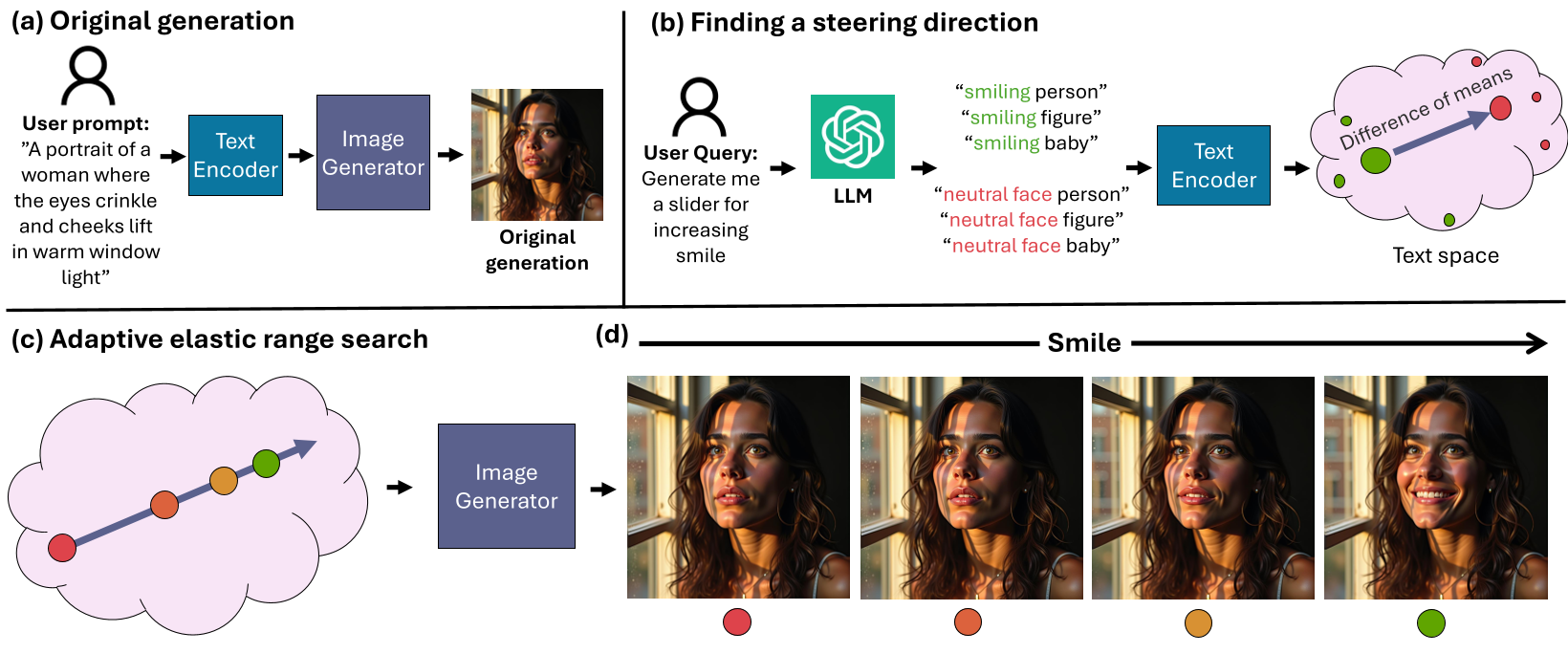 Figure 1: The full pipeline—from LLM concept generation to the final continuous slider.
Experiments and Results
The authors compared their method against SOTA controllers like SAEdit and Flux-Slider.
- Performance: On the Qwen-Image-Edit backbone, they hit a ΔVQA (edit success) of 0.63, significantly higher than mainstream training-free baselines.
- Continuity: They introduced a new metric, MID (Monotonic Increment Deviation). Their method consistently showed smoother transitions—meaning the slider feels "natural" to a human user, rather than jumping from "no change" to "extreme change" abruptly.
- Multomodal Generalization: Because the intervention happens in the text encoder, it works for Video (Wan2.1) without any modifications.
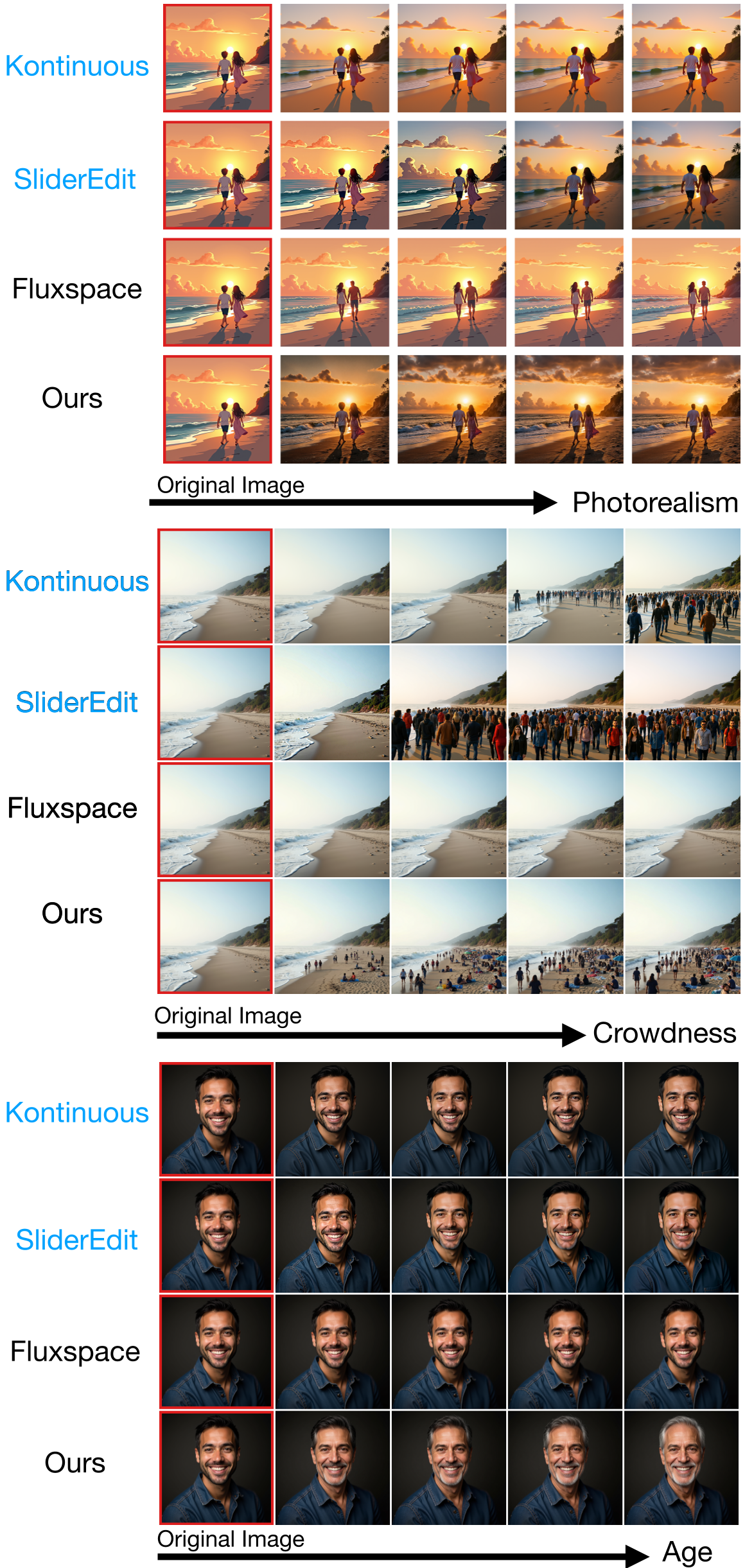 Figure 2: Qualitative results across stylization (photorealism), global scene (crowdness), and local edits (age).
Critical Analysis & Conclusion
The Takeaway
The "Unreasonable Effectiveness" in the title is a nod to the classic "Unreasonable Effectiveness of Mathematics." It suggests that the semantic space of LLMs is far more structured than we gave it credit for. By combining targeted token steering with dynamic range calibration, we can achieve "Photoshop-level" sliders for AI without ever hitting the "Train" button.
Limitations
- Model Bias: If a model has never seen a "six-fingered hand," no amount of steering will make it generate one correctly.
- LLM Dependency: The quality of the steering vector relies on the LLM's ability to generate a diverse, debiased dataset of prompts.
Future Outlook
This work paves the way for a Fully Autonomous Paradigm in image editing. Imagine a future where you simply type "make it more cinematic," and an agent automatically builds the vector, finds the range, and gives you a slider in seconds—no LoRA required.