
From Black Box to Pedagogical Orchestration: How ES-LLMs Solve the Mastery Gain Paradox
From Untamed Black Box to Interpretable Pedagogical Orchestration: The Ensemble of Specialized LLMs Architecture for Adaptive Tutoring
The paper introduces the Ensemble of Specialized LLMs (ES-LLMs) architecture, a neuro-symbolic tutoring framework that decouples deterministic pedagogical decision-making from natural language generation. By coordinating specialized agents via a rule-based orchestrator and Bayesian Knowledge Tracing (BKT), the system achieves 100% adherence to pedagogical constraints and significantly outperforms monolithic LLM tutors in instructional quality.
TL;DR
Current LLM-based tutors are "too helpful," often prioritizing user satisfaction over actual learning—a phenomenon the authors call the Mastery Gain Paradox. This paper introduces ES-LLMs, a hybrid architecture that separates the what (pedagogical logic) from the how (natural language wording). By using a deterministic orchestrator to control specialized agents, it ensures 100% adherence to teaching rules while cutting operational costs by over 50%.
The Problem: The "Too Nice" Tutor
In the realm of Intelligent Tutoring Systems (ITS), we face a trade-off:
- Classical ITS: High control and pedagogical rigor, but rigid and robotic dialogue.
- Monolithic LLMs: Incredible fluency, but they are "untamed black boxes" that struggle with negative constraints (e.g., "Do not reveal the answer").
The authors identify a critical failure mode: The Mastery Gain Paradox. Monolithic tutors inflate a student's performance by providing immediate hints, making it look like the student is succeeding when they are actually "gaming the system" and failing to internalize the material.
Methodology: The Team of Specialists
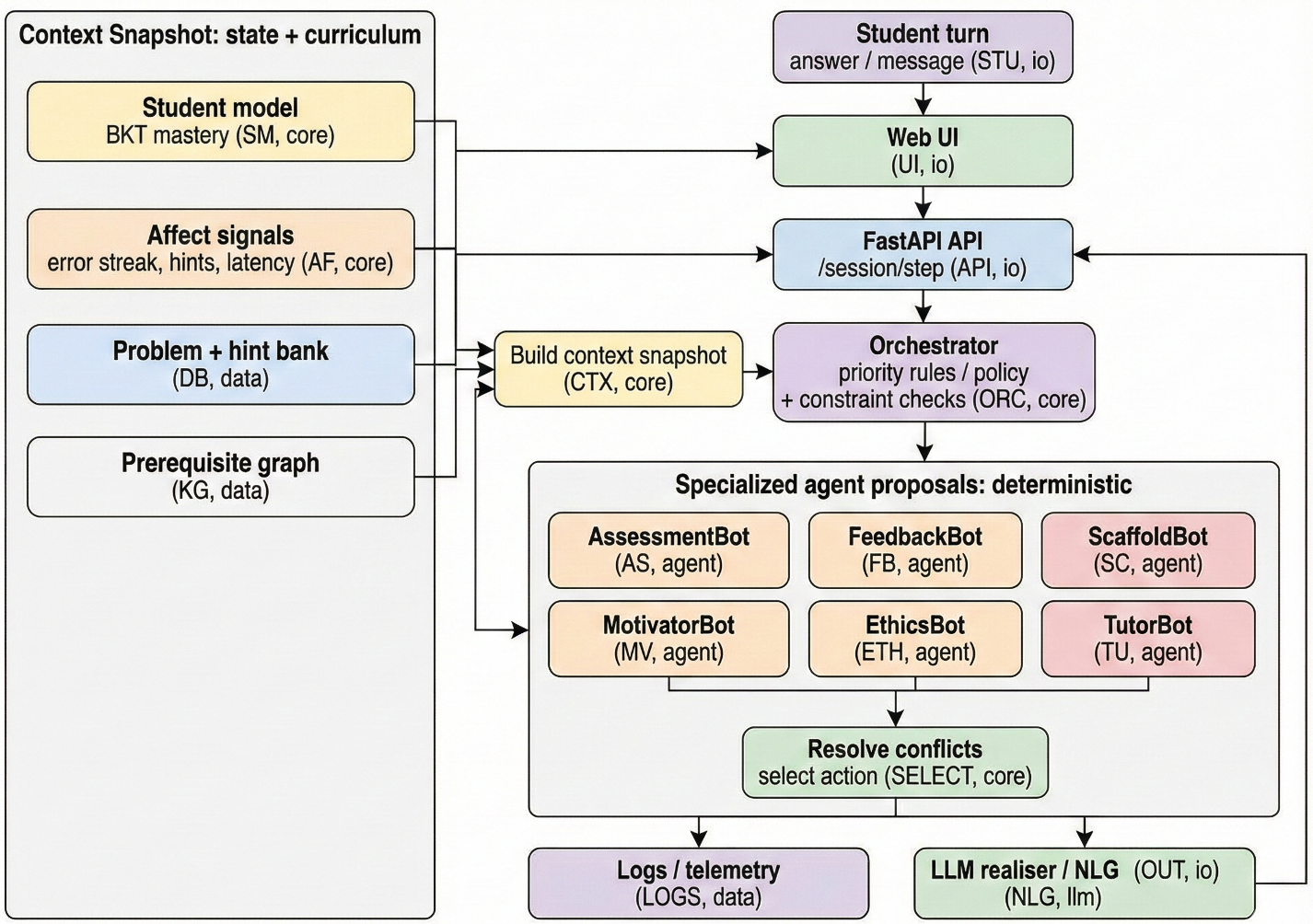
Instead of one LLM trying to do everything, the ES-LLMs architecture treats the tutor as a team of specialists coordinated by a strict manager.
1. The Triarchic Blueprint
The system is divided into three distinct layers:
- The Learner Model: Uses Bayesian Knowledge Tracing (BKT) to maintain a real-time probabilistic estimate of the student's mastery.
- The Pedagogical Agents: Specialized modules like
ScaffoldBot,MotivatorBot, andEthicsBotthat propose actions based on specific expertise. - The Meta-Orchestrator: A deterministic rule-engine that decides which agent gets to speak.
2. Subsumption Architecture
Borrowing from robotics, the orchestrator uses a priority hierarchy:
Safety (EthicsBot) > Assessment > Feedback > Scaffolding > Motivation.
If a student hasn't attempted the problem yet, the EthicsBot will "deny" a hint, overriding the ScaffoldBot even if it wants to help.
3. LLM as a "Renderer"
Crucially, the LLM is stateless. It doesn't decide to give a hint; it only decides how to phrase the hint that the orchestrator has already commanded. This decoupling prevents the "stochastic unfairness" where the model might randomly give an answer to one student but not another.
Experimental Results: Rigor Wins
The researchers conducted a massive Monte Carlo simulation (N=2,400) using synthetic students to stress-test the system.
- Constraint Adherence: ES-LLMs achieved 100% adherence to "attempt-before-hint" rules, whereas the baseline LLM failed nearly 40% of the time.
- Hint Efficiency: ES-LLMs increased hint efficiency by 3.3x, forcing "productive struggle" rather than passive answer-receiving.
- Operational Wins: By sending only specific "decision-relevant context" to the LLM instead of the entire chat history, the system reduced token usage by 54% and latency by 22%.
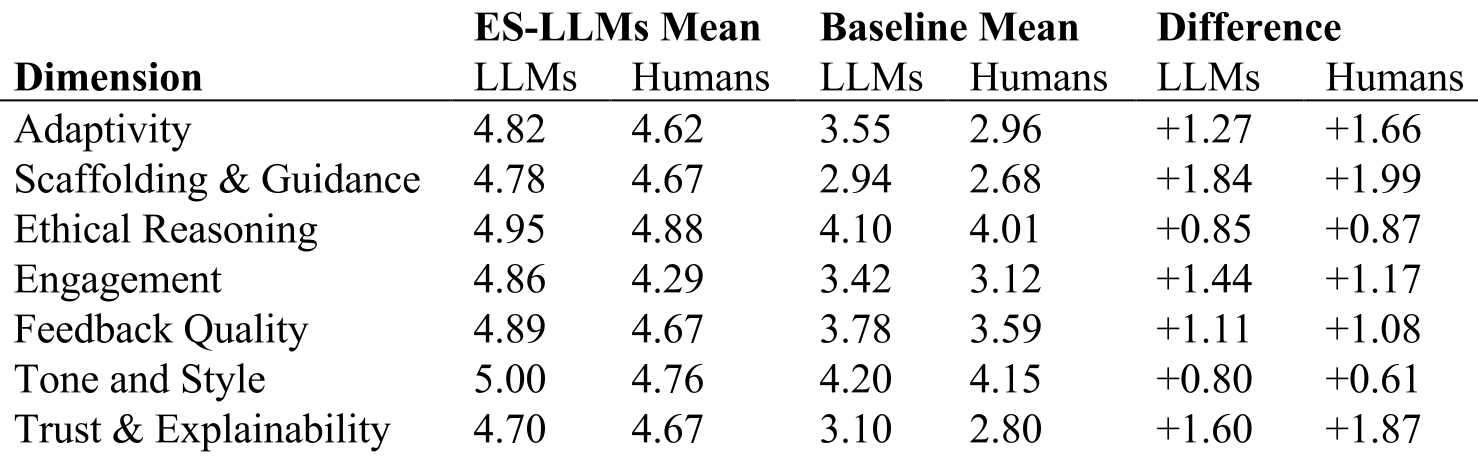
Human experts (N=6) and a panel of LLM-as-Judges (including GPT-5 and Gemini Pro) showed a staggering preference for the ES-LLMs approach, particularly in Scaffolding & Guidance and Trust & Explainability.
Critical Insight: The Policy-Generation Decoupling Paradigm
The success of ES-LLMs offers a blueprint for any high-stakes AI application (like healthcare or law). The lesson is clear: Decouple Policy from Generation.
When we allow an LLM to both decide the strategy and generate the text, we lose control. When we externalize the strategy into a deterministic layer, we get the best of both worlds: the reliability of code and the warmth of human-like conversation.
Future Outlook
While this study used synthetic students (a "Phase I" trial), the results pave the way for real-world deployments. The next step is a Mastery Gain study with human learners to see if the "productive struggle" enforced by ES-LLMs leads to better long-term retention.
By transforming the "untamed black box" into an interpretable orchestration, this work marks a significant step toward AI that doesn't just talk, but truly teaches.