
[ACL 2025] Verify Before You Commit: SAVER Framework Cracks the Code on Faithful LLM Reasoning
Verify Before You Commit: Towards Faithful Reasoning in LLM Agents via Self-Auditing
The paper introduces SAVER (Self-Audited Verified Reasoning), a framework designed to ensure reasoning faithfulness in LLM agents. It moves beyond consensus-based methods by implementing an adversarial self-auditing and minimal counterfactual repair mechanism, achieving SOTA results in minimizing logic violations across six benchmarks like HotpotQA and FEVER.
TL;DR
Large Language Model (LLM) agents are notorious for "hallucinating with confidence." While current methods try to fix this via "voting" (consensus), they often suffer from groupthink. SAVER (Self-Audited Verified Reasoning) introduces a rigorous, localized auditing loop that treats an agent's internal reasoning as a verifiable state. By identifying specific logical fractures and repairing them with minimal structural changes, SAVER slashes reasoning errors by over 60% without sacrificing performance.
The Problem: The "Illusion" of Coherent Reasoning
In agentic systems, reasoning trajectories (like Chain-of-Thought) aren't just for show—they are stored in memory and guide future actions. The researchers identified a critical flaw: an agent can arrive at the right answer through a logically "broken" path.
Traditional methods like Multi-Agent Debate (MAD) assume that if multiple agents agree, they must be right. However, models often share the same training biases, leading to "correlated failures." If an agent commits an unverified assumption to its memory, that error propagates, leading to systematic behavioral drift in long-horizon tasks.
Methodology: The SAVER Architecture
SAVER operates on the principle of "adversarial self-correction." Instead of rewriting the whole logic from scratch, it surgically fixes what is broken.
1. Diverse Belief Generation
To avoid correlated errors, SAVER uses different Personas (e.g., "evidentialist" vs. "minimalist") to generate a coalition of candidate beliefs. This forces the model to explore the problem space through different cognitive biases.
2. Structure-Aware Selection (k-DPP)
It's not enough to have many candidates; they must be differently flawed. SAVER uses a k-Determinantal Point Process (k-DPP) to select the most structurally diverse subset of beliefs for auditing, ensuring high coverage of potential failure modes.
3. Adversarial Auditing & Minimal Repair
This is the core innovation. The auditor localizes violations into categories like Circular Reasoning or Unjustified Inference.
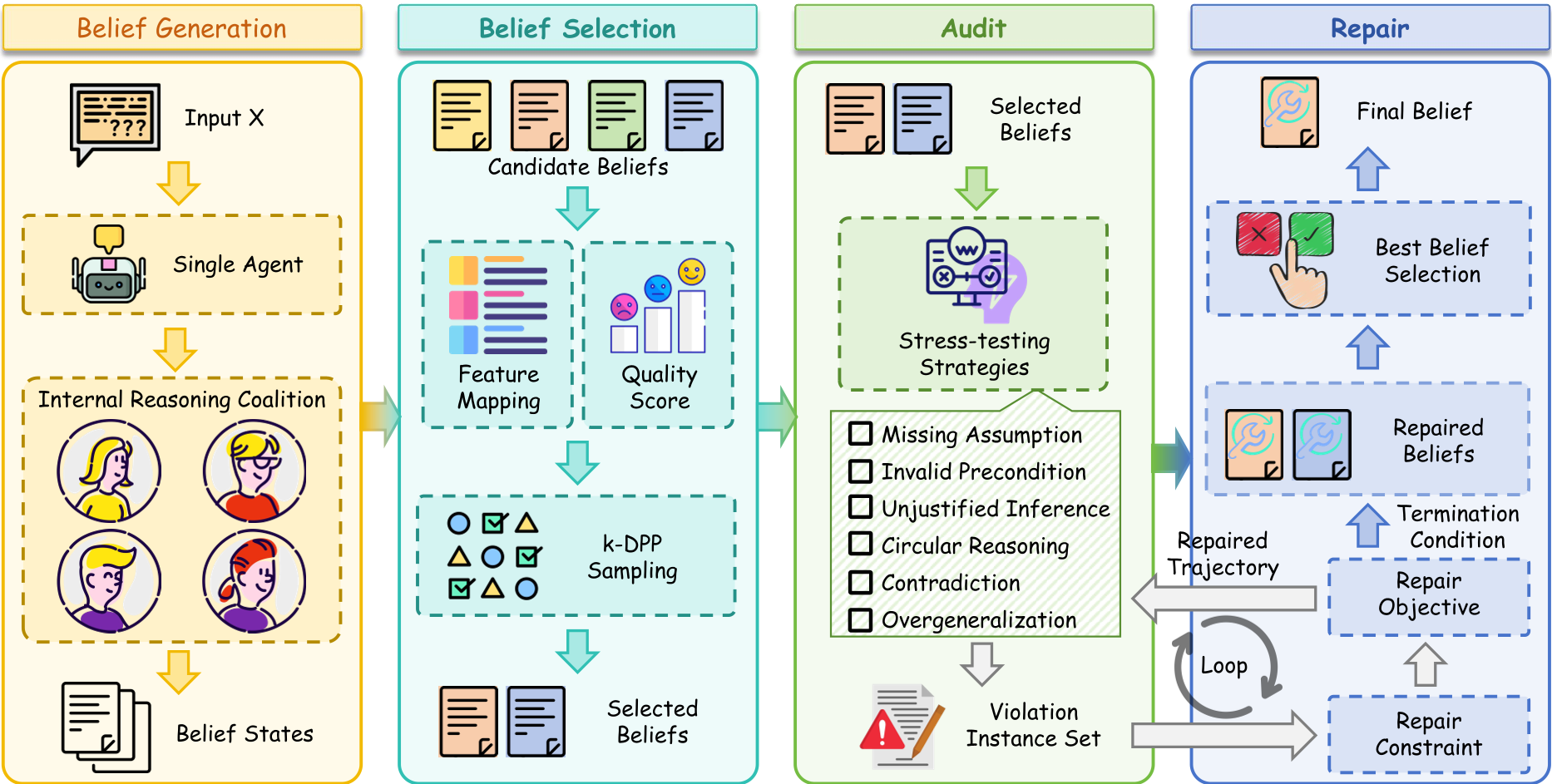 Figure 1: The closed-loop workflow of SAVER, from persona generation to iterative repair.
Instead of a total rewrite, SAVER uses Minimal Counterfactual Intervention. It solves a constrained optimization problem: fix the logic while staying as close to the original path as possible to maintain auditability.
Results: Faithfulness Beyond Accuracy
The researchers tested SAVER across six benchmarks, including multi-hop reasoning (HotpotQA) and fact verification (FEVER).
| Method | HotpotQA (USR ↓) | 2WikiMHQA (USR ↓) | VFR ↑ |
|---|---|---|---|
| CoT | 27.36% | 32.11% | 24.89% |
| MAD | 23.94% | 28.82% | 36.74% |
| SAVER | 9.12% | 13.84% | 81.36% |
As shown in the table, while CoT and Debate struggle with a high Unfaithful Step Rate (USR), SAVER brings it down to single digits. More impressively, the Violation-Free Rate (VFR) jumps to over 80%.
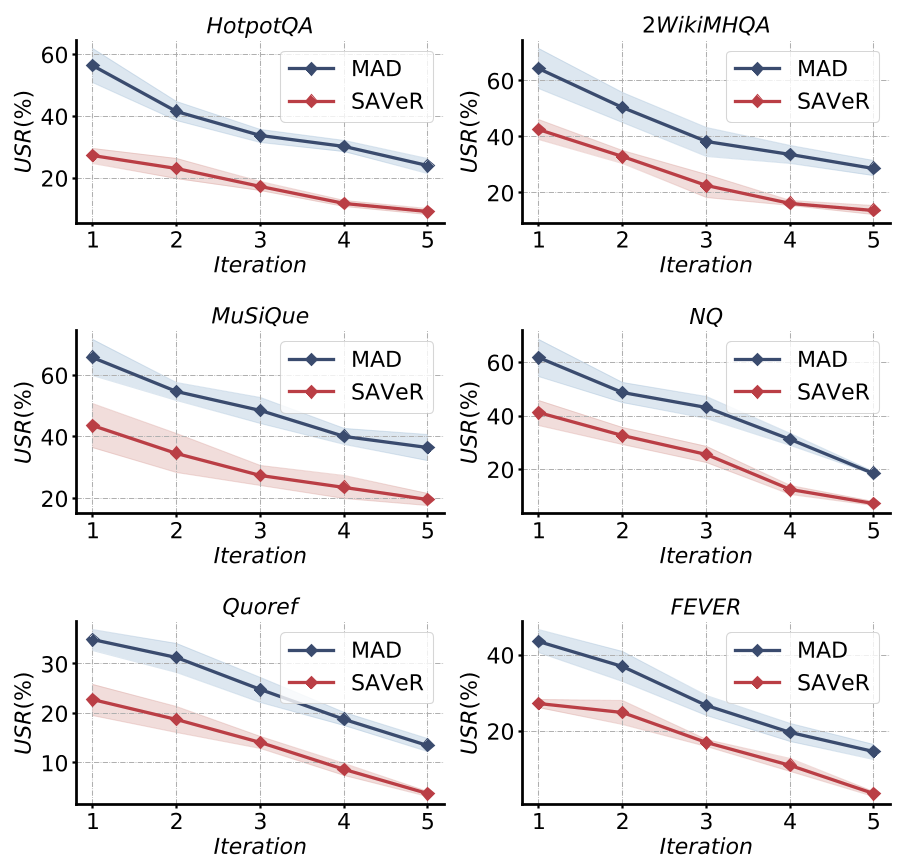 Figure 2: The Audit-Repair dynamics show that SAVER converges to a much lower unfaithfulness level faster than standard debate-based methods.
Deep Insight: Why "Minimal Repair" Matters
The "Minimal Repair" strategy is a masterstroke of Inductive Bias. If you ask an LLM to "fix the whole thing," it often introduces new hallucinations. By constraining the model to fix a localized slice identified by the auditor, SAVER preserves the parts of the reasoning that were already grounded, preventing "drift" during the correction process itself.
Conclusion & Future Outlook
SAVER proves that for LLM agents to be truly autonomous, they cannot rely on "vibes" or consensus. They need an internal legal system—an auditor that checks every inference against evidence before it’s committed to history.
Future Work: The current limitation is computational overhead. In the future, we might see "Adaptive Auditing," where the agent only invokes SAVER for high-stakes decisions or when internal uncertainty exceeds a certain threshold.
Takeaway: If you are building agentic systems, stop asking "Is the answer right?" and start asking "Is the path to the answer verifiable?"