
[CVPR 2025] DynaEdit: Mastering Action and Interaction in Video Editing Without Training
Versatile Editing of Video Content, Actions, and Dynamics without Training
DynaEdit is a training-free video editing framework that enables unconstrained manipulation of actions, dynamics, and object interactions using pretrained text-to-video (T2V/I2V) flow models. By leveraging an inversion-free approach with novel noise control mechanisms, it achieves state-of-the-art performance in non-rigid editing, rivaling proprietary trained models like Runway Aleph.
TL;DR
DynaEdit is a breakthrough in training-free video editing that allows users to modify not just the style, but the actual actions and physical dynamics of a video. By introducing specialized noise aggregation and correlation schedules, it enables "world-model" level edits—like making a cat jump or a train collide with a new object—using only off-the-shelf models like Wan2.1 or HunyuanVideo.
Background: The "Rigid" Reality of Video Editing
Until recently, video editing was largely "structure-preserving." You could turn a horse into a zebra (style transfer), but you couldn't easily make that horse jump over a fence if it was originally just walking. This is because non-rigid editing requires the model to deviate from the source's motion paths while somehow staying "loyal" to the background and identity.
Previous attempts faced a "Roadblock of Two Frequencies":
- Low-Frequency Misalignment: The video's camera or main subjects drift away from the original scene.
- High-Frequency Jitter: Frequent changes in noise across frames cause the video to look "fuzzy" or "vibrating."
Methodology: Steering the Flow
DynaEdit builds on the Inversion-Free paradigm. Instead of trying to "invert" a video back into noise (which is mathematically unstable), it constructs an ODE path directly from the source to the target.
1. Similarity Guided Aggregation (SGA)
To solve the drift problem, DynaEdit doesn't just pick one random direction. It samples multiple potential "edit velocities," projects them to see where they would lead (the "projected edit"), and calculates a cosine similarity to the original video. It then performs a softmax-weighted average (SGA) to ensure the model chooses a path that respects the original scene's layout.
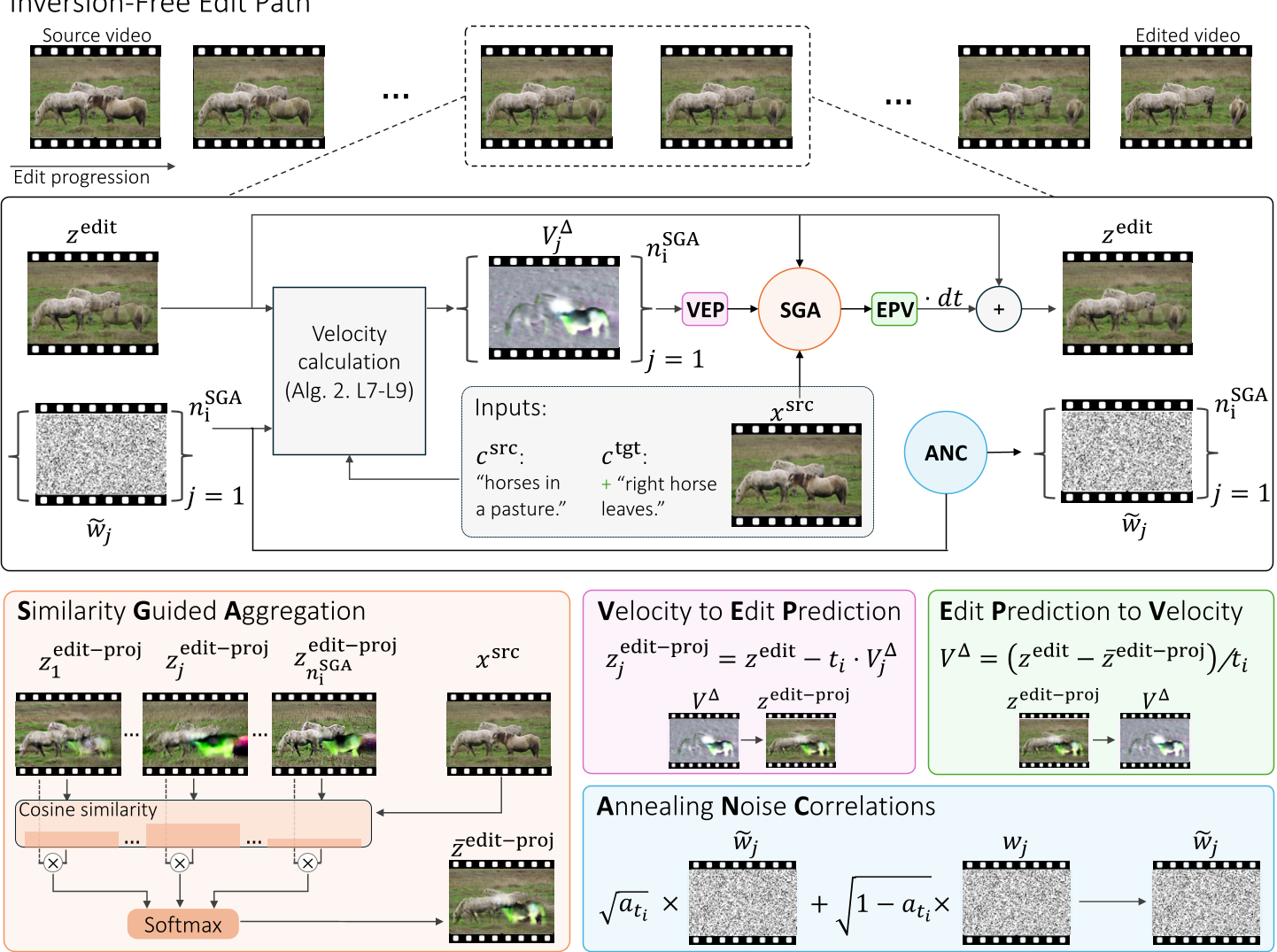 Figure: The DynaEdit pipeline featuring SGA for structural guidance.
2. Annealed Noise Correlation (ANC)
To stop the "jitter," the authors discovered that noise across timesteps needs to be correlated. However, if noise is too correlated early on, the model can't make big changes. ANC introduces noise correlations that start at zero (full freedom for big changes) and grow to 100% at the end (fixing high-frequency details).
Experiments: Surpassing the Giants
The authors tested DynaEdit on 71 complex scenarios, ranging from "Interactive Swap" (changing juice to a chemical reaction) to "Action Change" (making a bird dive).
Qualitative Edge
In the "Strawberry vs. Feather" test, most models fail to understand the physics of a feather. DynaEdit successfully makes the feather float on the water surface while keeping the other strawberry's physics untouched.
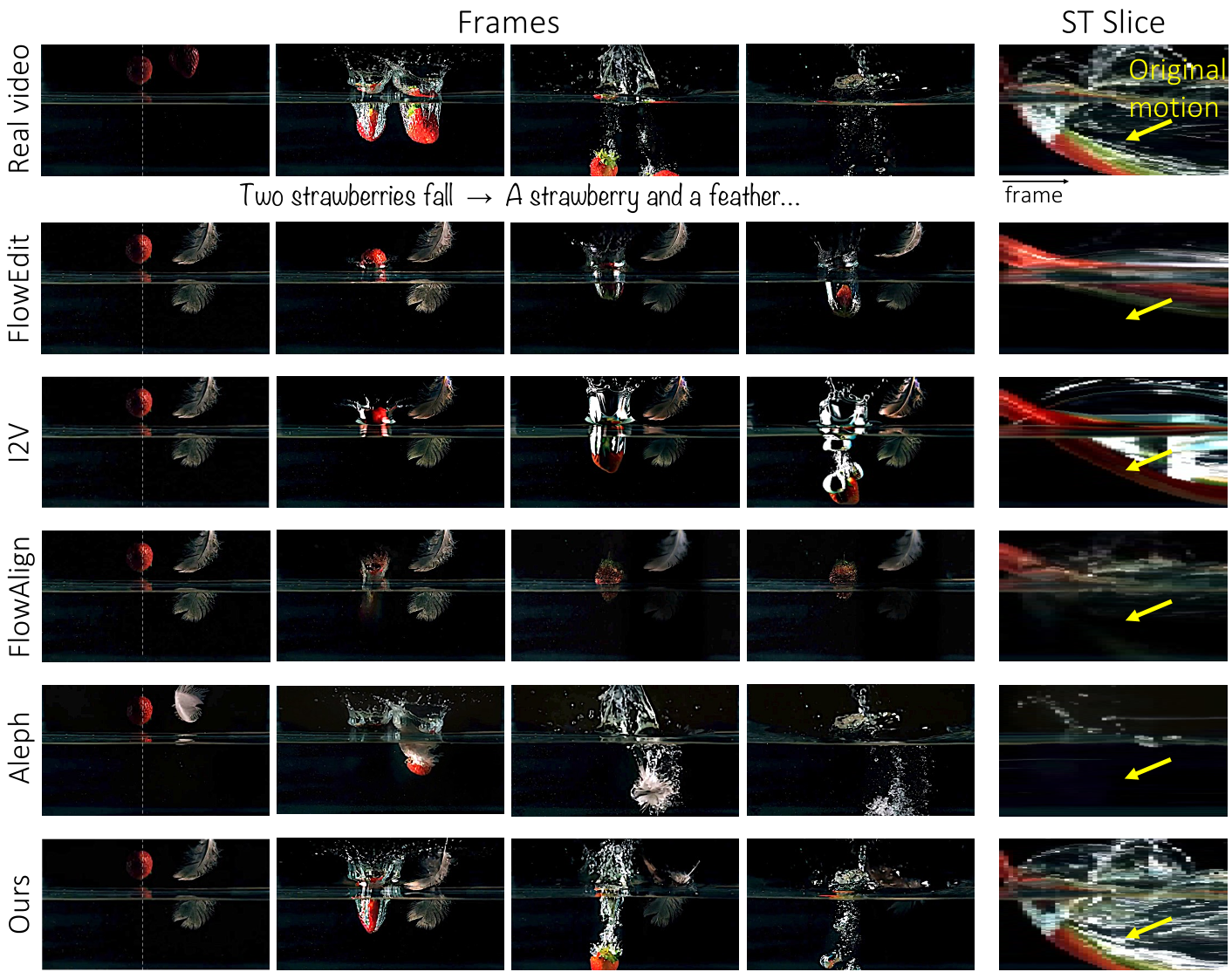 Figure: Quantitative comparison showing DynaEdit's superior balance between content preservation and prompt adherence.
Key Results:
- User Preference: Outperformed leading training-free methods and even reached/surpassed the proprietary Runway Aleph model in specific categories like "Interactive Insertion."
- Model Agnostic: Works seamlessly with different base models like Wan2.1 and HunyuanVideo.
Conclusion & Insights
DynaEdit proves that we don't necessarily need more "editing-specific" training data to achieve complex video manipulation. Instead, by carefully engineering how we traverse the latent space of existing "World Models," we can unlock sophisticated physical reasoning.
Limitations: The method is still bound by the "wisdom" of its base model. If the base model doesn't understand the physics of a specific action, DynaEdit cannot fix it. Furthermore, very large spatial changes still present a challenge for maintaining background perfect-fidelity.
For more details, check out the website mentioned in the paper for video comparisons that highlight the temporal smoothness of this approach.