
Video Active Perception: Boosting VLM Efficiency via the "Element of Surprise"
Video Active Perception: Effective Inference-Time Long-Form Video Understanding with Vision-Language Models
Video Active Perception (VAP) is a training-free framework designed to enhance long-form Video Question Answering (Video QA) by selectively identifying informative frames. By leveraging a lightweight video diffusion model to predict video dynamics and comparing them to real footage, VAP achieves SOTA zero-shot results on benchmarks like EgoSchema and NExT-QA while using up to 5.6x fewer frames than standard uniform sampling.
TL;DR
Researchers from CMU and MIT have introduced Video Active Perception (VAP), a training-free method that allows Large Vision-Language Models (VLMs) to "see" better by looking at less. By using a lightweight generative model to predict what should happen in a video, VAP identifies frames that are "surprising" or informative, leading to SOTA results on long-form video QA with a 5.6x reduction in frame overhead.
The Bottleneck: The Paradox of Choice in Video Sampling
Processing long-form video is a computational nightmare for modern VLMs. If you sample at 1 frame per second (fps), a one-hour video generates millions of tokens—well beyond the practical context window or budget of most APIs. Conversely, sparse uniform sampling often misses the "smoking gun" frame—the exact moment a collision occurs or a specific object is picked up.
The core insight of VAP is rooted in Active Perception Theory: an intelligent agent shouldn't just passively consume data; it should actively seek data that challenges its current understanding of the world.
Methodology: Surprising is Informative
VAP operates in three distinct phases:
- A Priori Knowledge Generation: Using a few initial frames and the question as context, VAP employs a lightweight Video Diffusion Model (CogVideoX) to generate the "expected" video dynamics in a latent space.
- Data Acquisition (The Selection Step): It encodes all real video frames into the same latent space. Then, it compares the real frames to the generated expectations. The frames with the lowest cosine similarity (the most "surprising" ones) are designated as keyframes.
- VLM Inference: These selected frames are fed into a flagship VLM (like GPT-4o or Gemini 1.5 Pro) to generate the final answer.
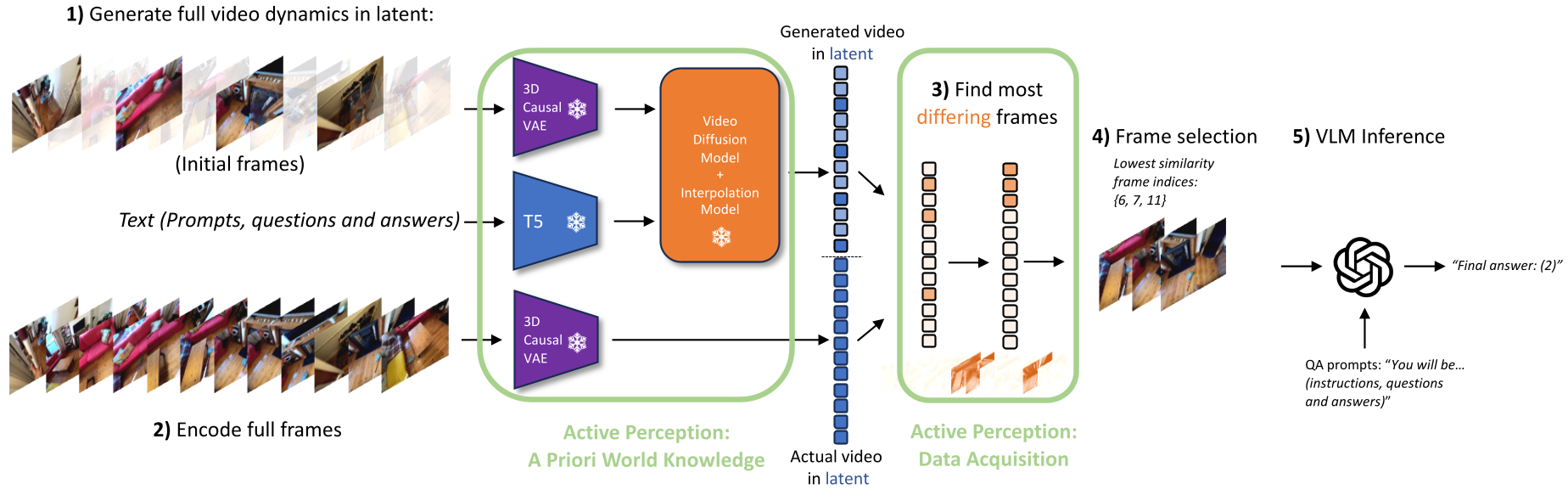 Figure: The VAP workflow. By comparing generated vs. real dynamics, the model picks the most informative frames.
Experiments: More with Less
VAP was tested against heavyweights like GPT-4o, Gemini 1.5 Pro, and LLaVA-OV across five major benchmarks (EgoSchema, NExT-QA, ActivityNet-QA, IntentQA, and CLEVRER).
Key Breakthroughs:
- Superior Efficiency: On EgoSchema, VAP with 32 frames outperformed standard GPT-4o using 180 frames.
- Reasoning Power: In the CLEVRER dataset (tasks involving causal and counterfactual reasoning), VAP showed massive gains, specifically in "Explanatory" and "Counterfactual" questions, because it successfully captured fast-moving "transition" moments that uniform sampling traditionally skips.
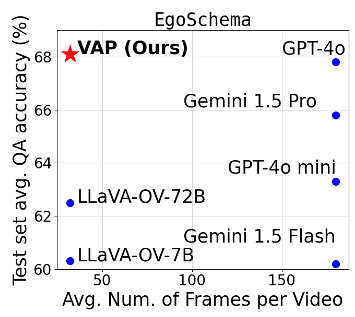 Figure: VAP demonstrates a clear advantage in accuracy vs. frame count compared to standard uniform sampling.
Why it Works: The Physics of "Surprise"
In the causal reasoning task of CLEVRER, an initial state might show two balls moving toward each other. A generative prior will predict they collide and bounce. If the real video shows a sudden change in trajectory (perhaps due to an invisible obstacle or a complex collision), the similarity between the "imagined" frame and the "real" frame drops. This drop signals to VAP that this specific frame is critical for understanding the scene's logic.
Critical Analysis & Future Outlook
Takeaway: VAP proves that generative models aren't just for making pretty pictures; they can act as "world models" that help other AI agents prioritize their attention.
Limitations: The current method relies on the quality of the latent space of the generative model (CogVideoX). If the prior is too poor, the "surprise" metrics might become noisy. Additionally, while it saves VLM tokens, it introduces a pre-processing step involving a diffusion model, though the authors note this is still faster than multi-round agentic reasoning.
Future Work: We can expect this technique to be integrated into autonomous systems (like drones or self-driving cars) where an agent must constantly decide which visual "events" are worth the energy of deep processing.
Performance Summary Table
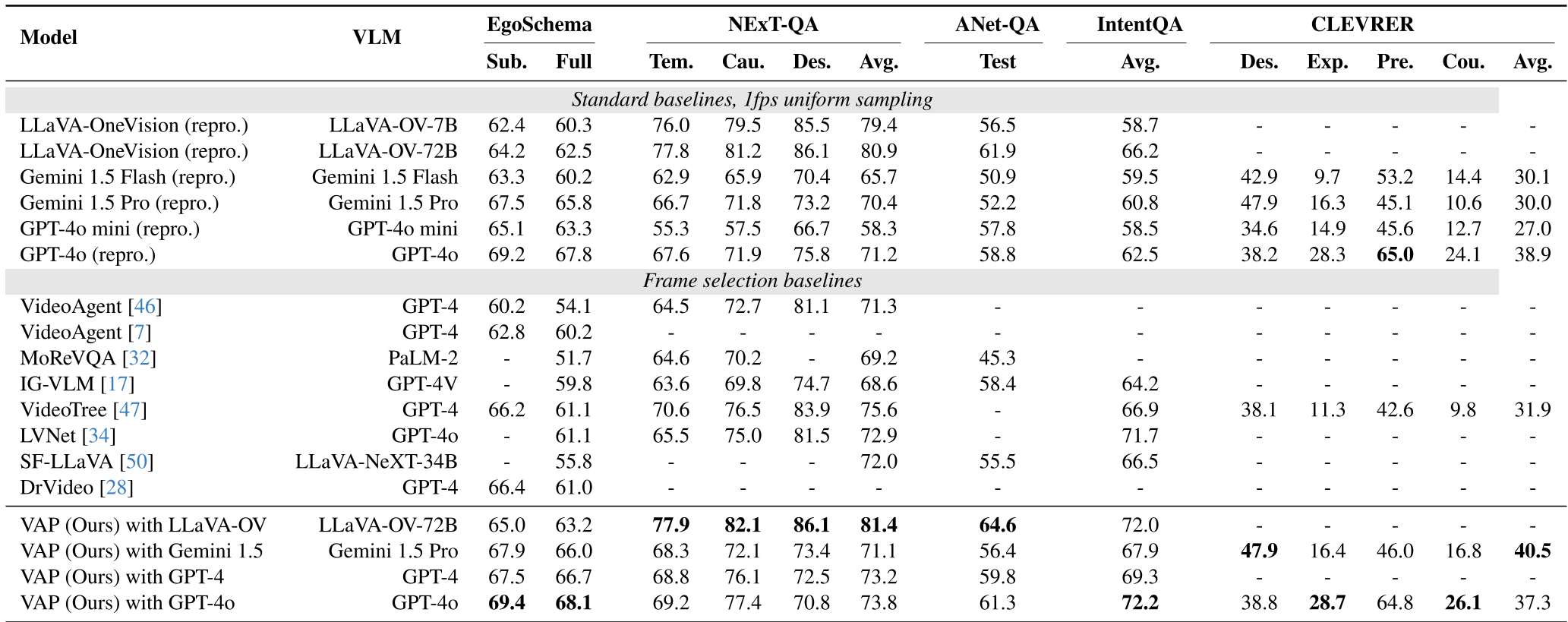 Table: VAP consistently outperforms both standard baselines and complex agent-based frame selection methods.