
PV-VAE: Strengthening Video Generation through Predictive World Modeling
Video Generation with Predictive Latents
PV-VAE (Predictive Video VAE) is a novel video tokenizer that integrates predictive world modeling into latent generative frameworks. By unifying video reconstruction with a predictive learning objective, it achieves state-of-the-art video generation quality, notably outperforming the Wan2.2 VAE with a 34.42 FVD improvement on UCF101.
TL;DR
Researchers from ByteDance, PKU, and Tsinghua have introduced Predictive Video VAE (PV-VAE), a breakthrough in video tokenization. Unlike standard VAEs that merely compress pixels, PV-VAE learns to predict the future. By training the model to reconstruct full videos from partial observations, it creates a latent space rich in motion priors. The result? Faster training convergence, 34+ FVD improvement over SOTA baselines (Wan2.2), and superior motion consistency in generated content.
The Motivation: Why Reconstruction is Not Enough
In the world of Latent Diffusion Models (LDMs), the VAE acts as the "bridge" between raw pixels and the generative space. Traditionally, we judge a VAE by how well it reconstructs an image or video.
However, the authors point out a critical gap: High-fidelity reconstruction does not guarantee high-quality generation. For videos, a latent space must do more than store colors and shapes; it must understand dynamics. If a latent space treats a video as a stack of independent images, the diffusion model will struggle to learn the "physics" of motion, leading to flickering and warping. PV-VAE bridges this by treating the VAE as a mini World Model.
Methodology: Learning to See the Unseen
The core innovation is the Predictive Reconstruction Objective. Instead of the standard pipeline, PV-VAE introduces a temporal challenge:
- Temporal Masking: A video clip is split into "observed" and "future" frames.
- Partial Encoding: Only the observed frames are passed through the encoder.
- Latent Padding: The missing temporal slots in the latent space are filled with learnable tokens or Gaussian noise.
- Predictive Decoding: The decoder must use the "past" latents to reconstruct the entire sequence, effectively forcing the encoder to compress "predictive" features that hint at what happens next.
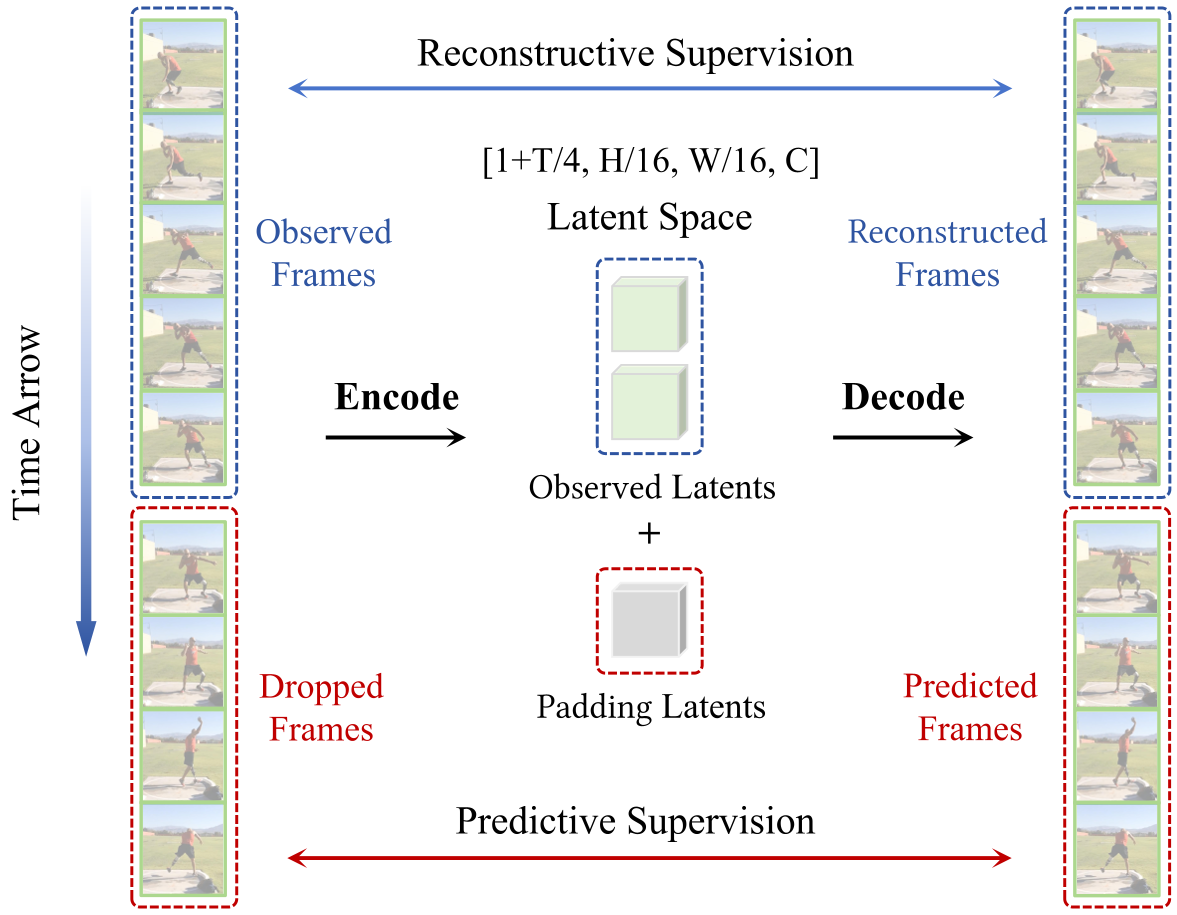
To ensure the model doesn't just "cheat" by copying static backgrounds, a Motion-aware Objective is added. This requires the model to reconstruct the difference between frames, highlighting the importance of moving objects.
Experiments: Faster, Cheaper, Better
The results across benchmarks like UCF101 and Kinetics-400 are striking.
1. Generative Superiority
PV-VAE achieves a significantly lower FVD (Frechet Video Distance) compared to industry heavyweights like CogVideoX and Wan2.2.
- UCF101: 146.37 FVD (vs. 180.79 for Wan2.2).
- Efficiency: Despite having more parameters, the architecture is designed for speed, showing a 2.68x training speedup over Hunyuan-VAE.
2. Latent Diagnostics
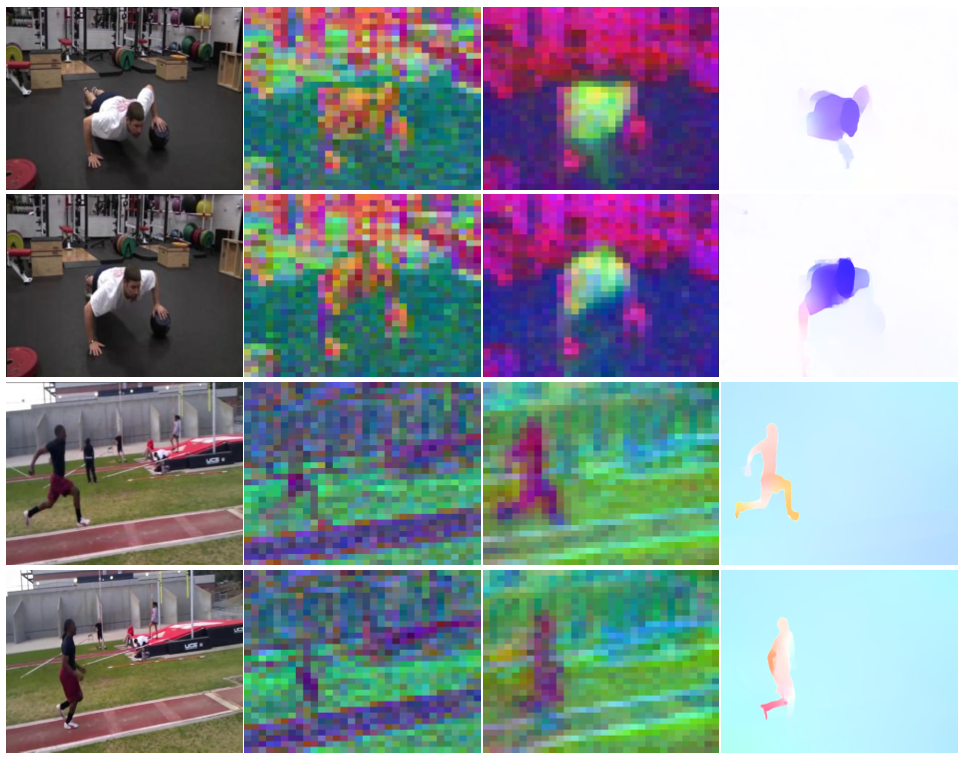
The authors used PCA (Principal Component Analysis) to visualize the latent channels. As seen below, PV-VAE’s latent activations (center) align almost perfectly with the ground-truth Optical Flow (right). This proves the latent space "understands" which parts of the scene are moving.
3. Downstream Understanding
Because the latent space captures dynamics, it excels at non-generative tasks too. Specifically, features from PV-VAE showed marked improvements in point tracking and optical flow estimation, reinforcing its value as a general-purpose video representation learner.
Conclusion and Future Outlook
PV-VAE marks a shift in how we design tokenizers for generative media. It suggests that the best way to generate the world is to first learn to predict it.
Key Takeaways:
- Predictive Learning is a "Free Lunch": It improves generation without needing more labels or complex losses.
- Transformer VAEs are Coming: While CNNs dominate now, the authors' exploration of a 1.2B Transformer-based VAE suggests significant inference speed benefits for long-form video in the future.
By moving beyond simple "pixel-to-pixel" matching, PV-VAE sets a new standard for temporally coherent and physically plausible video generation.