
[CVPR 2026] VideoAtlas: Navigating 10-Hour Videos with Logarithmic Compute
VideoAtlas: Navigating Long-Form Video in Logarithmic Compute
VideoAtlas is a task-agnostic, hierarchical grid environment that represents video as a navigable, lossless MDP, enabling Recursive Language Models (Video-RLM) to process long-form content. Using a Master-Worker architecture, it achieves SOTA-level performance on 1-10 hour videos (e.g., 70.1% on LVB-10hr) with logarithmic compute scaling.
TL;DR
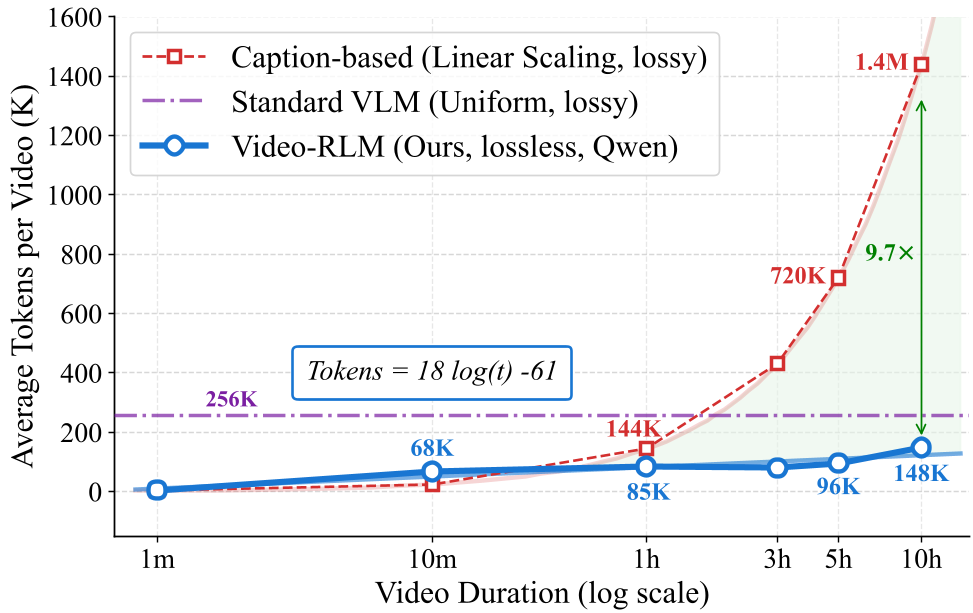
VideoAtlas transforms long-form video understanding from a "big data" problem into a "navigation" problem. By representing video as a hierarchical, navigable grid (VideoAtlas) and deploying a Master-Worker agent (Video-RLM), researchers have enabled LLMs to "zoom in" on relevant frames with surgical precision. The result? Logarithmic compute scaling—enabling 10-hour video analysis with 9.7x fewer tokens and significantly higher accuracy than traditional uniform sampling.
The "Coverage-vs-Fidelity" Trap
Until now, Long-Form Video Understanding (LFVU) was stuck in a zero-sum game. If you want to process an hour of video (90,000 frames) within a 128k context window, you have two bad choices:
- Uniform Sampling: Sample frames every 60 seconds. You keep the resolution but miss every short event (like a goal in a match).
- Compression/Captioning: Convert video to text. You get the whole timeline, but you lose the "visual truth." If the caption stays "a man is talking," you'll never know the color of his tie or the text on his slide.
The authors argue that a representation must be lossless, navigable, and scalable. VideoAtlas achieves this by treating the video as a Markov Decision Process (MDP) environment rather than a static file.
Methodology: The Hierarchical Grid & Video-RLM
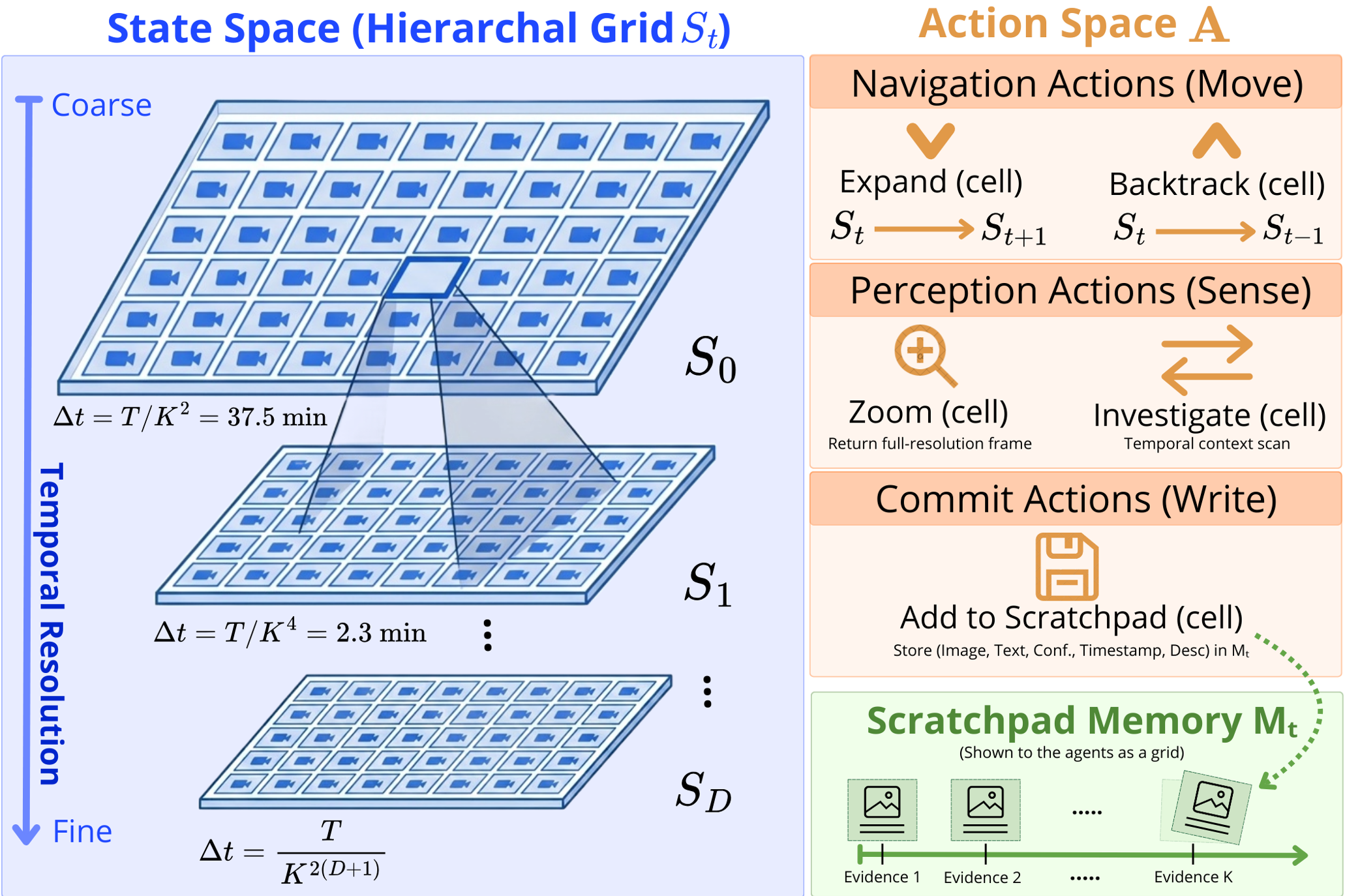
The core innovation is the Hierarchical Grid. Imagine a "Contact Sheet" of the whole video. If a cell looks interesting, the agent performs an EXPAND action, which generates a new grid specifically for that small temporal slice.
1. The VideoAtlas Environment
The environment provides a structured state space where temporal resolution increases geometrically with depth.
- Root Grid (): Overview of the entire duration.
- Action Space: Includes
EXPAND(drill down),ZOOM(high-res look), andADD_TO_SCRATCHPAD(commit evidence). - Lossless Visual Scratchpad: Instead of text summaries, the agent stores actual image patches, preserving visual fidelity for the final decision.
2. Video-RLM: The Master-Worker Engine
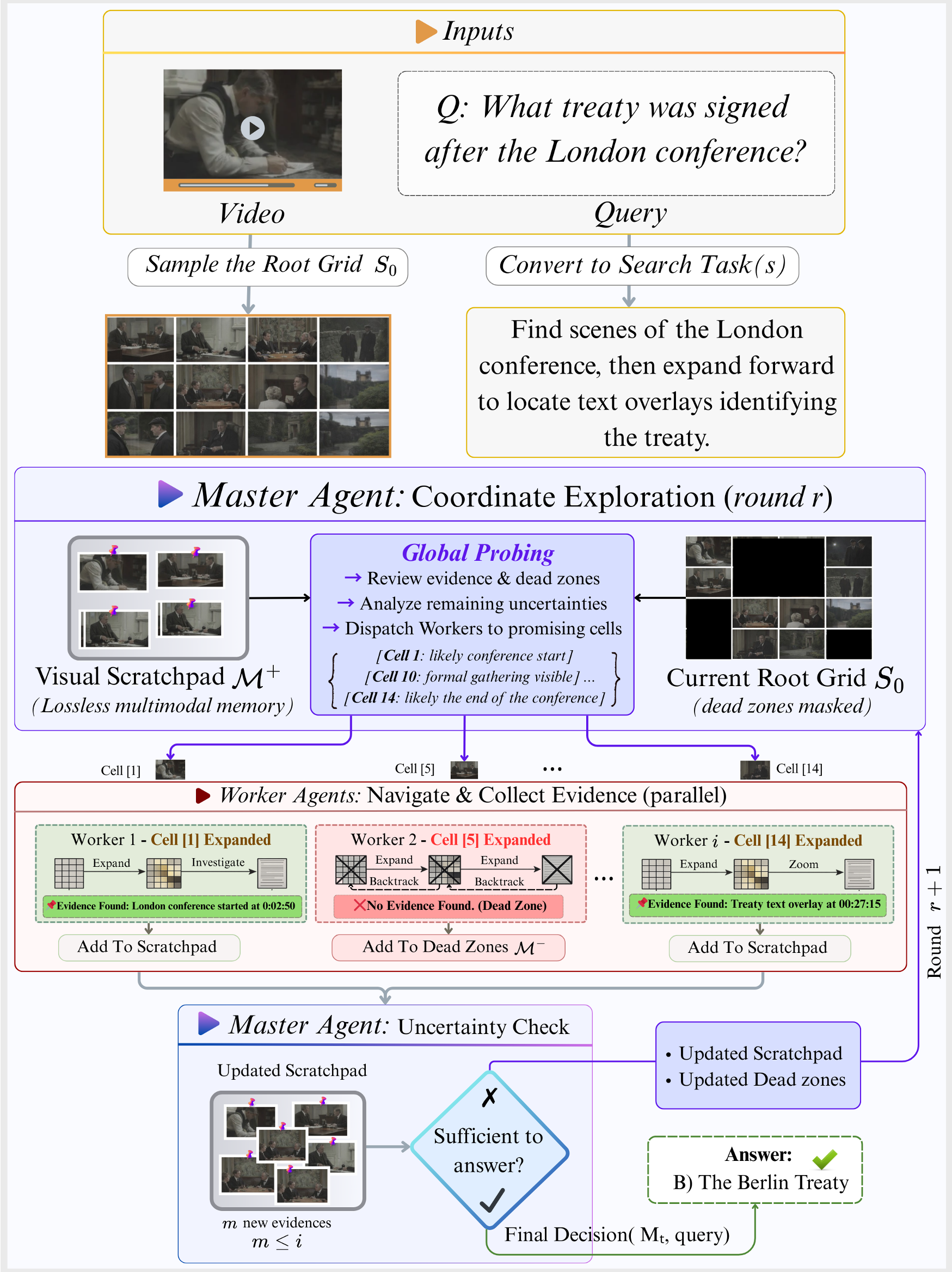
To navigate this "Atlas" efficiently, the authors introduce a Master-Worker architecture:
- The Master: Acts as the strategist. It analyzes the root grid, masks "dead zones" (already explored areas), and assigns specific cells to workers.
- The Workers: Run in parallel. They are autonomous agents that drill into assigned regions to extract evidence.
- Recursive Reasoning: Like Recursive Language Models (RLMs) for text, Video-RLM uses sub-agents to handle long contexts without overwhelming the main model's window.
Experimental Breakthroughs: Scaling to 10 Hours
The most striking result is how Video-RLM handles duration. While uniform sampling models fall off a cliff as videos get longer (due to sampling sparsity), Video-RLM stays nearly flat in accuracy.
- Performance on Video-MME (10h): Video-RLM maintained 49.7% accuracy, whereas uniform sampling dropped to 50.6% from a much higher baseline, and captioning methods collapsed to 36% due to context window limits.
- Logarithmic Scaling: Compute cost grows at . To find a "needle in a haystack" in a 10-hour video, you only need one or two more levels of depth than a 1-hour video.
- Cache Efficiency: Because the grid structure is repetitive, the system achieved a 30-60% Multimodal Cache hit rate using vLLM, drastically reducing GPU load.
Critical Analysis & Insights
Why does it work? The "Environment Budgeting" is the secret sauce. By bounding the maximum exploration depth (), you can set a hard limit on temporal resolution (e.g., "I want sub-second precision"). This makes compute a tunable hyperparameter—a level of control missing from "black box" VLMs.
Limitations:
The system is still limited by the backbone VLM's perception. If the model misinterprets a frame at , it might never EXPAND into the correct cell. However, the authors show that swapping Qwen-3.5 for a stronger backbone (Gemini-3-Flash) immediately boosts accuracy to 72%+, proving the structure is sound and will only get better as base models improve.
Conclusion: A New Era of Visual Navigation
VideoAtlas proves that "more context" shouldn't mean "more tokens." By treating video as a navigable space, we can achieve far better understanding with a fraction of the compute. This MDP-based approach opens the door for Reinforcement Learning (PPO/DQN) to eventually learn the most efficient "search policies" for video, potentially outperforming human-designed Master-Worker logic.