
VISD: Accelerating Video Reasoning via Structured Self-Distillation
VISD: Enhancing Video Reasoning via Structured Self-Distillation
This paper introduces VISD, a structured self-distillation framework designed to enhance Video Large Language Models (VideoLLMs) for complex temporal and spatial reasoning. By utilizing a video-aware judge model to provide multi-dimensional diagnostic feedback and a direction-magnitude decoupling mechanism, VISD achieves a nearly 2x acceleration in convergence while reaching new SOTA performance on grounded video reasoning benchmarks like V-STAR and Video-MME-v2.
TL;DR
In the quest to make VideoLLMs "think" more accurately about dynamic scenes, VISD (Video Structured Self-Distillation) emerges as a powerful framework that solves the "sparse reward" problem. By using a specialized judge to diagnose why a model failed (e.g., "you looked at the wrong time window" vs. "you identified the wrong object") and using that diagnosis to modulate token-level training, VISD achieves SOTA reasoning performance while converging 2x faster than traditional Reinforcement Learning (RL) methods.
The Bottleneck: Why Video Reasoning is Hard for RL
Traditional Reinforcement Learning with Verifiable Rewards (RLVR) is great for math but struggles with video. In math, your answer is either right or wrong. In video, a model might get the right answer for the wrong reason—perhaps it guessed correctly but hallucinated the temporal segment where the action happened.
Current methods suffer from two main issues:
- Sparse Credit Assignment: A single scalar reward at the end of a long video reasoning chain doesn't tell the model which specific token or "thought" was the weak link.
- Unstructured Supervision: Existing self-distillation methods treat teacher signals as a "black box," failing to distinguish between spatial, temporal, and logical errors.
Methodology: Structured Diagnosis & Decoupled Optimization
VISD introduces a Video-Aware Judge that acts like a senior editor. Instead of just saying "Correct" or "Incorrect," the judge provides Structured Privileged Information.
1. The Structured Judge
The judge evaluates rollouts across three distinct dimensions:
- Answer Correctness: Is the final output right?
- Logical Consistency: Does the "thought" process actually lead to the answer?
- Spatio-Temporal Grounding: Did the model look at the right frames and the right bounding boxes?
2. Direction-Magnitude Decoupling
This is the mathematical heart of VISD. To keep training stable, the authors separate the "Direction" (should we do more of this?) from the "Magnitude" (how much should we change this specific word?).
- Direction: Determined by the global RL advantage (Rollout-level).
- Magnitude: Modulated by the Teacher-Student discrepancy, which is conditioned on the judge's structured feedback.
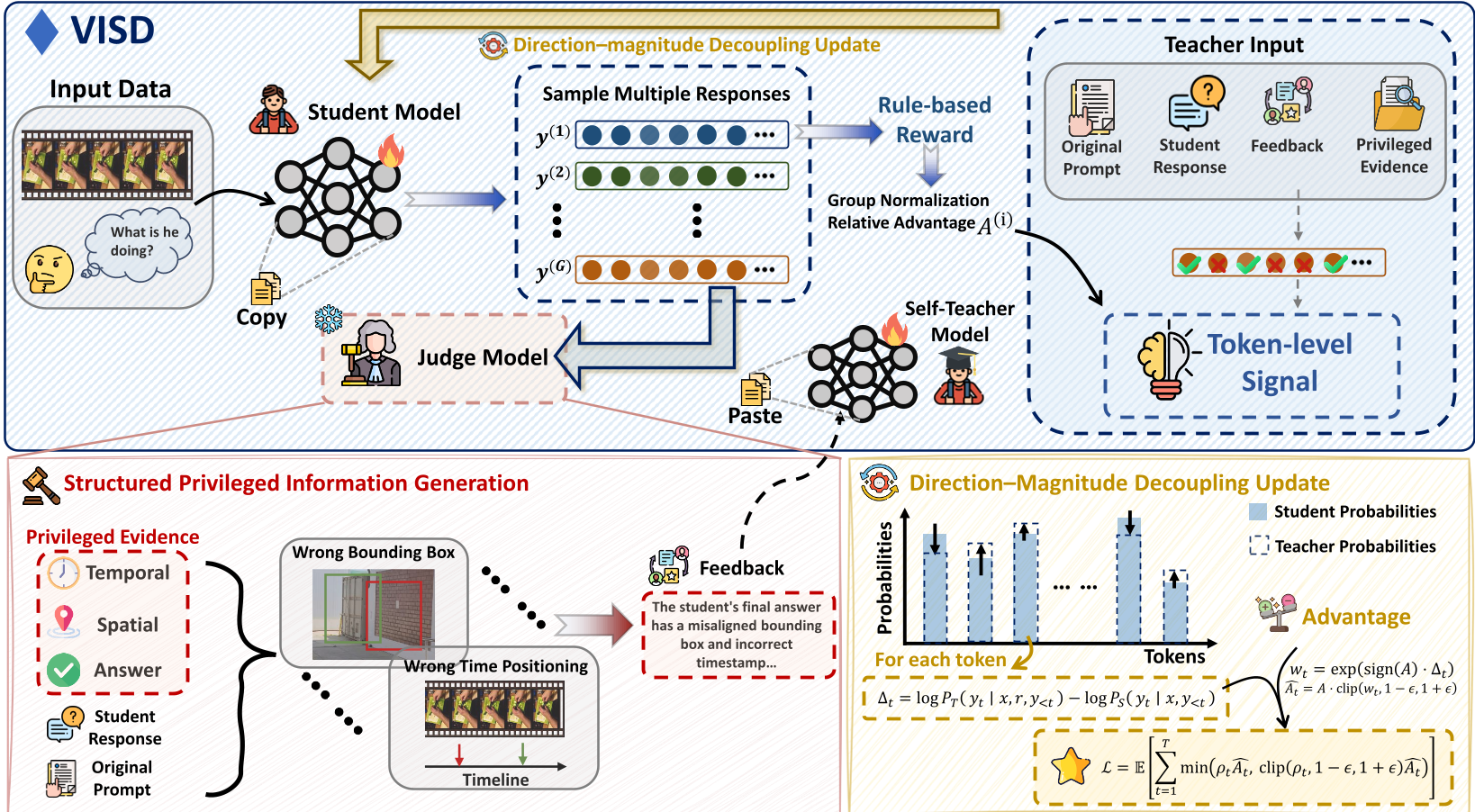 Figure: The VISD framework. The judge generates feedback, the teacher replays the sequence, and the magnitudes are adjusted token-by-token.
Experiments: Speed and Accuracy
The results on the Open-o3-Video and Video-MME-v2 benchmarks are definitive. VISD doesn't just improve accuracy; it improves the faithfulness of the reasoning.
Key Performance Gains:
- V-STAR Benchmark: VISD improved answer accuracy by +28.4 points over the Qwen2.5-VL-7B baseline.
- Efficiency: While baseline models like VisionCoach required over 2300 optimization steps, VISD reached higher performance in only 1200 steps.
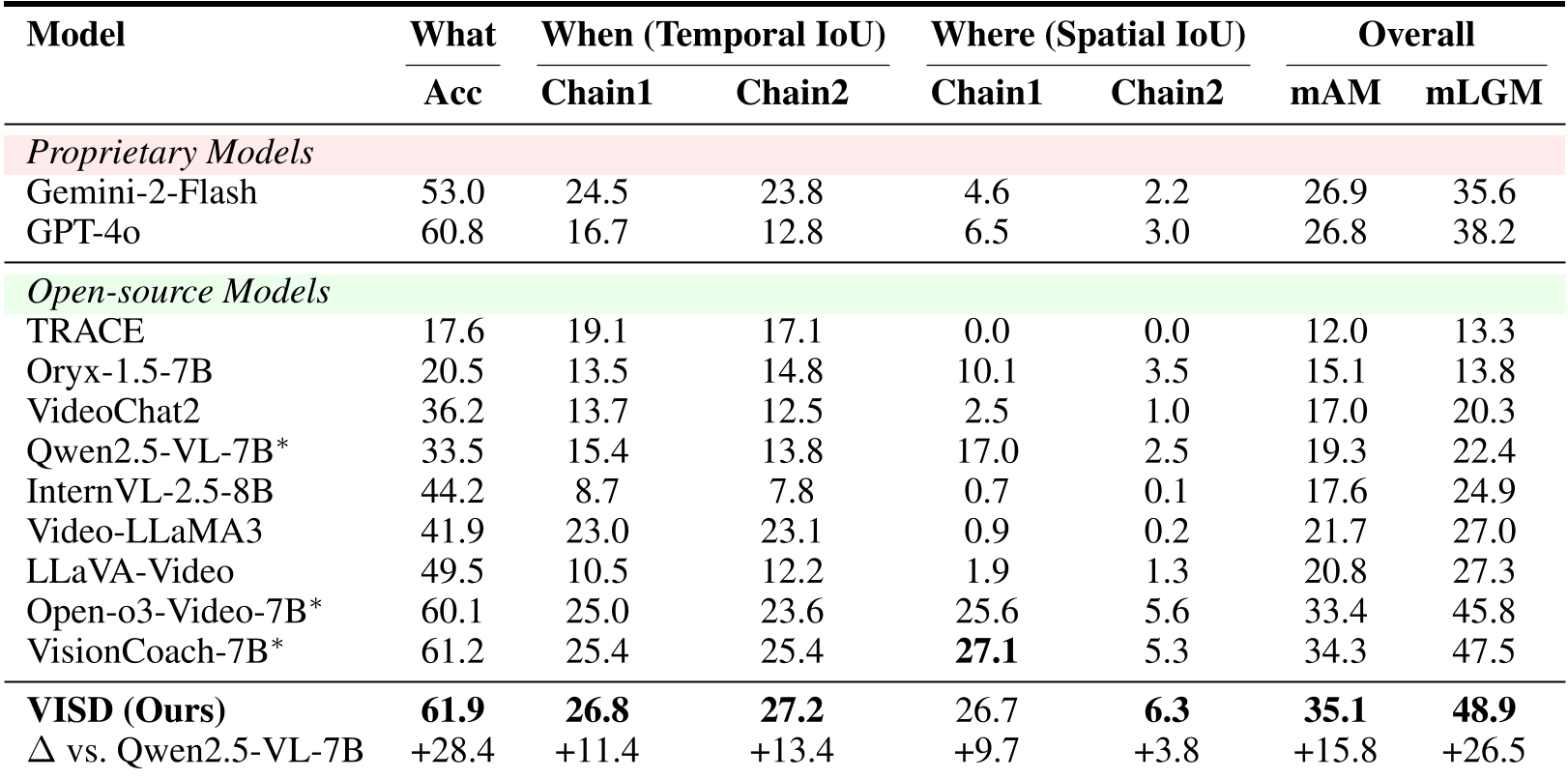 Table: Comparison across proprietary and open-source models on V-STAR.
Visual Evidence
Qualitative cases show that VISD is much better at "temporal localization." For instance, when asked when a person looks out a window, VISD accurately captures the exact start and end timestamps, where other models often "drift" or focus on irrelevant movements.
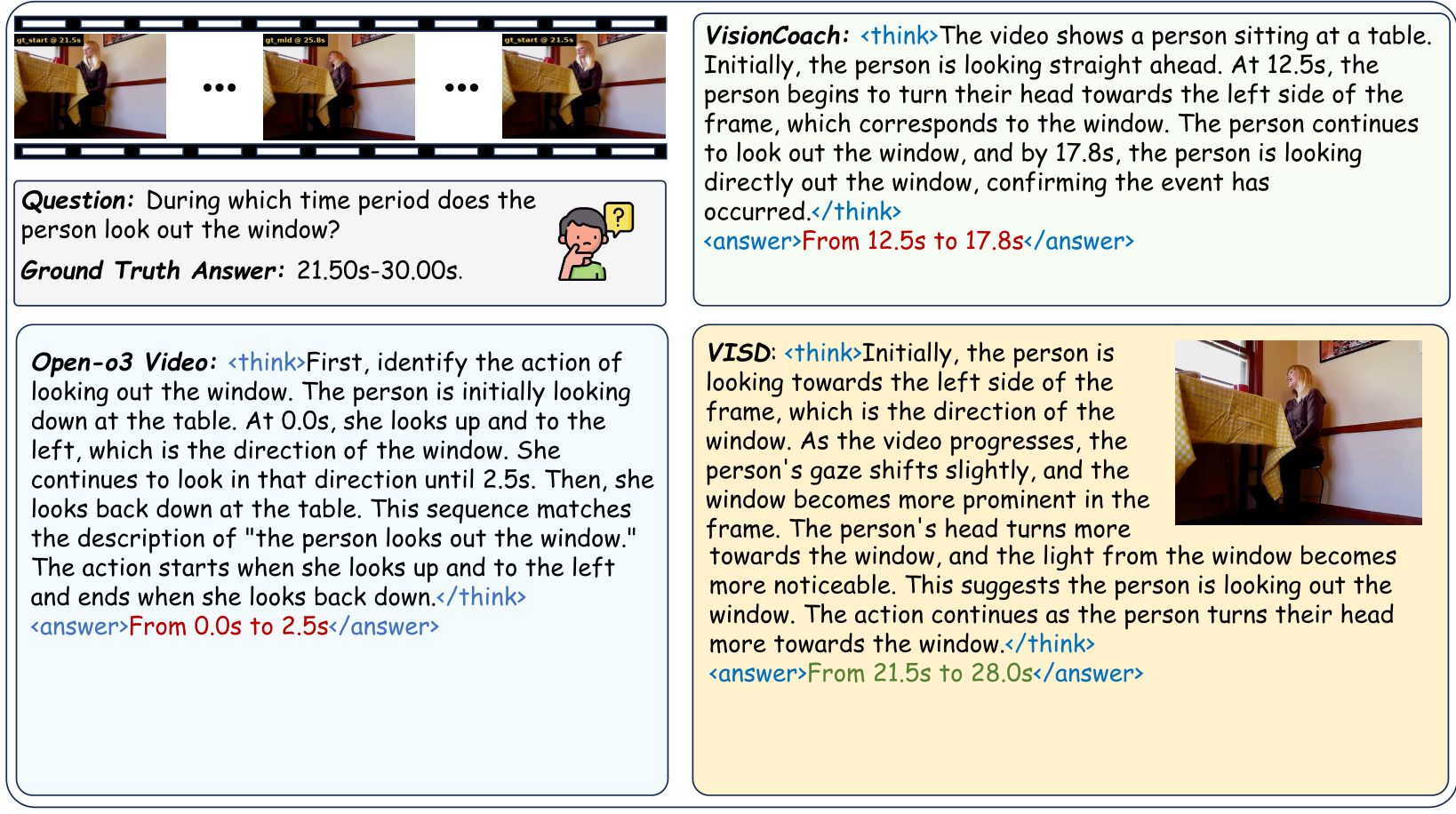 Figure: VISD vs. Baselines on temporal localization. VISD's reasoning (green) matches the ground truth more closely thanks to structured feedback.
Critical Analysis & Future Outlook
The "Takeaway" from VISD is clear: Semantics matter in optimization. By making the feedback "diagnostic" rather than "numerical," we bridge the gap between high-level reasoning and low-level token prediction.
Limitations: The framework currently relies on a powerful external LLM (like GPT-4o or "GPT-5.4" mentioned in the appendix) to act as the judge during training. This adds a computational overhead during the training phase, though it has zero impact on inference speed.
Future Work: We can expect this "Structured Distillation" approach to migrate into other complex domains, such as Robotic Path Planning or Multi-modal Agentic Workflows, where identifying the type of error is just as important as knowing an error occurred.
Conclusion
VISD proves that we can train smarter, not just longer. By decoupling the "what" from the "how much" and providing structured diagnostic feedback, it sets a new standard for efficient VideoLLM alignment.