
[WACV 2025] VISER: Boosting Iris PAD Robustness via Denoised Human Eye-Gaze Saliency
VISER: Visually-Informed System for Enhanced Robustness in Open-Set Iris Presentation Attack Detection
The paper introduces VISER, a Visually-Informed System for Enhanced Robustness in open-set iris Presentation Attack Detection (PAD). It employs saliency-guided training using denoised human eye-tracking data to guide a DenseNet-121 model, achieving state-of-the-art generalization against unseen attack types.
TL;DR
Iris Recognition systems are only as secure as their Presentation Attack Detection (PAD). While most AI models struggle with "unseen" attacks (Open-Set PAD), VISER proves that teaching AI to "look" at an image the way a human expert does—specifically using denoised eye-tracking data—dramatically improves its ability to spot fakes. By filtering out "eye-noise" using HDBSCAN, the authors achieved a 10.63% improvement in APCER over standard training methods.
The "Motor-Planning Bottleneck": Why Hand Annotations Aren't Enough
In the quest to make AI more robust, researchers often use human-provided saliency maps (highlighting important regions). Traditionally, this is done via manual hand annotations (e.g., drawing boxes or clicking).
The authors of VISER argue that this creates a second-order manifestation of intent. When a human annotates by hand, the brain must translate visual perception into physical movement (motor planning), leading to a "bottleneck" where subtle, low-level visual cues are lost. In contrast, eye-tracking captures first-order physiological signals—the direct link between fixation and reflexive brain processing.
Methodology: Denoising the Window to the Soul
The core innovation in VISER is the move from raw gaze data to Denoised Initial Eye Tracking. Eye-tracking devices sample at high frequencies (200Hz+), making them susceptible to involuntary movements like micro-saccades and jitters.
The VISER Pipeline:
- Collection: Gathering gaze data from experts and novices during iris evaluation.
- Denoising: Applying HDBSCAN (Hierarchical Density-Based Spatial Clustering of Applications with Noise) to identify valid fixation clusters and discard "noise" fixations.
- Saliency-Guided Training: The model (DenseNet-121) is trained with a multi-task loss:
- Standard Cross-Entropy (Class prediction).
- Mean Squared Error (MSE) between the model's internal Class Activation Map (CAM) and the human gaze heatmap.
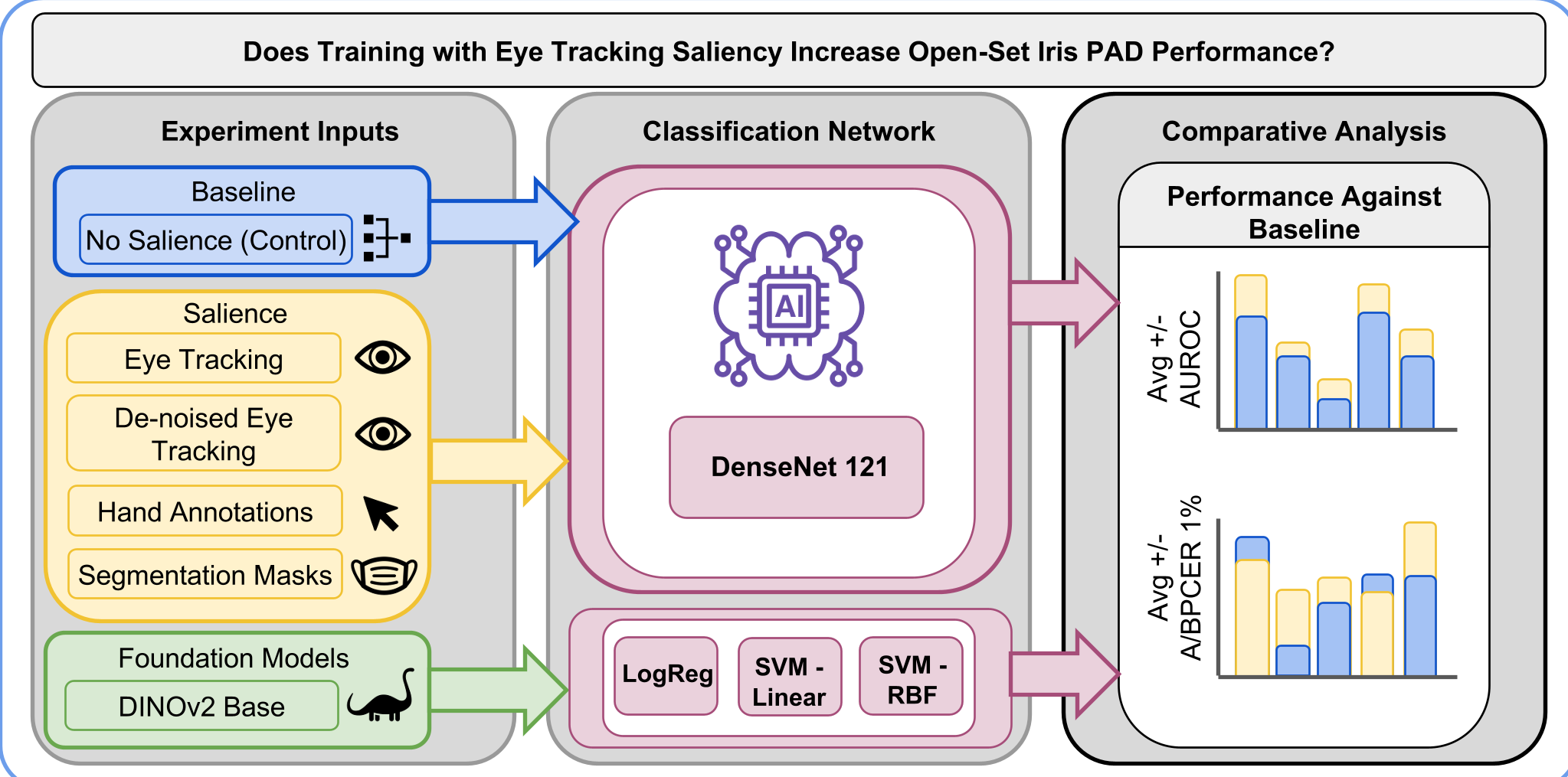 Figure 1: The experimental pipeline comparing various saliency modalities and foundation models.
Results: Saliency vs. Foundation Models
One of the most provocative findings is that VISER's saliency-guided approach outperformed modern Foundation Models like DINOv2 in the open-set context.
Key Breakthroughs:
- Open-Set Generalization: On "Artificial Eyes" (unseen during training), the denoised eye-tracking model showed an AUROC boost of nearly 27% over the baseline.
- Initial vs. Full Gaze: Interestingly, "Initial" eye-tracking (the first impression) often proved more effective than "Full" eye-tracking, suggesting that the most discriminative features are identified in the first moments of human inspection.
- The DINOv2 Paradox: While foundation models excel in closed-set tasks, they showed poor generalization in this open-set iris PAD benchmark, sometimes performing worse than the simple DenseNet baseline.
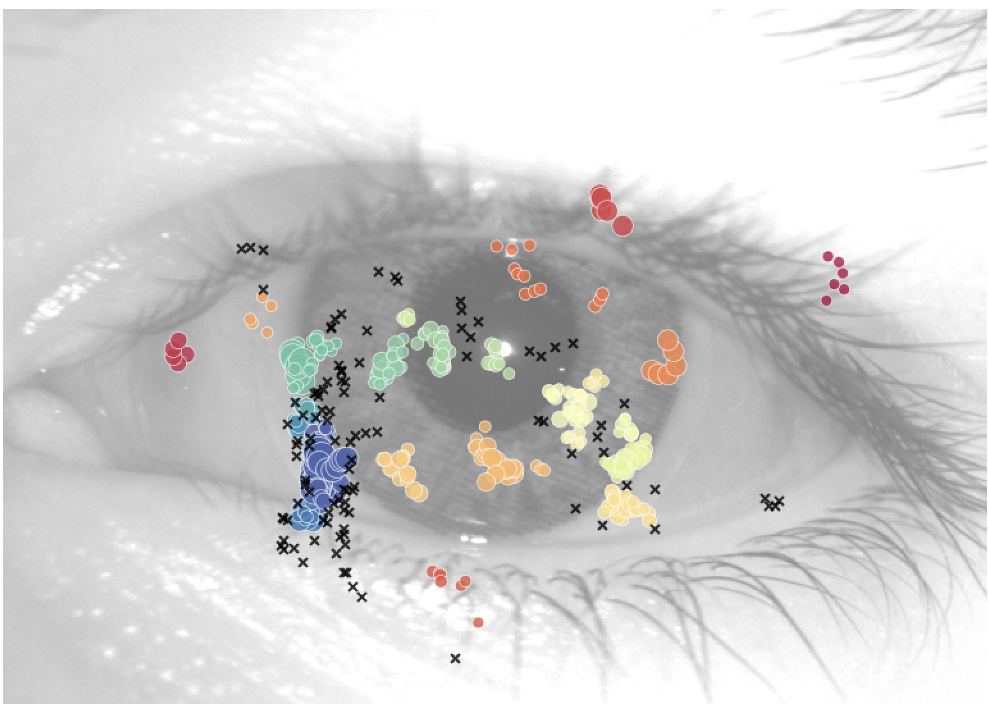 Figure 2: HDBSCAN in action. Black crosses indicate noise fixations excluded to create a cleaner, more effective training signal.
Performance Benchmarks
The following table highlights the "Average Delta" (improvement over baseline metrics). Note the significant dominance of eye-tracking methods.
| Method | Avg. AUROC Δ | Avg. APCER Δ (@1% BPCER) |
|---|---|---|
| De-noised Initial ET | +0.0608 | -0.1063 |
| Hand Annotations | +0.0164 | +0.0112 |
| DINOv2 + LogReg | -0.0013 | -0.0087 |
Critical Insight: Why Does Denoising Help?
Raw eye-tracking heatmaps are often "blurry" because of saccadic eye movements. By using HDBSCAN, the authors force the deep learning model to focus only on regions where the human eye remained fixated (stable attention). This ensures the "Cyborg" training process—blending human and machine intelligence—is fed with high-signal, low-noise data.
Conclusion & Future Work
VISER proves that how we source human knowledge matters just as much as what knowledge we source. By tapping into raw physiological gaze and applying rigorous denoising, we can build AI that inherits human-like robustness for critical security tasks.
The authors have released their code, weights, and maps, providing a new benchmark for the community to move beyond simple bounding boxes and into the realm of physiological AI alignment.
Note: Performance reported as AUROC (higher is better) and APCER (lower is better).