
[CVPR 2024] VisionFoundry: Scaling Visual Perception with Task-Aware Synthetic Images
VisionFoundry: Teaching VLMs Visual Perception with Synthetic Images
VisionFoundry is a fully automated, task-aware synthetic data generation pipeline that improves the visual perception of Vision-Language Models (VLMs). By generating 10,000 image-question-answer triples (VisionFoundry-10K) across 10 low-level perception tasks, the method achieves SOTA-level improvements of up to +7% on MMVP and +10% on CV-Bench-3D.
Executive Summary
TL;DR: Researchers from Princeton and NYU have introduced VisionFoundry, an end-to-end pipeline that creates high-quality training data for Vision-Language Models (VLMs) using nothing but task keywords (e.g., "Depth Order"). By bypassing the need for real images or human labels, they produced VisionFoundry-10K, a dataset that fixes the long-standing "perception bottleneck" in VLMs, yielding gains of up to 10% on 3D perception benchmarks.
Background: While VLMs have mastered high-level reasoning, they often fail at "simple" tasks like telling which of two objects is closer to the camera. VisionFoundry positions itself as a systematic solution to this low-level vision gap, demonstrating that synthetic data is no longer just a "placeholder" but a first-class primitive for multimodal training.
The Perception Bottleneck: Why "More Data" Isn't Enough
Existing VLMs are often trained on massive web-scraped datasets (like LAION or COCO). However, these "natural" datasets have a major flaw: they rarely contain the precise, varied supervision needed for geometric reasoning. For instance, a caption for a beach photo might mention "a sunset," but it rarely specifies the exact depth ordering of every seashell on the sand.
The authors identify three core requirements for fixing this:
- Controllability: The ability to target specific failures (e.g., viewpoint recognition).
- Visual Determinism: Ensuring questions are answerable only by looking at the image, not through language priors.
- Verification: Overcoming the "hallucination" problem where T2I models fail to render what the prompt requested.
Methodology: The Closed-Loop Synthesis
VisionFoundry operates in three distinct stages, moving from abstract keywords to verified triples:
- Task-Aware Generation: An LLM (GPT-5.2) takes a keyword like "Spatial Relationship" and samples objects and attributes. It doesn't just write a prompt; it creates a triplet: a highly detailed T2I prompt, a question, and a deterministic answer.
- Image Synthesis: A modern T2I model (Gemini-2.5-Flash) renders the image. Because the prompt was so specific, the image should contain the exact data needed for the QA pair.
- The Judge (Verification): This is the secret sauce. A frontier VLM (Gemini-3-Pro) acts as a verifier. It converts the QA into a declarative statement (e.g., "The car is facing left") and checks if the image actually shows that. If not, the sample is discarded or refined.
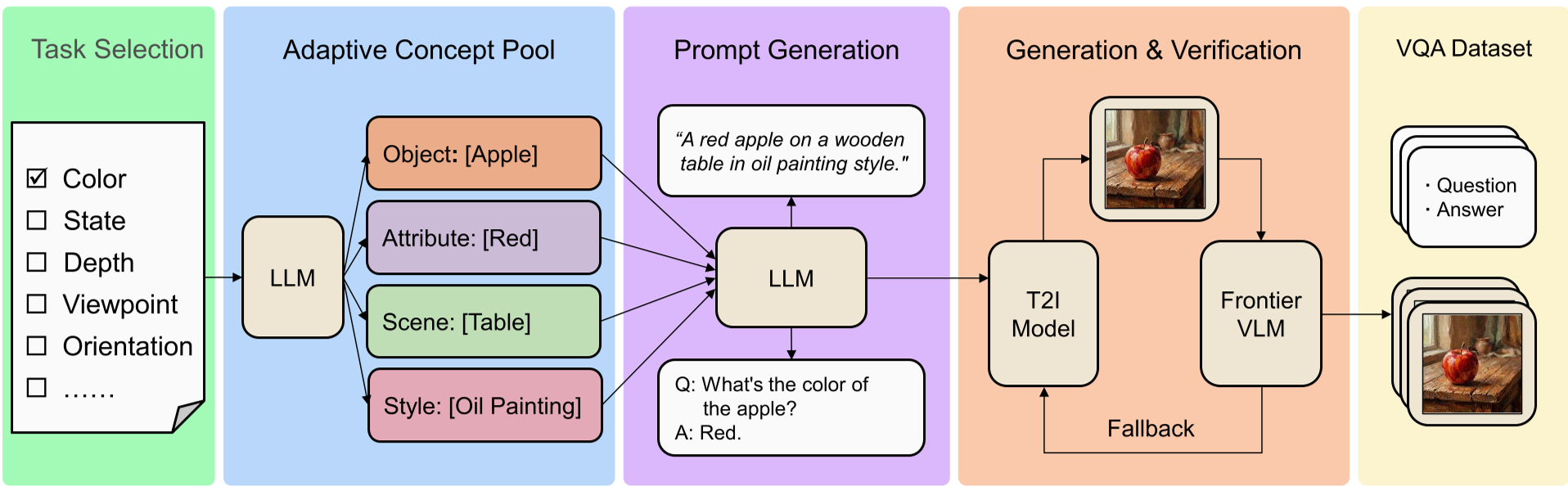 Figure 1: The VisionFoundry pipeline moves from keywords to verified VQA triples through LLM planning and VLM verification.
Experimental Results: Synthetic beats Natural
The team tested VisionFoundry across several backbone architectures, including Qwen2.5-VL-3B and Llama-3.2-11B. The results were striking:
- Massive Perception Gains: On CV-Bench-3D, model performance jumped by 10%.
- The Power of Verification: The authors proved that without the "VLM Judge" stage, the synthetic data is far less effective, as unverified images often fail to match their questions.
- Scaling Laws: Unlike some natural datasets that plateau quickly, performance on VisionFoundry-10K showed a healthy upward trend as the synthetic data volume increased from 0.5k to 10k samples.
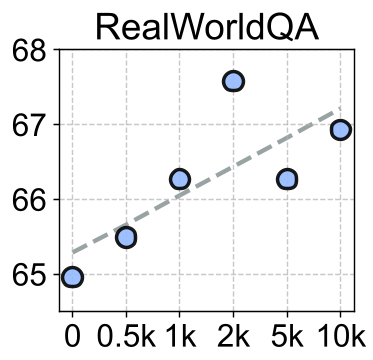 Figure 2: Scaling behavior showing consistent improvements on visual perception benchmarks as the synthetic data budget increases.
One of the most surprising findings was that a 50/50 mix of synthetic and natural data outperformed a pure natural dataset of the same size. This suggests that synthetic images provide a "clean" signal for spatial logic that natural images—cluttered with background noise and vague captions—simply cannot match.
Deep Insight: Is Synthetic Data the Future of Pretraining?
The success of VisionFoundry signals a shift in VLM research. Historically, synthetic data was used to "fill the gaps." Now, it is becoming clear that for specialized skills like 3D spatial understanding and viewpoint recognition, synthetic data is actually better than natural data.
Limitations: Currently, VisionFoundry focuses on low-level perception. The next frontier will be "long-chain reasoning"—can we synthesize images for complex physics problems or multi-step logic? Additionally, the pipeline relies on "frontier" models (like Gemini-3-Pro) for verification, which creates a cost dependency on proprietary APIs.
Conclusion
VisionFoundry-10K proves that the "perception bottleneck" is largely a data problem. By using LLMs and T2I models to build a systematic factory for visual supervision, the authors have provided a roadmap for building VLMs that don't just "see" the world, but actually understand its structure.
Takeaway: If you want your model to understand space and geometry, stop crawling the web—start building a foundry.