
Unsilencing Visual Latents: Solving the MLLM Shortcut Pathology via Inference-Time Optimization
Visual Latents Know More Than They Say: Unsilencing Latent Reasoning in MLLMs
The paper introduces a novel framework to address "Silenced Visual Latents" in Multimodal Large Language Models (MLLMs), where continuous latent reasoning tokens are semantically enriched but under-utilized due to autoregressive shortcuts. It proposes a two-stage inference-time optimization method—query-guided contrastive warm-up and confidence-progression reinforcement—to unleash latent reasoning capacity without parameter updates. The method achieves state-of-the-art performance across eight benchmarks, including significant gains on IQTest (+8.66%) and MM-Vista (+5.00%).
TL;DR
Existing Multimodal Large Language Models (MLLMs) often "ignore" the complex visual reasoning they are supposed to do, instead taking shortcuts from image pixels straight to a text answer. This paper identifies this as the Silenced Visual Latents phenomenon. The authors propose a two-stage inference-time optimization—without changing a single model parameter—that warms up visual latents and then forces the model to use them via a reward-driven reinforcement step. The result? Dramatic improvements in visual IQ, math, and perception benchmarks.
Background: The Illusion of Latent Reasoning
In the quest for better multimodal reasoning, researchers have moved from textual Chain-of-Thought (CoT) to Latent Space Reasoning. Instead of generating words like "I see a red car," the model generates high-dimensional vectors (latents) that represent visual evidence.
However, the authors discovered a startling "pathology": even when these latents are trained to be semantically rich, the model's final answer prediction often ignores them. Because the model is trained with a joint objective (Alignment + Autoregression), the autoregressive part finds a "shortcut" directly from the input image to the answer, driving the beautifully crafted latent tokens into useless "transition states."
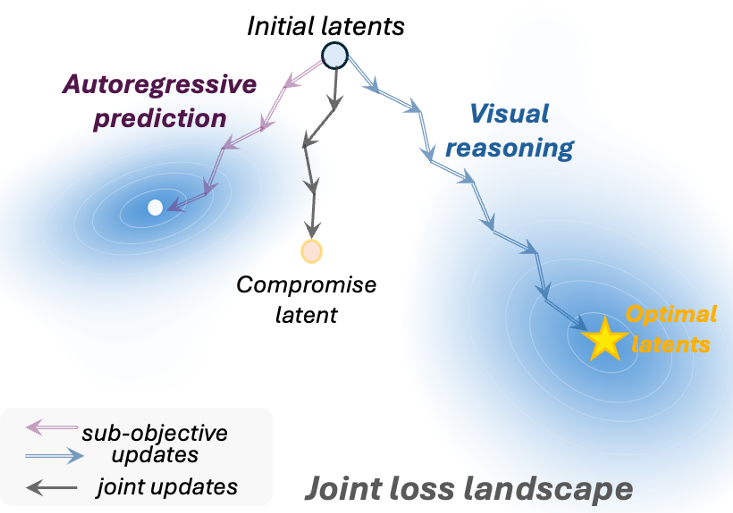 Figure 1: The conflict between the visual reasoning objective and the autoregressive shortcut, leading to a compromise "silenced" state.
Methodology: Disentangling Quality and Utilization
To fix this, the authors suggest we stop trying to train our way out of the problem and instead optimize the inference process. They propose a two-stage framework:
Stage I: Visual Latent Warm-up
Instead of simple alignment, they use query-guided contrastive alignment.
- They rank visual tokens by their relevance to the user's question.
- They partition these into "positive" (relevant) and "negative" (irrelevant) sets.
- The latent tokens are optimized to pull toward relevant patches and push away from irrelevant ones, ensuring they capture the right visual details.
Stage II: Latent-to-Answer Reinforcement
Even "smart" latents are useless if the model ignores them. Stage II applies a confidence-progression reward. Using a stochastic gradient estimator (NES), the latents are perturbed until the model's predicted token distributions become more "concentrated" (lower entropy) as the reasoning moves through the latent sequence. This effectively "funnels" the model's attention through the latents to reach a certain conclusion.
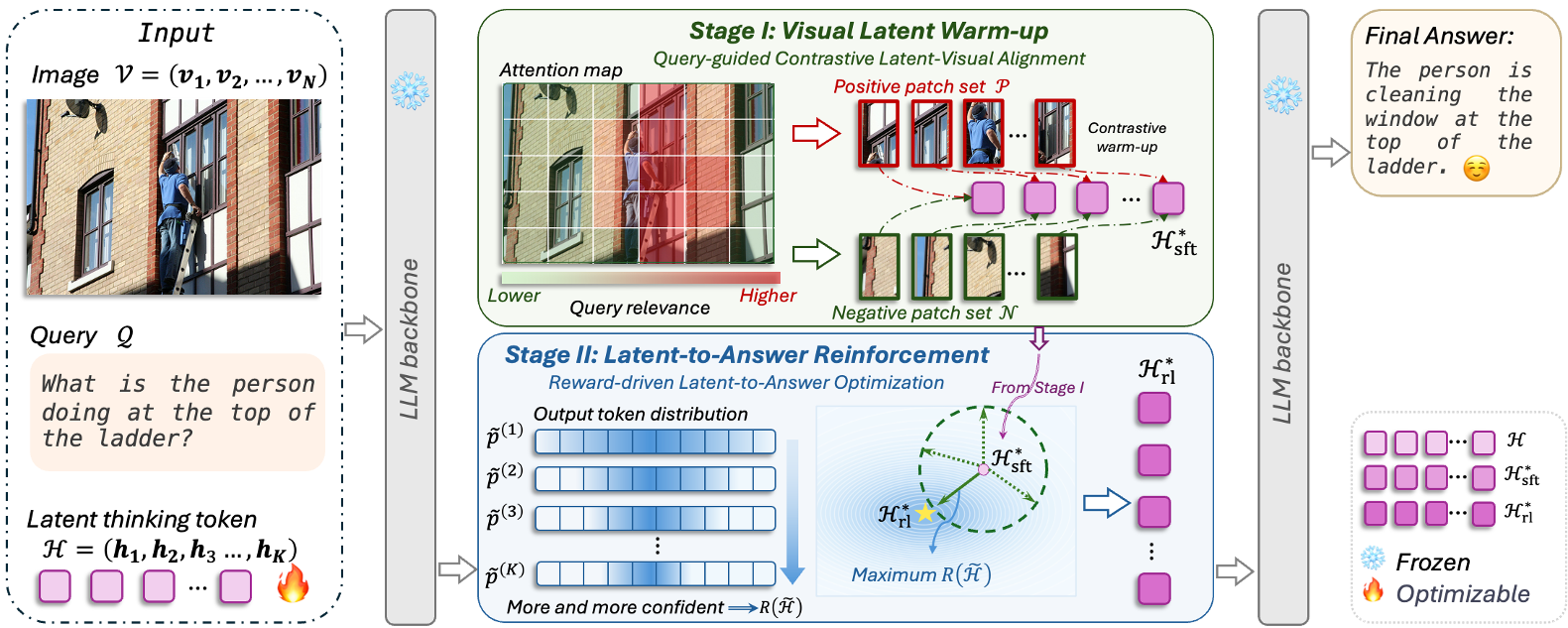 Figure 2: The Two-Stage framework: Stage I warms up the semantics; Stage II ensures they are utilized for the final answer.
Experimental Battleground
The framework was tested on eight grueling benchmarks using top-tier backbones like Qwen2.5-VL-7B and R1-OneVision-7B.
- Perception & IQ: on IQTest and on Relative Reflectance.
- Math & Science: on MM-Vista and on ScienceQA.
- Efficiency: Unlike textual CoT, which bloats the token count, this method delivers higher accuracy gains per token, achieving a superior Efficiency Ratio of .
Proof of "Unsilencing"
Visualization of attention maps shows a clear shift. In older models, attention was scattered across the image; in this new framework, the model's prediction output focuses intensely on the optimized latent tokens.
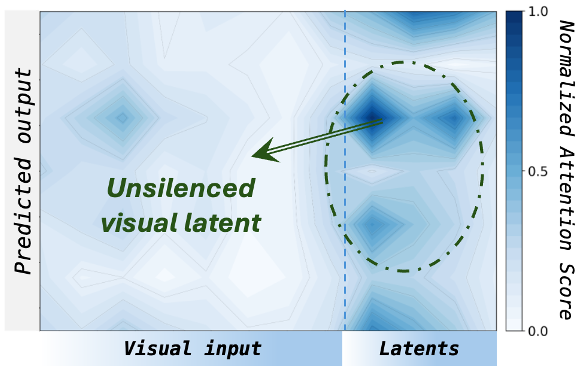 Figure 3: Attention visualization confirms that optimized latents are finally being "heard" by the model's output layer.
Critical Insight & Conclusion
The biggest takeaway here is the disentanglement of objectives. Most multimodal research assumes that if we align vision and language better, reasoning will follow. This paper proves that the autoregressive objective is actually a "lazy" learner that prefers shortcuts.
Future Outlook: While this method requires per-instance optimization at test time (adding some latency), it points toward a future where "inference-time scaling" (similar to OpenAI's o1) happens in the continuous latent space rather than just through massive textual chains.
Takeaway: Visual latents know more than they say—we just need to stop the model from cutting corners.