
ViTok-v2: Shattering the Scaling Ceiling for Visual Tokenizers
ViTok-v2: Scaling Native Resolution Auto-Encoders to 5 Billion Parameters
ViTok-v2 is a state-of-the-art Vision Transformer (ViT) autoencoder family scaled up to 5 billion parameters, designed for high-fidelity image tokenization. It introduces the DINOv3-based perceptual loss and NaFlex training to achieve superior reconstruction and stable scaling without adversarial training.
TL;DR
ViTok-v2 represents a paradigm shift in visual tokenization, scaling Vision Transformer (ViT) autoencoders to a staggering 5 billion parameters. By abandoning unstable GAN-based training in favor of a novel DINOv3-based perceptual loss and adopting NaFlex variable-resolution training, it achieves SOTA reconstruction fidelity. Crucially, it handles 8K resolution images where all current CNN-based tokenizers fail (OOM), providing a 50x speedup at 4K.
The Scaling Wall and the Resolution Trap
In the generative AI pipeline, the autoencoder (or tokenizer) is the unsung hero. It compresses high-resolution pixels into a latent space that diffusion models can manage. However, we have hit two walls:
- The Stability Wall: Prior SOTA models relied on Adversarial (GAN) losses. While they produce "sharp" images, they are notoriously brittle at scale (350M+ parameters).
- The Resolution Trap: Most ViT-based tokenizers are trained on fixed 256x256 crops. When they encounter 512p or 1024p images during inference, they produce hideous grid artifacts because their positional embeddings fail to generalize.
ViTok-v2 addresses these by reimagining the objective function and the training curriculum.
Methodology: Stability through DINOv3 and NaFlex
The core innovation of ViTok-v2 lies in its asymmetric architecture and "GAN-free" scaling.
1. DINOv3 Perceptual Tile Loss
Instead of the standard LPIPS (based on aging VGG features) or GANs, the authors use DINOv3-S as a frozen feature extractor. By sampling random 224x224 tiles from both original and reconstructed images and minimizing the MSE between their DINO features, they capture semantic and structural nuances that pixel-wise losses (L1/SSIM) miss. This allowed the team to scale to 5B parameters without a single training collapse.
2. NaFlex and SWA
To solve the "Resolution Trap," the authors used NaFlex training:
- 90% of training: Variable aspect ratios fitting a 256-token budget.
- 10% of training: A 1024-token budget to "teach" the model high-resolution dependencies.
- Inference: They employ Sliding Window Attention (SWA). This transforms the complexity of Transformers into , allowing the model to process 8K images on a single GPU.
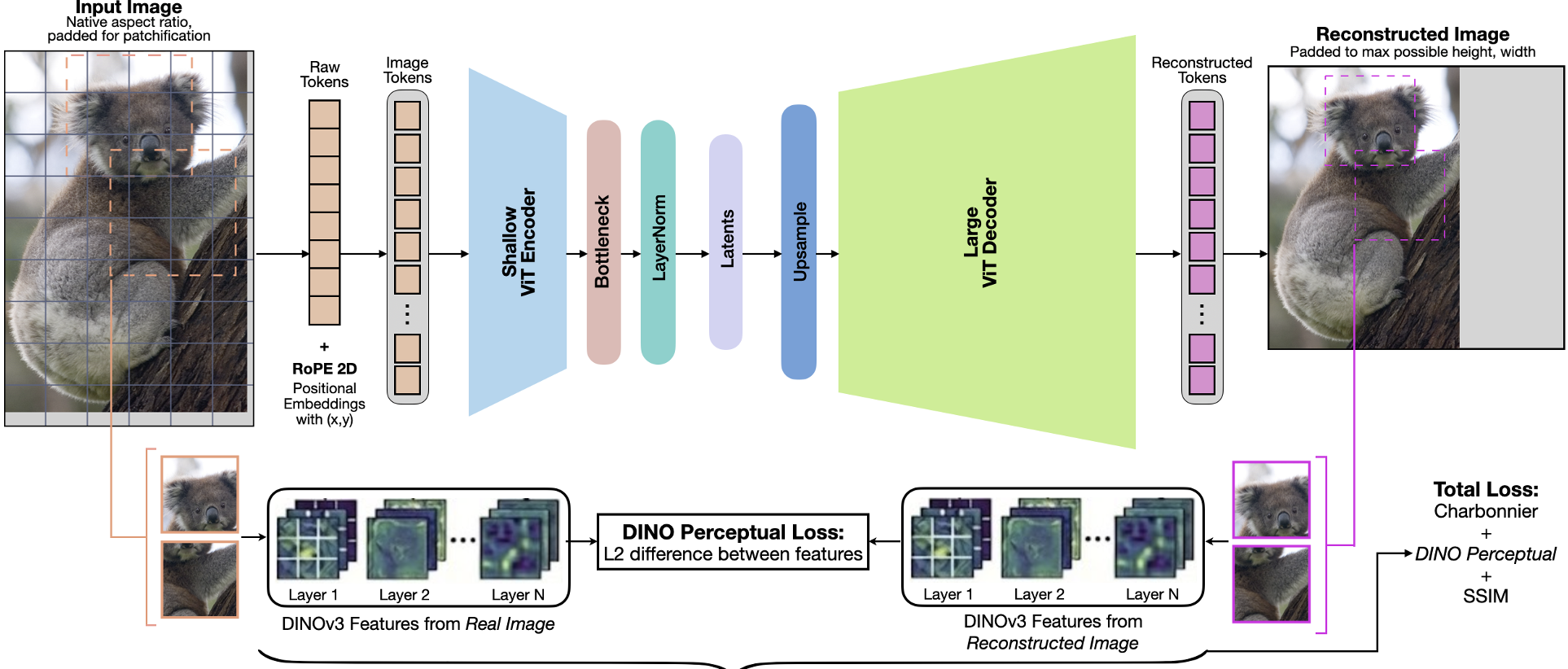 Figure 1: ViTok-v2's asymmetric pipeline featuring a shallow encoder and massive decoder.
Experiments: Breaking the Pareto Frontier
The paper introduces a crucial finding: Decoder capacity matters more than encoder capacity. By scaling the decoder from 88M to 4.5B, the reconstruction quality (rFID) improved most drastically at higher compression ratios (r=48), where the task is hardest.
Performance Highlights:
- Pixel Fidelity: +3.1 dB PSNR over FLUX.2 at r=12.
- Efficiency: While CNN tokenizers like SD-VAE "time out" or OOM at 4K/8K resolutions, ViTok-v2 processes 8K in roughly 5 seconds.
- The Joint Scaling Law: The authors proved that as you scale the autoencoder (AE), the downstream generator (Flow model) also gets better. Interestingly, larger generators are significantly better at "decoding" low-compression latents that smaller models find too complex to learn.
 Table 1: SOTA Reconstruction Comparison showing ViTok-v2's dominance in PSNR and SSIM.
Critical Insights & Future Outlook
The most profound takeaway is that "worse is better" doesn't always apply to tokenizers. While some researchers previously thought small latents were better for generators, ViTok-v2 shows that if you scale the decoder and the generator together, the system can utilize much richer (lower compression) latents to reach new levels of visual realism.
Limitations: While reconstruction is SOTA, the model's perceptual "sharpness" (as measured by FID) can still be slightly behind GAN-based models like FLUX.2 at low resolutions. However, the authors show this gap can be closed by increasing the DINO loss weight, albeit at a small cost to pixel-perfect fidelity.
ViTok-v2 sets a new benchmark for what is possible in high-resolution visual generation, moving us closer to a future where 8K AI-generated content is not just a dream, but a real-time reality.