
[Physical AI] ViVa: Why Your Robot Needs an "Imagination" to Learn Better
ViVa: A Video-Generative Value Model for Robot Reinforcement Learning
ViVa (Video-generative Value model) is a novel value estimation framework for robotic reinforcement learning that repurposes a pretrained video diffusion Transformer. By jointly predicting future robot proprioception and scalar values, it achieves SOTA performance on complex real-world tasks like box assembly, significantly outperforming traditional VLM-based value functions.
TL;DR
Researchers have introduced ViVa, a Video-Generative Value model that turns video generation into a powerful "judge" for robot learning. Instead of just looking at a static picture to guess how well it's doing, ViVa "imagines" the immediate future. By predicting the next state of the robot's limbs alongside task progress, it achieves a 73% success rate in complex box assembly—a massive leap over traditional vision-language methods.
The Problem: Static Models Can't See "Progress"
In Reinforcement Learning (RL), the Value Function is the North Star; it tells the robot if its current action will lead to victory or a messy failure.
Current state-of-the-art robots (using VLA models) typically use Vision-Language Models (VLMs) as value functions. However, VLMs are trained on billions of static images. They are great at identifying a "folded shirt" but terrible at understanding the process of folding. This leads to erratic value signals: the robot might think it's winning even as it's about to drop an object because the static frame looks "close enough" to the goal.
The Insight: Value is Foresight
The authors of ViVa argue that value estimation is inherently a problem of anticipating the future. If you can't imagine how a scene evolves, you can't truly judge the current state.
They pivoted from discriminative models to Generative Video Models. Since video models are trained to understand how pixels move and interact over time, they possess an inherent "physical intuition" (spatiotemporal priors) that static VLMs lack.
Methodology: Latent Injection & Joint Prediction
ViVa doesn't just generate a video; it repurposes the Wan2.2 video diffusion Transformer.
1. Latent Injection
The model takes multi-view images and the robot's proprioception (joint positions). It converts these into a unified sequence of latent frames.
- Images: Encoded via a VAE.
- Proprioception: Repeat-padded to match the latent grid.
- Value: Broadcasted across an entire latent frame.
2. Joint Foresight
Instead of just outputting a number, ViVa is tasked with two simultaneous predictions:
- Future Proprioception: Where will the robot's arms be in steps?
- Scalar Value: What is the current progress toward the goal?
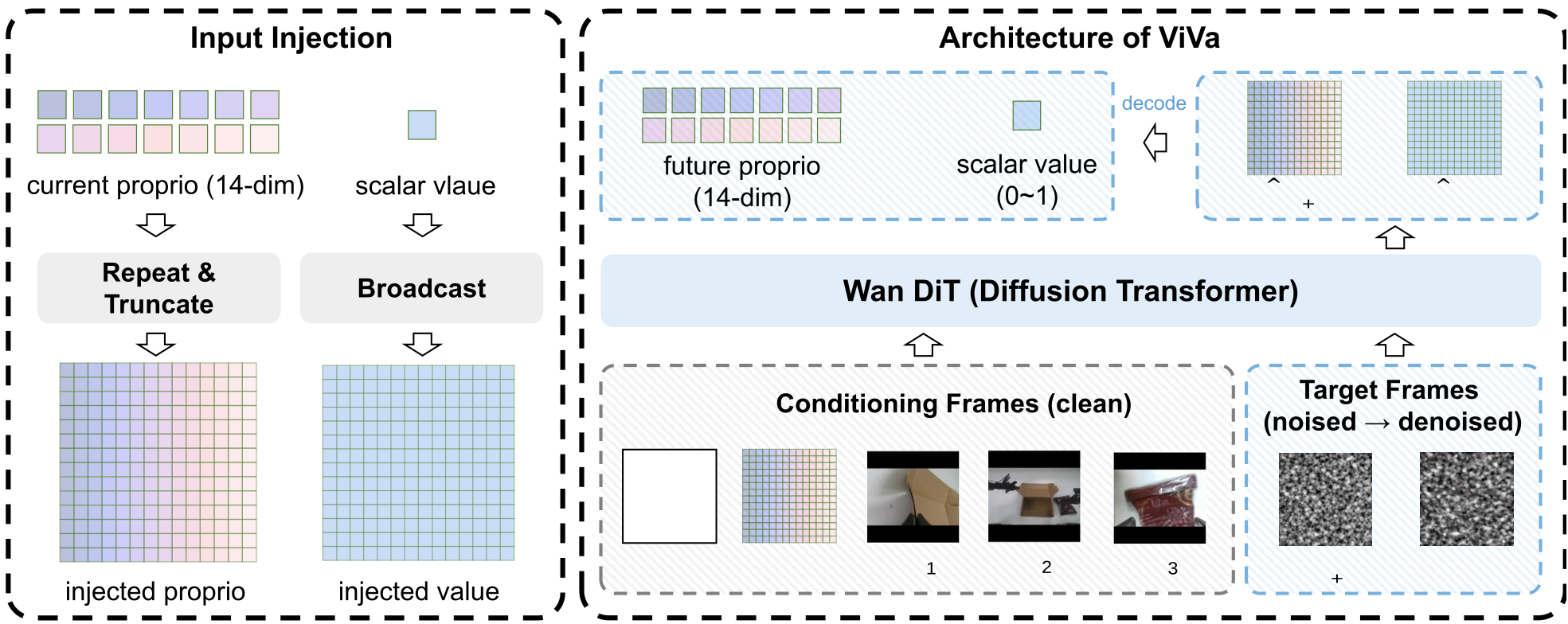
By forcing the model to predict its own body's future state, the value signal becomes "grounded" in physics. If the robot "imagines" its arm missing the box, the value signal drops immediately.
Experimental Showdown: Sensitivity is Key
The most striking results come from qualitative analysis. In the box assembly task, which requires high precision, the differences were clear:
- VLM Baseline: Remained "blind" to errors, showing a monotonically increasing value even when the robot misaligned a corner. It overfitted to the time elapsed.
- ViVa: Showed sharp drops in value the moment a mistake occurred. It understood that a misalignment meant the future return was now lower.

Real-World Success
In hardware tests, ViVa-integrated policies (using the RECAP pipeline) significantly boosted the success rate of box assembly to 73%, compared to 58% for VLM-based critics.
| Method | Success (%) | Throughput (Tasks/hr) |
|---|---|---|
| Gigabrain-0 (Imitation) | 53% | 10 |
| RECAP (VLM-based) | 58% | 11 |
| RECAP (ViVa) | 73% | 14 |
Deep Insight: Generalization Beyond Training
One of the "holy grails" of robotics is Generalization. When tested on folding pants (an object never seen during training), the VLM baseline's value signal became erratic. ViVa, however, maintained a smooth, rising value curve, identifying key milestones like "waistband folding" with high precision. This suggests that video-based priors capture the logic of manipulation rather than just memorizing textures.
Conclusion: The Future is Generative
ViVa proves that the next generation of robotic brains won't just be "classifiers." To act in a dynamic world, they must be "simulators." By grounding value in generated futures, we provide robots with a reliable internal critic that can handle the complexity of the real world.
Limitations: The primary bottleneck is the computation required for diffusion rollouts, although ViVa already shows 1.5x faster training than some VLM baselines. Future work will likely look at distilling these generative counts into even faster real-time critics.