
vla-eval: Solving the Fragmentation Crisis in Vision-Language-Action Benchmarking
vla-eval: A Unified Evaluation Harness for Vision-Language-Action Models
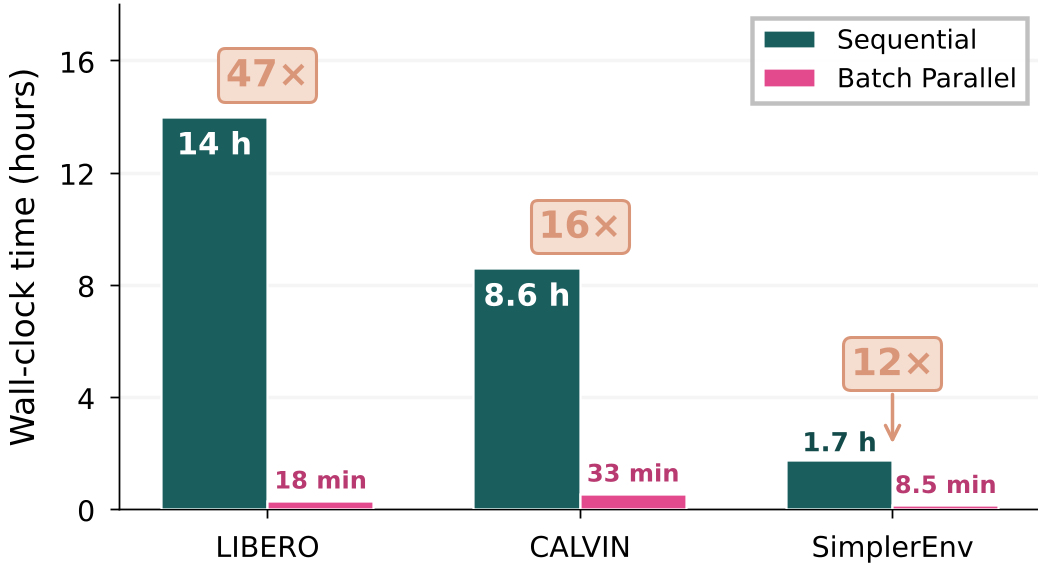
vla-eval is a unified, open-source evaluation harness for Vision-Language-Action (VLA) models that standardizes benchmarking through a client-server architecture. By decoupling model inference from benchmark execution via Docker isolation and a WebSocket+msgpack protocol, it supports 13 simulation benchmarks and achieves a 47x throughput increase via parallel episode sharding.
TL;DR
The field of Vision-Language-Action (VLA) models has been plagued by inconsistent evaluation scripts and conflicting software dependencies. vla-eval introduces a unified, Docker-based evaluation harness that decouples models from benchmarks. It achieves a 47x speedup in evaluation time and exposes hidden "reproducibility traps" that have previously led to silent score distortions in major publications.
The Problem: The "Dependency Hell" of Robotics Research
In the current VLA landscape, evaluating a single model across multiple benchmarks like LIBERO, CALVIN, and ManiSkill2 is a software engineering nightmare.
- Asset Conflicts: LIBERO needs Python 3.8; ManiSkill2 needs 3.10. Installing both on one system often breaks the environment.
- Implicit Knowledge: Authors frequently forget to mention specific observation normalization or whether a "success" flag actually means the episode should end.
- Sluggishness: Evaluating 2,000 episodes sequentially can take over 14 hours, making rapid iteration impossible.
Methodology: High-Performance Decoupling
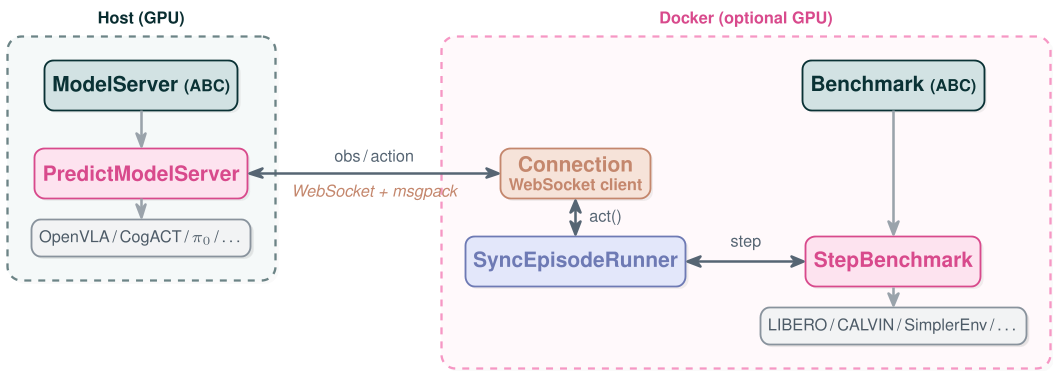
vla-eval adopts a Client-Server Architecture. The model acts as the server, and the benchmark acts as the client. They communicate via a lightweight WebSocket + msgpack protocol.
1. Unified Interfacing
Models only need to implement a single predict() method. Benchmarks are wrapped in dedicated Docker containers, ensuring that the specific OS/library requirements of a simulator (like SAPIEN or PyBullet) never interfere with the model's neural network dependencies.
2. The 47x Parallelism Strategy
The authors treat evaluation as a Demand/Supply problem. By sharding episodes across multiple CPU-heavy environment containers (Demand) and grouping requests into single-batch GPU inference (Supply), they maximize hardware utility.
- Environment Throughput (): Scaled by adding Docker shards.
- Model Throughput (): Scaled by increasing batch size (). The optimal point is found where the environment demand utilizes ~80% of the model's batching capacity.
Experiments: The Reproducibility Audit
To prove the framework's worth, the authors audited a published VLA model. While they successfully matched published scores, they uncovered two major "silent killers" of reproducibility:
- Ambiguous Termination: In SimplerEnv, some models stopped as soon as a "success" flag was triggered. However, the robot often knocks over the object a split second later. vla-eval enforces running to the true limit, preventing score inflation.
- Hidden Normalization: CALVIN requires specific mean/std stats derived from its training set. Without these (which are often unlisted), model performance crashes.
Deep Insight: A Unified Leaderboard
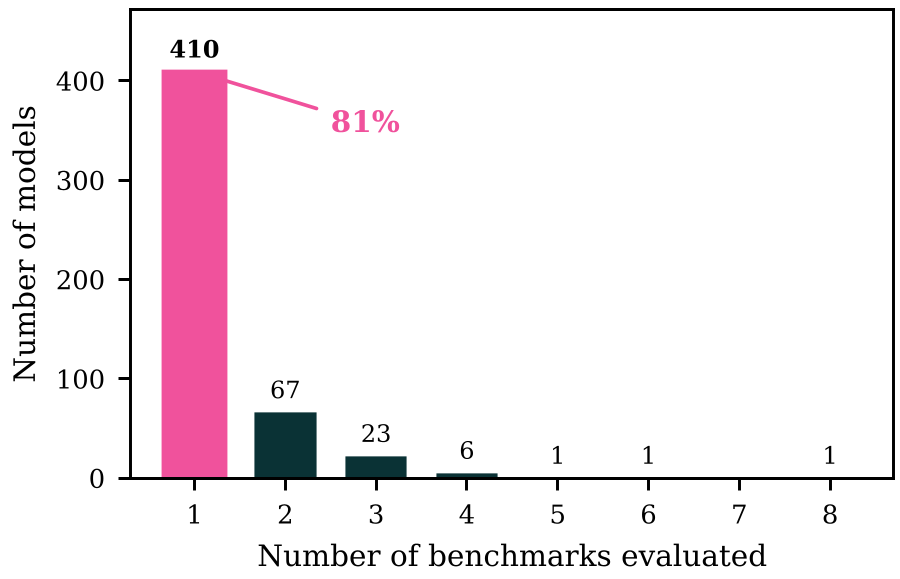
The authors also released a comprehensive VLA Leaderboard. A startling finding from their curation: 81% of VLA models are only evaluated on a single benchmark. Only 0.6% have been tested on 5 or more. This "siloed" evaluation makes it impossible to know if a model is a generalist or just an overfitted specialist.
Conclusion
vla-eval is move toward "Scientific Maturity" for robotic AI. By providing a standardized, high-speed, and Docker-isolated pipeline, it allows researchers to spend less time debugging conda environments and more time analyzing model behavior across diverse embodiments.
Future Outlook: While simulation is a start, the next frontier for vla-eval will be extending this rigorous protocol to real-world robot teleoperation and safety metrics.