
VOFA: Powering Humanoid Loco-Manipulation with Force-Adaptive Control
VOFA: Visual Object Goal Pushing with Force-Adaptive Control for Humanoids
VOFA is a visual goal-conditioned loco-manipulation system designed for humanoid robots to push heavy objects (up to 17kg) toward arbitrary goal locations. It utilizes a two-level hierarchical architecture combining a high-level depth-based visuomotor policy with a low-level force-adaptive whole-body controller, achieving over 80% success rate in real-world trials.
TL;DR
Pushing a heavy box across a room sounds simple for a human, but for a humanoid robot, it involves a complex dance of balance, visual tracking, and brute force. VOFA (Visual Object-Goal Pushing) is a new framework that enables humanoid robots to push unknown objects weighing over half their body weight to arbitrary targets using only onboard depth cameras and proprioception.
The Challenge: Physics and Perception Gap
Most existing humanoid systems struggle with "object goal pushing" for two reasons:
- Dynamic Uncertainty: You don't know how heavy the box is or how slippery the floor is until you touch it. Without force adaptation, a robot either fails to move the object or falls over when the resistance is higher than expected.
- The "Myopic" Problem: Standard Reinforcement Learning (RL) often results in "greedy" behavior where the robot just touches the object immediately, often from the wrong side, making it impossible to push toward the actual goal.
Methodology: The Hierarchical Approach
VOFA solves this using a two-tier hierarchy that separates thinking (planning) from reacting (physics).
1. High-Level Visuomotor Policy
The system uses a Teacher-Student distillation method.
- The Teacher: Trained with "privileged" information (exact object position and mass) in simulation.
- The Student: Learns to mimic the teacher but only uses noisy onboard depth images and joint sensors.
- The Secret Sauce: A specific Object-Goal Alignment Reward. This forces the robot to navigate to the opposite side of the object before making contact, ensuring the push is directed toward the target.
2. Low-Level Force-Adaptive Controller
The low-level utilizes the FALCON framework. This controller is specifically trained to handle external forces acting on the arms. When the robot pushes a 17kg box, the controller "feels" the resistance and adjusts the whole-body stance to maintain stability.
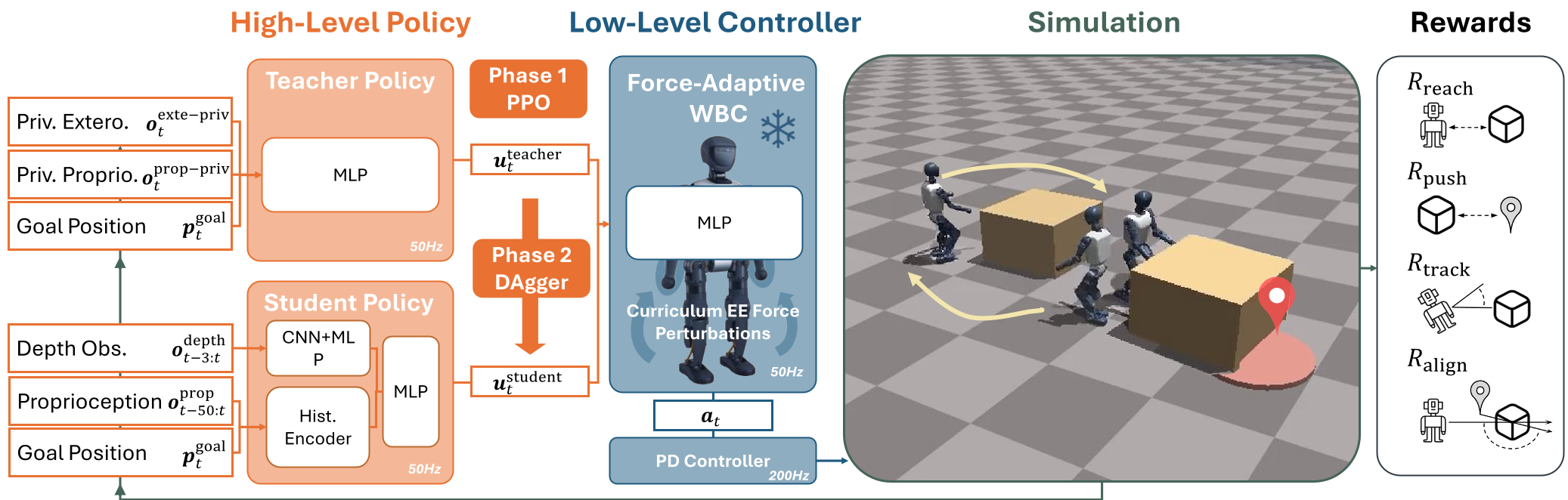 Fig 2: VOFA Architecture - High-level visuomotor policy meets low-level force-adaptive whole-body control.
Experimental Breakthroughs
The researchers tested VOFA on the Booster T1 humanoid. The results were impressive:
- Success Rate: Consistently above 80% across front, lateral, and even rear goal configurations.
- Heavy Lifting: The robot pushed a 17kg object. Since the robot itself weighs roughly 30kg, this is a significant feat of strength and balance.
- Closed-Loop Intelligence: In tests where the object was kicked off-course, VOFA automatically stopped, re-oriented, walked behind the object, and resumed the push.
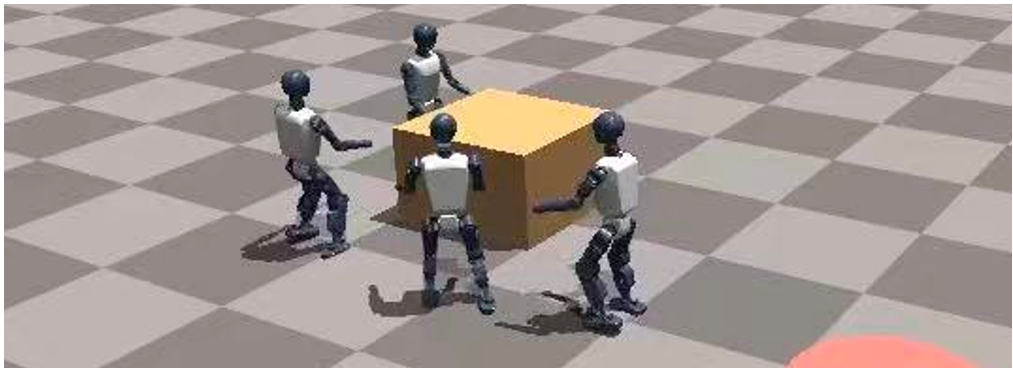 Fig 4: Ablation study showing how the Force-Adaptive controller prevents "kicking" and maintains stable contact.
Why It Works: Visual Randomization
Sim-to-real transfer is often where these projects fail. VOFA uses aggressive Visual Randomization:
- Far-plane depth perturbation: Simulates messy backgrounds.
- Correlated depth noise: Models the specific graininess of the ZED 2i camera.
- Pixel dropout: Mimics real-world sensor failure.
Without these, the robot "hallucinates" the goal or gets confused by background clutter.
Critical Insights & Future Work
The core value of VOFA is its robustness to unknown mass. By training in a physics-rich simulation and distilling that knowledge into a vision-based policy, the authors have bridged the gap between "locomotion" (walking) and "manipulation" (using arms).
However, limitations remain. Currently, the system assumes a single target object in a relatively clear environment and requires an external module for the relative goal position. The next frontier? Multi-object rearrangement in cluttered, human-centric environments where the robot must decide which object to push and how to weave through obstacles.
Final Takeaway
VOFA proves that humanoid robots don't need to be perfectly "told" the physics of the world; they can learn to sense and adapt to them through a combination of hierarchical control and massive-scale simulation.