
Volt: Bringing the Vanilla Transformer Revolution to 3D Scene Understanding
Volume Transformer: Revisiting Vanilla Transformers for 3D Scene Understanding
The Volume Transformer (Volt) is a plain Transformer encoder adapted for 3D scene understanding, utilizing volumetric patch tokens and full global self-attention. By extending Rotary Positional Embeddings (RoPE) to 3D and employing a data-efficient training recipe, it achieves new state-of-the-art results in both semantic and instance segmentation across indoor and outdoor datasets.
TL;DR
The Volume Transformer (Volt) proves that "less is more" in 3D deep learning. By ditching complex, domain-specific 3D operators in favor of a plain Transformer encoder with global attention and a 3D adaptation of RoPE, Volt achieves state-of-the-art performance on ScanNet and nuScenes. It is faster, more memory-efficient, and demonstrates superior scaling behavior compared to current heavyweights like PTv3.
Problem & Motivation: The "3D Isolation" Trap
For years, 3D scene understanding has been a "special snowflake" in the AI world. While NLP and 2D Vision converged on the standard Transformer, 3D research remained wedded to specialized architectures like MinkowskiEngine (Sparse CNNs) or Point Transformers with complex local grouping and multi-resolution U-Net hierarchies.
The authors argue this specialization has two major downsides:
- Optimization Lag: 3D models cannot easily borrow the latest software/hardware speedups (like FlashAttention-3).
- Scaling Ceiling: Hand-crafted priors (inductive biases) that help when data is scarce often become "shackles" when data scales up.
Methodology: Simplicity is the Ultimate Sophistication
1. The Architecture
Volt converts a 3D point cloud into a sequence of tokens through a simple Volumetric Patchification process. The scene is voxelized, and cubic patches are flattened and projected—just like patches in a 2D ViT.
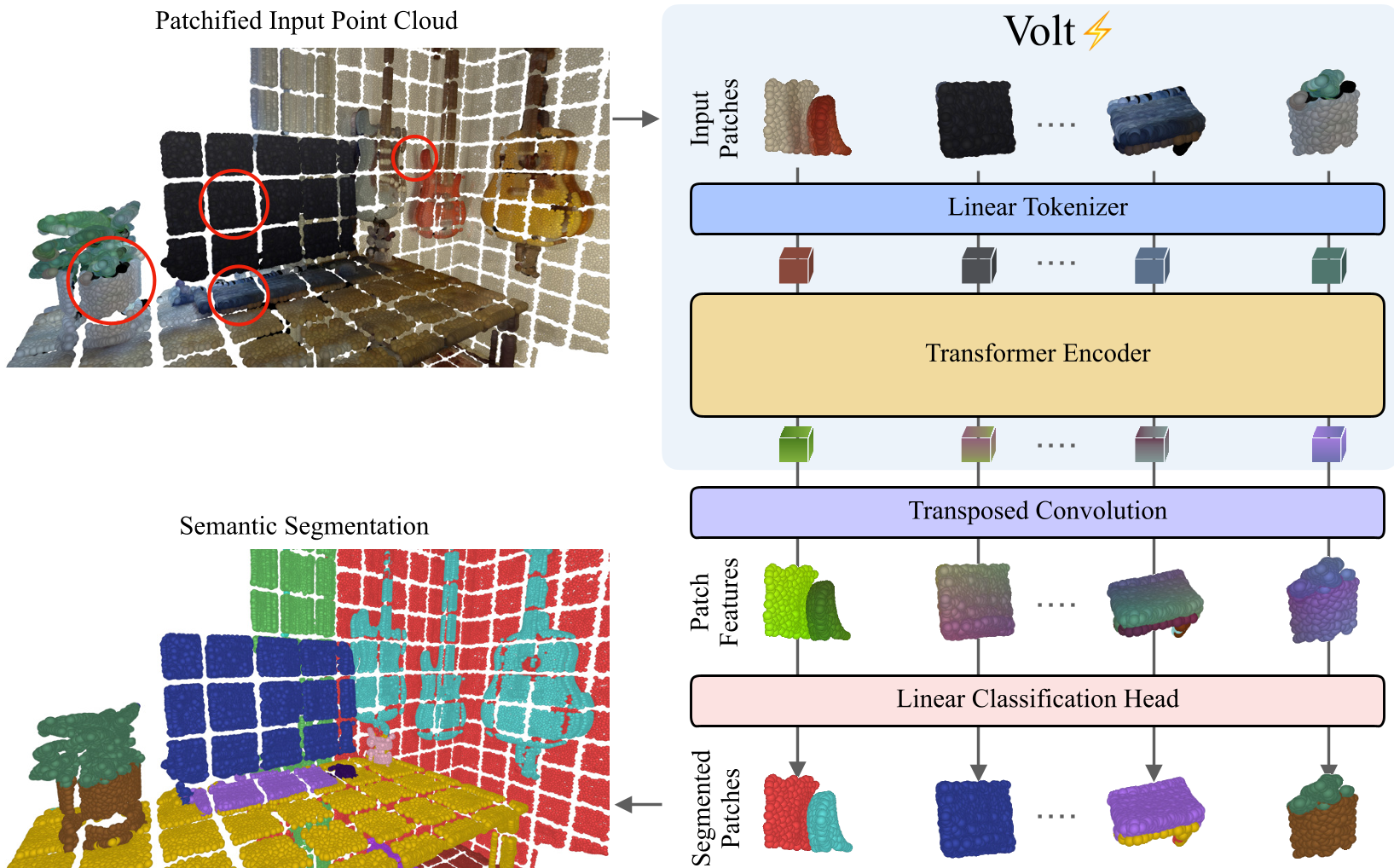
Key components include:
- Global Attention: Unlike local-window methods, every token attends to every other token in the scene. Thanks to FlashAttention-2, this is surprisingly efficient—typical scenes only generate ~5,000 tokens.
- 3D RoPE: To give the model a sense of space without absolute position embeddings (which don't scale to infinite 3D space), Volt generalizes Rotary Positional Embeddings to 3D. Crucially, they use an asymmetric allocation (more capacity for X-Y axes than the gravity-aligned Z axis) to match the physics of real-world scenes.
2. Overcoming the Data Gap
Transformers are notoriously "data-hungry." Since 3D datasets are tiny compared to ImageNet, Volt uses a specialized Data-Efficient Training Recipe:
- CNN Distillation: It "borrows" inductive biases from a convolutional teacher (MinkUNet) during training.
- Heavy Augmentation: Utilizing Mix3D and elastic distortions to prevent the model from memorizing shortcuts.
Experiments & Results: Efficiency Meets Power
Volt doesn't just win on accuracy; it wins on Inference Speed.
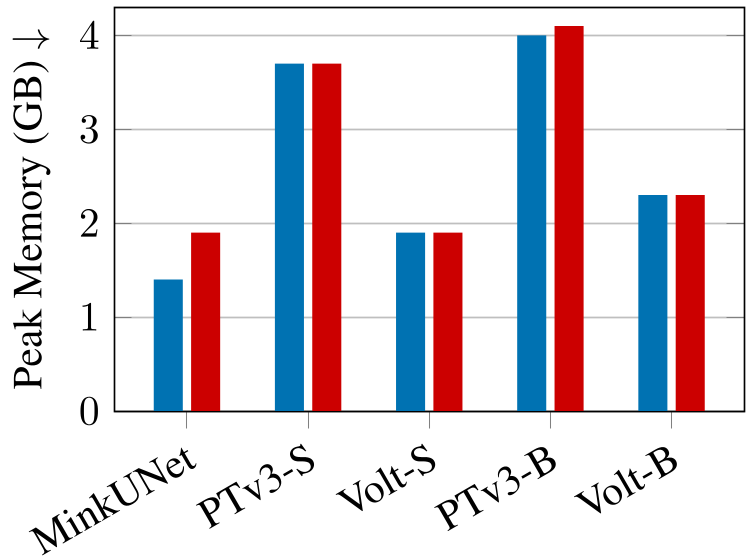
As shown in the efficiency graph, Volt-S is significantly faster than the previous SOTA (PTv3) and even the classic MinkUNet, while consuming less GPU memory.
The Scaling Proof
The most compelling evidence for Volt's design is its scaling behavior. As supervision increases (through joint training on multiple datasets like ScanNet++ and ARKitScenes), Volt’s performance climbs much steeper than domain-specific models.
| Method | ScanNet (mIoU) | ScanNet200 (mIoU) | nuScenes (mIoU) |
|---|---|---|---|
| PTv3 (SOTA) | 77.9 | 37.8 | 82.7 |
| Volt-B (Ours) | 80.5 | 41.6 | 83.2 (Jointly Trained) |
Critical Analysis & Conclusion
Takeaway
Volt marks a pivotal moment in 3D research: the transition from "Geometry-Native" to "Transformer-Native." It suggests that the future of 3D is not in building more complex 3D operators, but in better tokenization and larger-scale supervision for standard architectures.
Limitations
- Small Object Sensitivity: The patch-based tokenization (5x5x5) can sometimes blur extremely fine-grained structures, as seen in the patch-size ablation.
- Data Dependency: Without the CNN distillation and heavy augmentation, the "plain" Transformer still struggles, indicating that 3D data scale isn't quite at the "emergence" point where priors are completely unnecessary.
Future Outlook
The simplicity of Volt's backbone makes it an ideal candidate for Multimodality. By using a standard Transformer, researchers can now more easily perform mid-level or late-level fusion with LLMs or 2D Vision Foundations, potentially leading to the first truly unified "Foundation Model" for 3D.