
Wan-Image: Transforming Generative AI from Artistic Toys into Professional Productivity Tools
Wan-Image: Pushing the Boundaries of Generative Visual Intelligence
Wan-Image is a unified multi-modal visual generation system developed by Alibaba, integrating an MLLM-based Planner with a DiT-based Visualizer. It achieves state-of-the-art performance in professional-grade tasks including ultra-long text rendering, multi-subject identity preservation, and native 4K alpha-channel generation.
Executive Summary
Wan-Image, introduced by the Alibaba Wan Team, represents a milestone in the evolution of visual AI. For years, the community has grappled with a "controllability gap"—while models like Flux or DALL-E produces stunning art, they often fail the "professional test" where specific text, exact colors, and identity persistence are non-negotiable.
Wan-Image bridge this gap by treating image generation not as a single-step prediction, but as a planned workflow. By synergizing a Multi-modal Large Language Model (MLLM) with a Diffusion Transformer (DiT), the system achieves expert-level performance in complex typography, consistent multi-image storytelling, and native transparency (Alpha-channel) generation.
The "Professional" Problem: Beyond Aesthetics
The technical problem Wan-Image addresses is the lack of rigorous controllability. In a professional design workflow, an "almost right" image is often useless. Current SOTA models fail in:
- Typography: Rendering paragraph-length text without hallucinations.
- Identity Consistency: Keeping a character identical across 12 different frames of a storyboard.
- Alpha-Channels: Generating subjects with transparent backgrounds for immediate use in UI/UX design.
- Instruction Following: Understanding the difference between what should be changed and what should remain "common" between images.
Methodology: The Unified Brain (Planner + Visualizer)
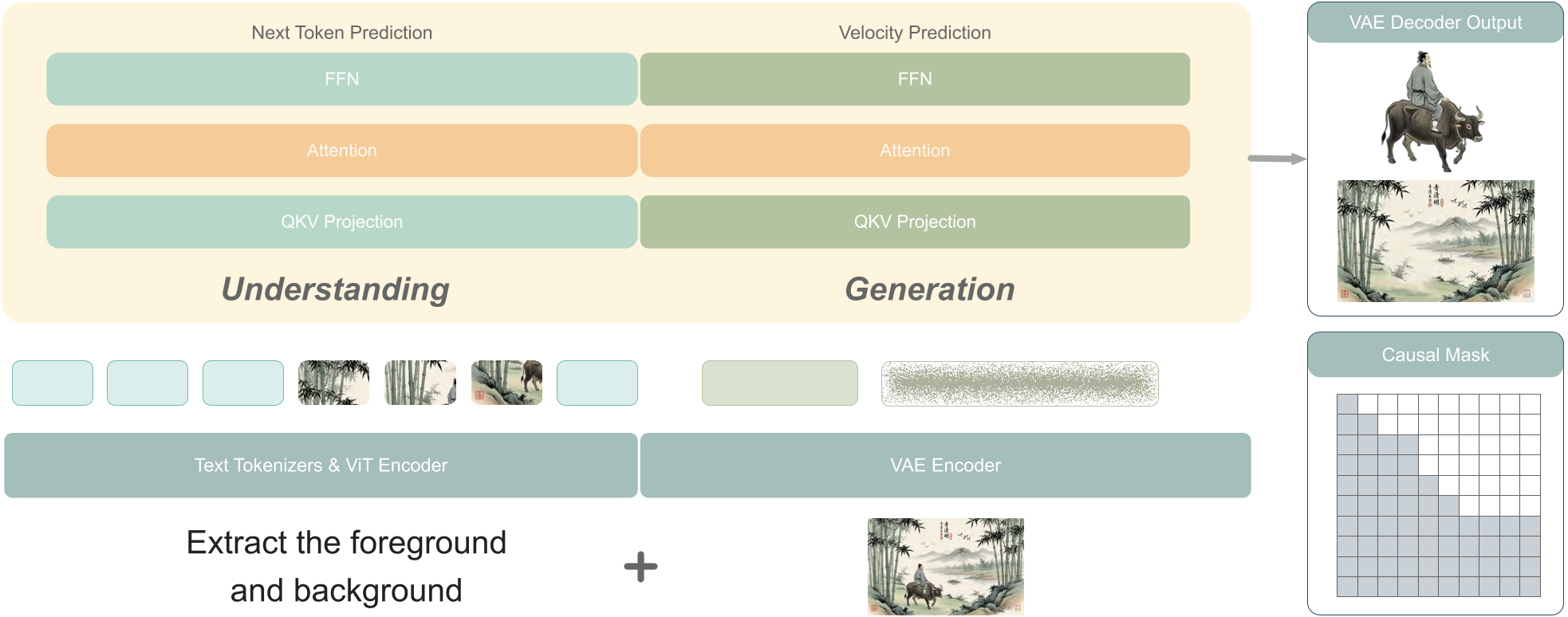
The core innovation of Wan-Image lies in its Unified Multi-modal Architecture. Unlike traditional pipelines that use a frozen T5 or CLIP encoder, Wan-Image conceptually integrates two specialized streams:
- The Planner (MLLM): Based on the Qwen architecture, it acts as the "CEO." It reasons through the user's intent, expands the prompt via Chain-of-Thought (CoT), and generates a "Visual CoT" plan for complex tasks like interleaved text-image generation.
- The Visualizer (DiT): The "worker" that translates semantic tokens into high-fidelity pixels using a Rectified Flow paradigm.
Native Transparency: The 4-Channel VAE
Typically, designers have to use secondary "background removal" AI, which often ruins edges. Wan-Image introduces a native 4-channel VAE (RGBA). By training on transparent PNG data, the model understands the physical boundary of objects.
- Insight: RGB-only modeling fails to disentangle background color from transparency. The Wan-Image VAE uses a hybrid reconstruction loss to ensure "clean" edges without the dreaded white/black fringes.
Experimental Results & Cascade RL
The team utilized Cascade RL (Reinforcement Learning) to refine the model. Traditional SFT (Supervised Fine-Tuning) can teach a model "what" to draw, but RL teaches it "how" to draw it beautifully and accurately.
Performance Highlights:
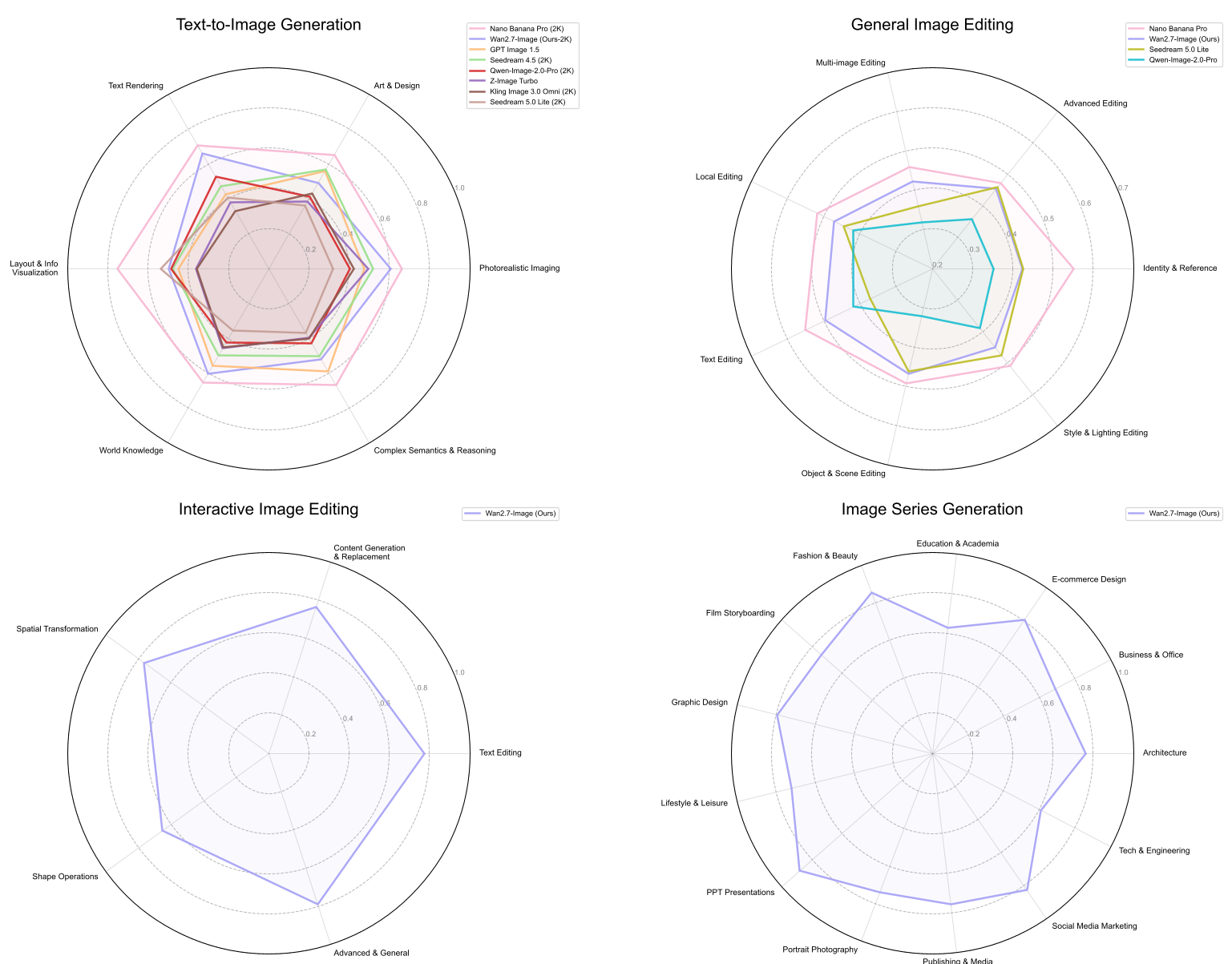
- Typography: accurately renders multi-line text (e.g., a complete song tracklist) without spelling errors.
- High Efficiency: Through model distillation, Wan-Image achieves an 8x speedup, enabling fast iterations for professional users.
- Identity Consistency: In TI2S (Text-Image-to-Image-Series) tasks, it maintains character ID across complex scene transitions.
Deep Insights: Why It Works
The success of Wan-Image isn't just the architecture; it's the Data Taxonomy. The team moved away from flat image-text pairs to a Hierarchical Taxonomy. Images are categorized into 5 primary classes (Photorealistic, Charts, UI, etc.) and annotated across 25 dimensions.
This "Expert-Level" data curation allows the model to learn the specific inductive biases of different domains—knowing that a "chart" requires mathematical precision while a "portrait" requires skin texture fidelity.
Critical Analysis & Conclusion
While Wan-Image closes the gap with closed-source giants like Nano Banana Pro (Gemini) in text rendering, it represents a more versatile tool for the integrated creative suite. Its ability to output 4K images with native transparency and its "Think Mode" for prompt expansion makes it a true "Design Assistant."
Takeaway: The future of generative AI is not more parameters, but better planning capabilities. By embedding a reasoning MLLM directly into the generation loop, Wan-Image proves that professional-grade AI must be able to "think" before it "paints."