
WavCube: Harmonizing the "Semantic-Acoustic" Divide in Unified Speech Modeling
WavCube: Unifying Speech Representation for Understanding and Generation via Semantic-Acoustic Joint Modeling
WavCube is a unified, compact 128-dimensional continuous speech representation designed to bridge the gap between speech understanding and generation. Developed using a two-stage "compress-then-enrich" recipe based on WavLM, it achieves SOTA zero-shot TTS performance and matches specialized models in understanding benchmarks like SUPERB.
TL;DR
WavCube introduces a compact 128-dimensional continuous representation that finally unifies speech understanding and generation. By transforming high-dimensional, redundant SSL features into a "diffusion-friendly" bottleneck and re-injecting acoustic details, WavCube achieves SOTA zero-shot TTS while retaining the linguistic power of WavLM.
Background: The Representational Dichotomy
In the world of speech AI, we have lived in two separate houses. The Understanding House (ASR, Emotion Recognition) is built on Self-Supervised Learning (SSL) features like WavLM—highly semantic but acoustically "hollow." The Generation House (TTS, Voice Conversion) is built on acoustic latents like Mel-spectrograms—rich in texture but semantically "blind."
Attempts to merge them often fail because:
- The Dimension Curse: 1024-dim SSL features are too noisy for Diffusion Models.
- The Detail Deficit: SSL encoders are trained to ignore "noise" (like phase and high frequency), which are exactly what makes speech sound real.
Methodology: The "Compress-then-Enrich" Recipe
WavCube breaks this deadlock with a clever two-stage recipe.
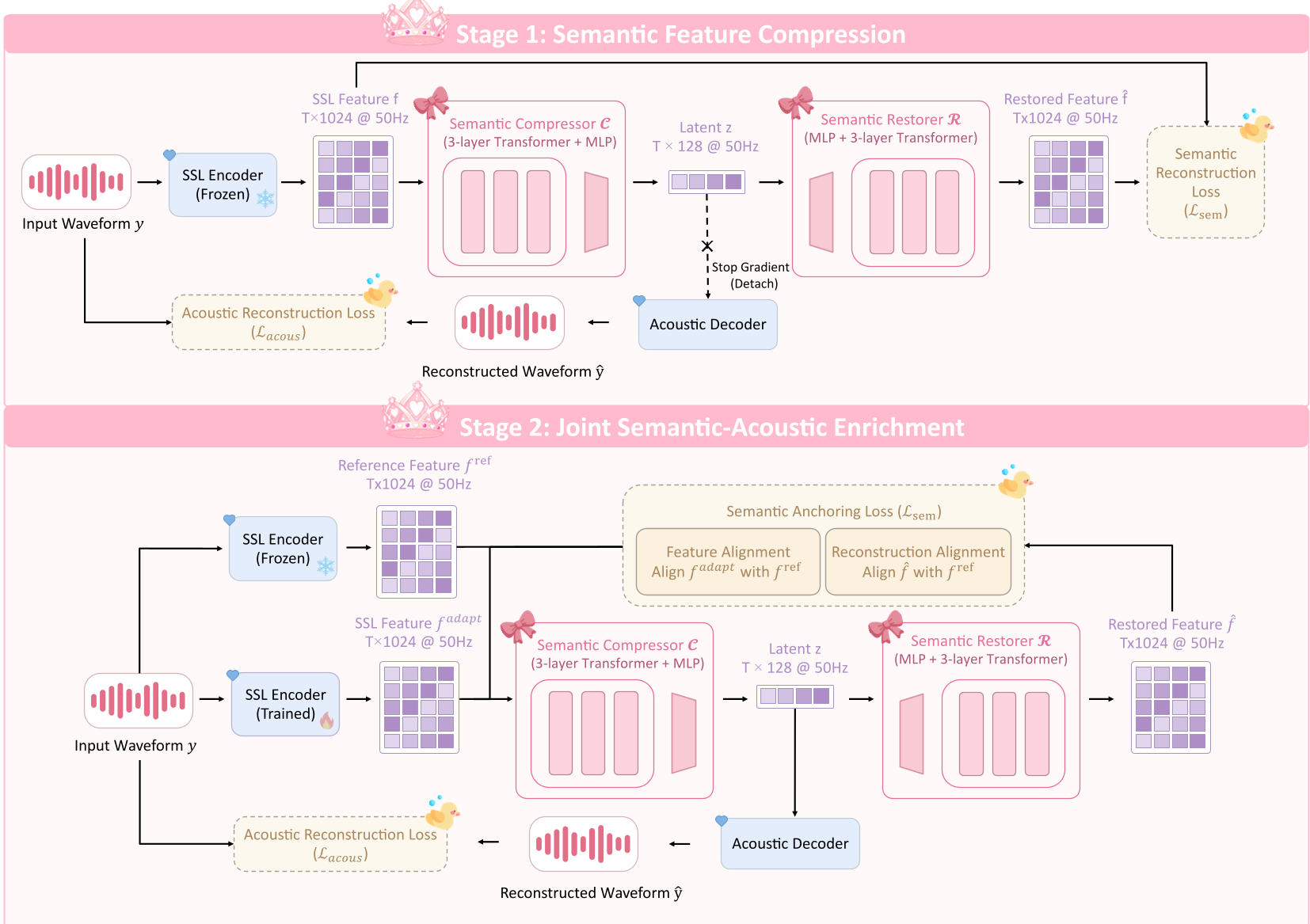
Stage 1: Semantic Compression
The authors use a symmetric adapter-based auto-encoder to squeeze 1024-dim WavLM features into a 128-dim bottleneck. This acts as a filter, removing the "off-manifold" redundancy that typically makes diffusion models collapse.
Stage 2: Joint Acoustic-Semantic Enrichment
Here is the "secret sauce": they unfreeze the SSL encoder and train the whole system on a reconstruction task. To prevent the model from "forgetting" how to understand speech, they use a Semantic Anchoring Loss, forcing the new features to stay aligned with the original frozen WavLM reference.
Experiments: Breaking the SOTA
The results are striking across three fronts:
- Generation: In Zero-shot TTS, WavCube-Pro outperforms established baselines like CosyVoice and F5-TTS, achieving a lower Word Error Rate (WER: 2.20%) and higher Speaker Similarity (SIM: 0.709).
- Understanding: On the SUPERB benchmark, WavCube (128-dim) performs almost as well as the full WavLM (1024-dim), proving the bottleneck hasn't "choked" the intelligence of the model.
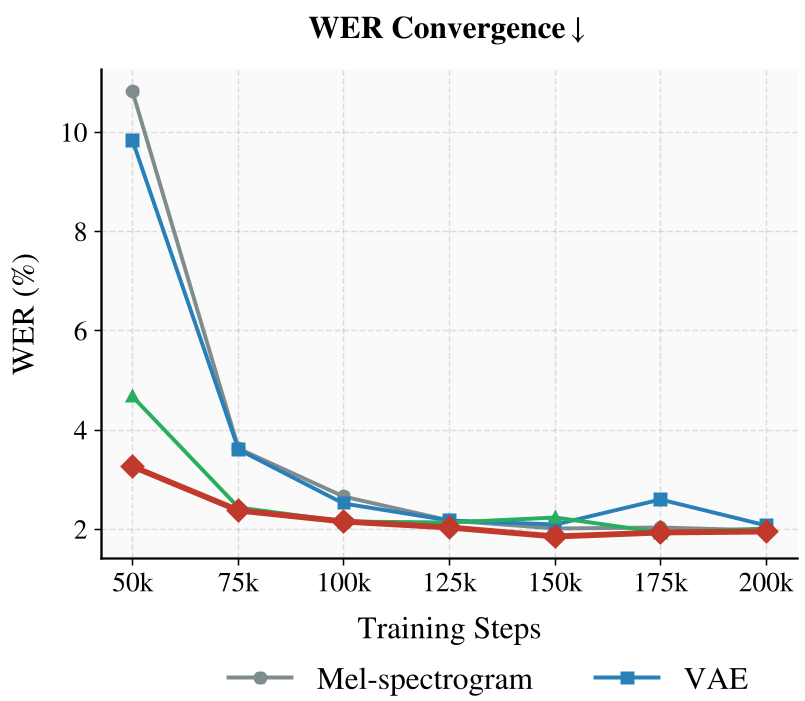
- Convergence: As shown in the training curves, WavCube converges significantly faster than Mel-spectrograms or vanilla VAEs, proving that semantic latents are inherently easier for models to learn.
Deep Insight: Why High-Dim SSL Fails
The paper’s most fascinating ablation (Table 6) shows that using raw WavLM features for generation results in a 110% WER—absolute gibberish. Scaling the model to 753M parameters reduces WER but still results in pathetic speaker similarity. This confirms that the problem isn't model size; it's the manifold. WavCube’s bottleneck successfully cleans the manifold, making it "diffusable."

Conclusion and Future Outlook
WavCube proves that we no longer need different "languages" for understanding and generating speech. By anchoring acoustic reconstruction to a semantic manifold, we get the best of both worlds. This paves the way for "Omni" models that can listen, think, and speak using one single, elegant representation.
Disclaimer: This analysis is based on the WavCube technical report by Shanghai Jiao Tong University and collaborators.