
Weak Distillation: Turning Quasi-Probability into a Practical Quantum Sampler
Weak distillation of quantum resources
The paper introduces "Weak Resource Distillation," a general framework that elevates quasi-probability-based methods (like error mitigation and circuit knitting) from simple expectation value estimation to "weak simulation" (sampling). It achieves this via a modified rejection sampling protocol where the sampling cost scales directly with the negativity (robustness measure) of the quantum resource.
TL;DR
Researchers from the University of Tokyo have bridged a critical gap in quantum resource theory. They’ve transformed "virtual distillation"—previously limited to calculating averages—into a tool that can actually sample measurement outcomes. By using a clever variation of rejection sampling, their method ensures that the cost of simulating a "high-quality" quantum state using "low-quality" hardware scales directly with how far the hardware is from the ideal.
Background: The Limits of "Virtual" Resources
In the NISQ (Noisy Intermediate-Scale Quantum) era, we often can't prepare the "perfect" states (magic states, Bell states) needed for the most powerful algorithms. Virtual Resource Distillation was the clever workaround: if you can't build it, simulate it. By decomposing a target state into a linear combination of accessible states , we could estimate the expectation value of an operator.
However, there was a catch. This method was great for finding the "average," but it couldn't perform a Weak Simulation—it couldn't give you a sample from the probability distribution as a real quantum computer would. Early attempts to fix this were "discontinuous": even for a near-perfect device, the overhead to sample was massive.
The Problem: The "Cost Discontinuity"
The technical headache lies in the negativity of the quasi-probability. To simulate a resource, you often need to subtract some states from others. Traditional methods for sampling from these distributions required estimating every single outcome's probability first. For a system with qubits, there are outcomes. This meant that even if your device was 99.9% accurate, the mathematical overhead made virtual sampling practically impossible for large systems.
The Methodology: Adaptive Rejection Sampling
The authors solve this by pivoting to Rejection Sampling.
- The Intuition: Imagine you want to sample from a "target" distribution , but you only have access to a "noisy" distribution . You take a sample from and "accept" it with a probability .
- The Innovation: In quantum virtual distillation, we don't know exactly. The authors propose estimating this acceptance ratio on the fly.
- The Efficiency: The breakthrough is that you don't need to estimate the ratio with high precision everywhere. When the negativity () is small, the cost to simulate the resource becomes negligible.
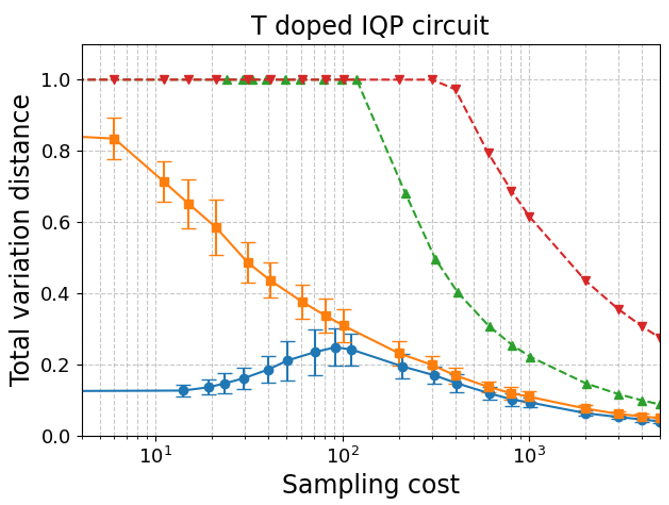 Above: The empirical performance of the proposed method versus the naive estimation approach across different sampling sizes.
Mathematical Insight
The sampling cost in this new framework is bounded by: The critical factor here is (negativity). As the state becomes "free" (attainable on your hardware), , and the sampling cost . This provides a smooth transition that allows researchers to squeeze every bit of "virtual" power out of their existing hardware.
Applications & Experiments
The team tested their framework on three pillars of quantum info:
- Error Mitigation: Using probabilistic error cancellation to generate noiseless samples.
- Entanglement Distillation: "Virtually" creating Bell states from noisy isotropic states.
- Magic State Distillation: Simulating the -states necessary for fault-tolerant computation.
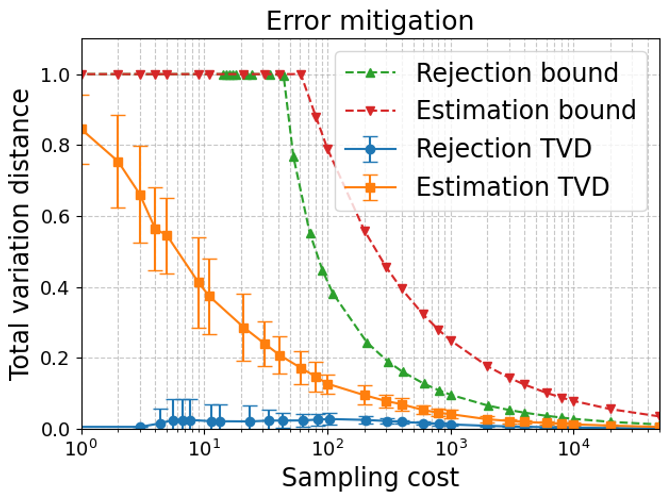 Above: Comparison of Total Variation Distance (TVD) for Error Mitigation (a). The proposed rejection-sampling method (red) converges to the target distribution much faster than the naive method (blue).
In all cases, the proposed method required significantly fewer samples to achieve a low Total Variation Distance (TVD) compared to prior methods.
Critical Analysis & Conclusion
The real value of this paper is moving "Virtual Distillation" out of the realm of theoretical curiosity and into functional algorithm design. By providing a valid way to sample, the authors have opened the door for Shor’s algorithm and other sampling-heavy protocols to run on noisy hardware (virtually).
Limitations: While the method scales well with negativity, the analytical bounds are still somewhat loose, as seen in the gap between the theoretical upper bound and numerical results. Future work will likely focus on tightening these bounds and extending the logic to infinite-dimensional systems (like GKP encodings).
Final Takeaway: Negativity isn't just a measure of how "hard" a state is to prepare; it is precisely the "gas price" for sampling from that state virtually.