
[CVPR 2025/arXiv] SCRL: When Majority Consensus Lies, Learn from Your Mistakes
What If Consensus Lies? Selective-Complementary Reinforcement Learning at Test Time
SCRL (Selective-Complementary Reinforcement Learning) is a robust framework for Test-Time Reinforcement Learning (TTRL) designed to enhance LLM reasoning on unlabeled data. It introduces selective positive pseudo-labeling and entropy-gated negative pseudo-labeling to mitigate noise from weak consensus, achieving SOTA performance on benchmarks like AIME25 and MATH-500.
TL;DR
Unsupervised Test-Time Reinforcement Learning (TTRL) typically assumes the "wisdom of the crowd"—that the most frequent answer in a group of rollouts is correct. However, on hard problems, the crowd is often wrong. SCRL (Selective-Complementary Reinforcement Learning) addresses this by introducing a conservative selection mechanism for positive labels and a world-first entropy-gated negative labeling strategy. It effectively prunes the search space of LLMs without the risk of premature convergence to false solutions.
The Problem: The Fragility of Majority Voting
Current LLM self-improvement techniques (like TTRL or Self-Play) rely heavily on Majority Voting Consensus. While effective for easy tasks, this approach breaks down in two critical scenarios:
- High Task Complexity: On benchmarks like AIME, the answer distribution is so dispersed that the "majority" might only represent 10% of rollouts and still be wrong.
- Constrained Budgets: When you can only afford 16-32 rollouts, the statistical significance of a majority vanishes.
Reinforcing these "false positives" leads to a feedback loop of error, where the model becomes increasingly confident in its own delusions.
Methodology: Selective & Complementary
The authors propose that when the model is uncertain, it is better to say "I don't know" than to guess. SCRL implements this via three core innovations:
1. Selective Positive Pseudo-Labeling
Instead of just taking the top answer, SCRL only assigns a positive reward if:
- The top answer exceeds a count threshold ().
- There is a significant margin between the 1st and 2nd most frequent answers (). If these aren't met, the model abstains from positive reinforcement.
2. Entropy-Gated Negative Pseudo-Labeling
This is the "Complementary" part. Even if we don't know the right answer, we can often identify the wrong ones. SCRL looks for answers that are both low-frequency and high-entropy (highly uncertain during generation).
- Physical Intuition: A rare answer with high token-level entropy is almost certainly a hallucination. By penalizing these, SCRL prunes the search space.
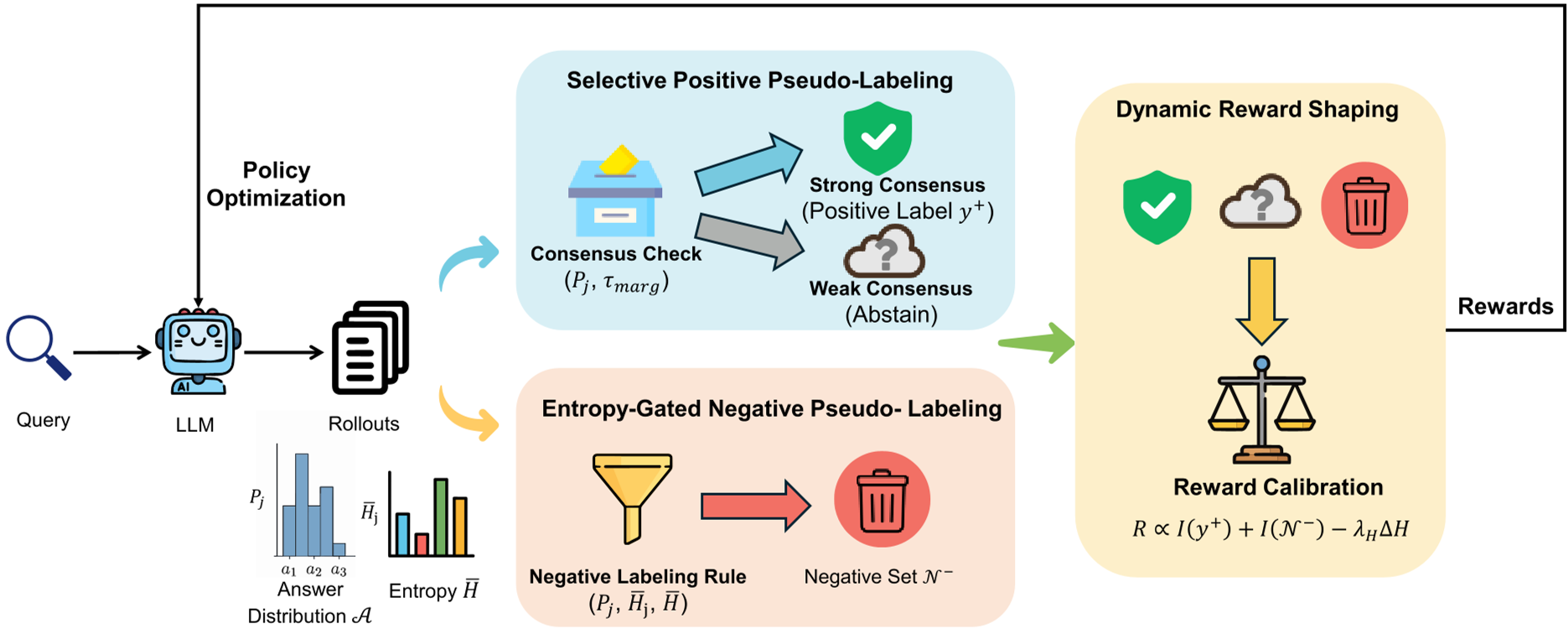
3. Dynamic Reward Shaping
SCRL doesn't use static +1/-1 rewards. It scales rewards based on the consensus strength () and adds an entropy penalty () to guide the model toward "smoother" reasoning paths.
Experimental Battleground
SCRL was tested against heavyweights like TTRL, RESTRAIN, and ETMR across architectures (Qwen, Llama) and tasks (AIME, MATH, GPQA).
Key Result: Dominance in "Hard" Math
On AIME25, a top-tier math competition benchmark, SCRL outperformed standard TTRL by a staggering 10.1% absolute accuracy (26.9% vs 16.8%).

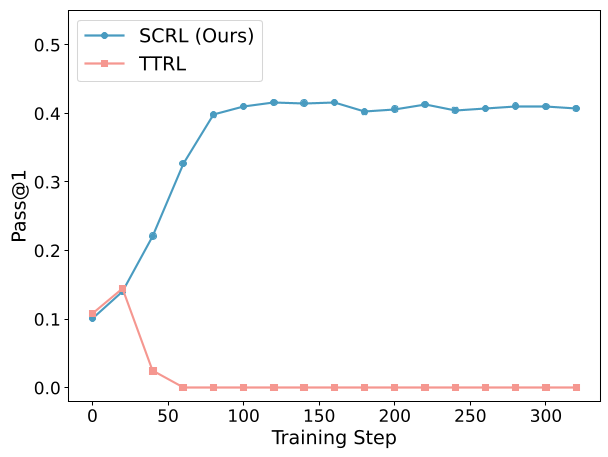
Training Stability (The Minerva Case)
In the Minerva dataset (Physics/Math), standard TTRL often suffered from "training collapse" where performance plummeted after a few iterations. SCRL maintained a steady upward trajectory, proving that its conservative labeling acts as a vital stabilizer.
Critical Insights & Conclusion
The genius of SCRL lies in its Inductive Bias toward safety. In the race to scale "inference-time compute" (reminiscent of OpenAI's o1), SCRL proves that how you filter that compute is just as important as how much you generate.
Takeaways:
- Negative Signals Matter: Penalizing clear errors is often more reliable than reinforcing uncertain "correct" answers.
- Entropy is a Compass: Token-level uncertainty is a high-fidelity signal for detecting logical failures.
- Future Work: The system's main limitation is "over-conservatism" in knowledge-heavy tasks (like Minerva with small 3B models). Future iterations might benefit from integrating external RAG or knowledge-retrieval to relax these thresholds.
SCRL sets a new standard for how LLMs can self-correct without human supervision, shifting the focus from "Majority Rule" to "Verified Consensus."