
Q2RL: Turning Behavior Cloning into a Value-Driven Guide for Robot RL
When Life Gives You BC, Make Q-functions: Extracting Q-values from Behavior Cloning for On-Robot Reinforcement Learning
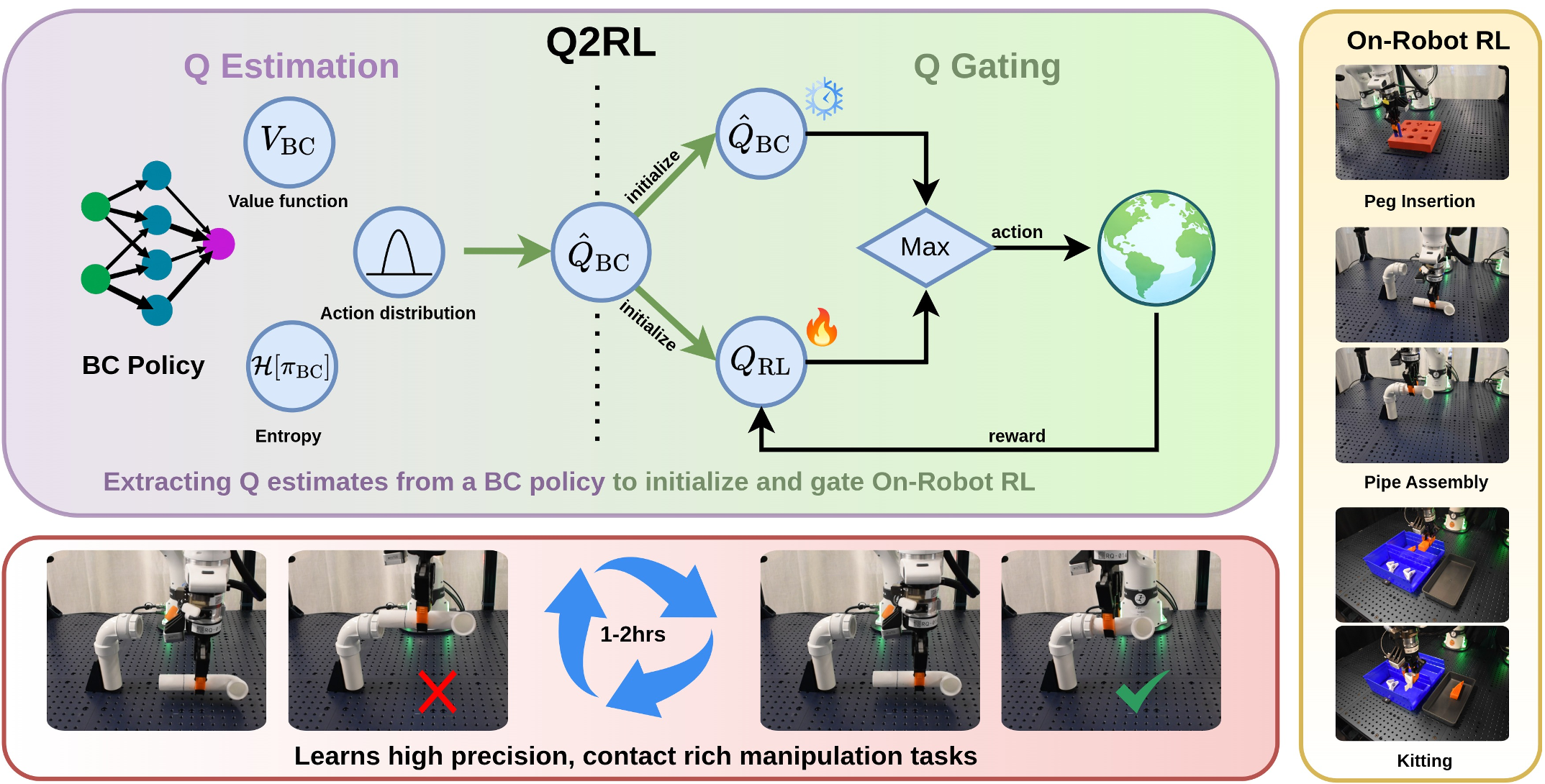
This paper introduces Q2RL (Q-Estimation and Q-Gating from Behavior Cloning for Reinforcement Learning), a novel offline-to-online learning framework that extracts a Q-function from a pre-trained Behavior Cloning (BC) policy to bootstrap Reinforcement Learning (RL). It achieves state-of-the-art results on D4RL and robomimic benchmarks and enables on-robot learning of contact-rich manipulation tasks in just 1-2 hours.
TL;DR
Behavior Cloning (BC) is great at mimicking experts but terrible at improving itself. Reinforcement Learning (RL) is great at improving but often "breaks" the good parts of BC during fine-tuning. Q2RL bridges this gap by extracting a hidden Q-function from a BC policy and using it as a "gatekeeper" to decide when to stick with the expert and when to let the RL agent explore. The result? Robots that learn high-precision tasks like pipe assembly in under 2 hours.
Problem & Motivation: The "Unlearning" Trap
In the world of robot learning, the transition from offline imitation to online refinement is notoriously brittle.
- Covariate Shift: BC policies fail when the robot hits a state it didn't see in the training data.
- Unlearning: When you start RL fine-tuning, the initial "noise" of RL often overwrites the stable behaviors learned via BC.
- Data Dependency: Many SOTA methods (like IBRL) require the original demonstration dataset to be "seeded" into the replay buffer, which isn't always possible in real-world deployment.
Q2RL asks: Can we treat the BC policy as a black box and extract its internal "opinion" on which actions are good?
Methodology: Q-Estimation and Q-Gating
The core innovation lies in two distinct phases that eliminate the need for re-accessing offline data.
1. Q-Estimation (The "Brain Scan")
The authors treat the BC policy as a Boltzmann distribution: . By rearranging this, they derive an analytical estimate for the Q-value () using only:
- The Log Probability of the action.
- The Entropy of the policy.
- A few Monte Carlo rollouts to estimate the baseline state value .
2. Q-Gating (The "Gatekeeper")
Instead of just blending actions, Q2RL maintains two critics: a frozen and a learnable . At every step, the robot asks both: "How good is your proposed action?" It executes the action from the policy whose critic reports a higher value.
Experiments & Results: Real-World Dominance
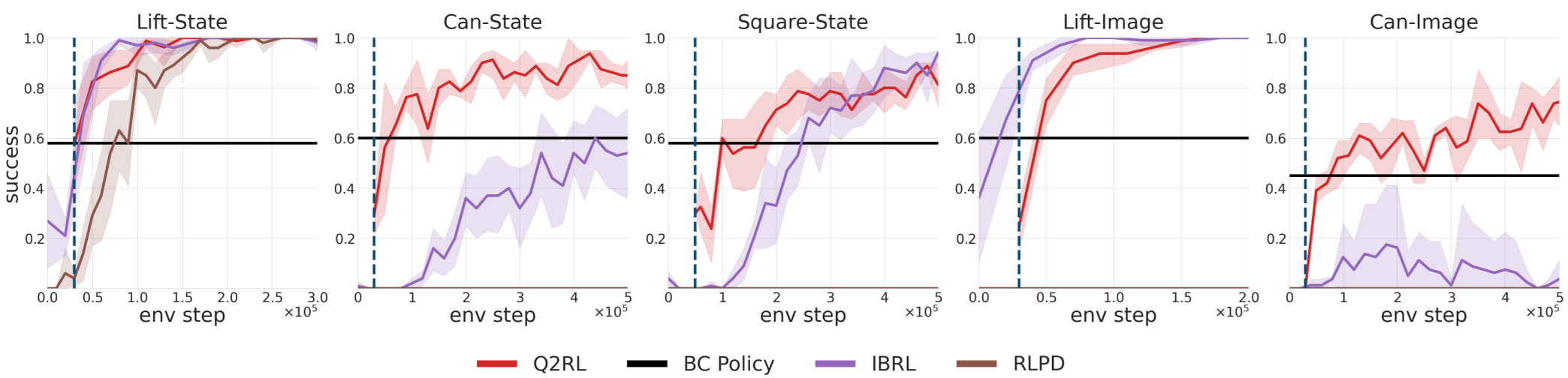
Q2RL was tested on challenging manipulation benchmarks (D4RL, robomimic) and physical Franka Panda robots.
- Simulation SOTA: In tasks like
Kitchen-Complete, Q2RL reached ~91% success, while offline-to-online methods like Cal-QL and CQL struggled to surpass 25% without massive datasets. - Real-Robot Efficiency: On a "Pipe Assembly" task (high-precision, narrow tolerance), the BC policy only succeeded 20% of the time. After 1.5 hours of Q2RL training, success jumped to 75% (a 3.75x improvement).
- Safety: Unlike the baseline IBRL, which caused robot faults due to excessive force during exploration, Q2RL's gating mechanism kept actions within a "safe" manifold dictated by the BC prior.
Critical Analysis & Conclusion
Q2RL represents a significant shift toward data-independent robot fine-tuning. By extracting the "value" inherent in a supervised model, it bypasses the need for massive replay buffers and specialized reward engineering.
Takeaway: This work proves that we don't need to choose between imitation and reinforcement; we can use the former to provide a safe, value-coded foundation for the latter.
Limitations: The current math relies on policies that provide action likelihoods (like GMMs or Gaussians). Extending this to Diffusion Policies—which are currently SOTA for complex robot trajectories—is the next frontier for the authors.
For more details, check out the project page at q2rl.rai-inst.com.