
FFDC-WAM: When Your Robot Learns to Check Its Own Imagination
When to Trust Imagination: Adaptive Action Execution for World Action Models
The paper introduces FFDC-WAM, an adaptive execution framework for World Action Models (WAMs) that enables robots to decide when to trust their "imagined" future. By implementing a lightweight verifier called Future Forward Dynamics Causal Attention (FFDC), the system achieves State-of-the-Art (SOTA) efficiency-robustness trade-offs, reducing model inference calls by 69% while improving success rates in complex tasks.
TL;DR
Researchers have developed FFDC-WAM, a framework that allows robots to "double-check" their internal plans against reality. Unlike traditional models that blindly follow a preset sequence of moves, this system uses a lightweight verifier to compare imagined visual futures with actual sensor data. The result? A robot that moves fast when the path is clear but slows down and replans the moment things get tricky—slashing inference costs by nearly 70% while boosting success rates.
The Problem: The High Cost of Being "Blind"
Modern World Action Models (WAMs) are powerful because they don't just predict the next move; they imagine the entire future scene. However, most current implementations use a "fixed chunk" strategy.
Imagine a robot grasping a cup:
- In predictable phases (reaching), it could easily execute 50 steps without thinking. Forcing it to stop and "re-think" every 10 steps is a massive waste of GPU power.
- In precise phases (contact), the slightest slip makes its internal plan obsolete. If it blindly continues its pre-planned 50 steps, it will likely crash or fail.
The fundamental friction is the lack of self-verification. Robots haven't been asking: "Is what I'm seeing now what I expected to see when I made this plan?"
Methodology: Future Forward Dynamics Causal Attention (FFDC)
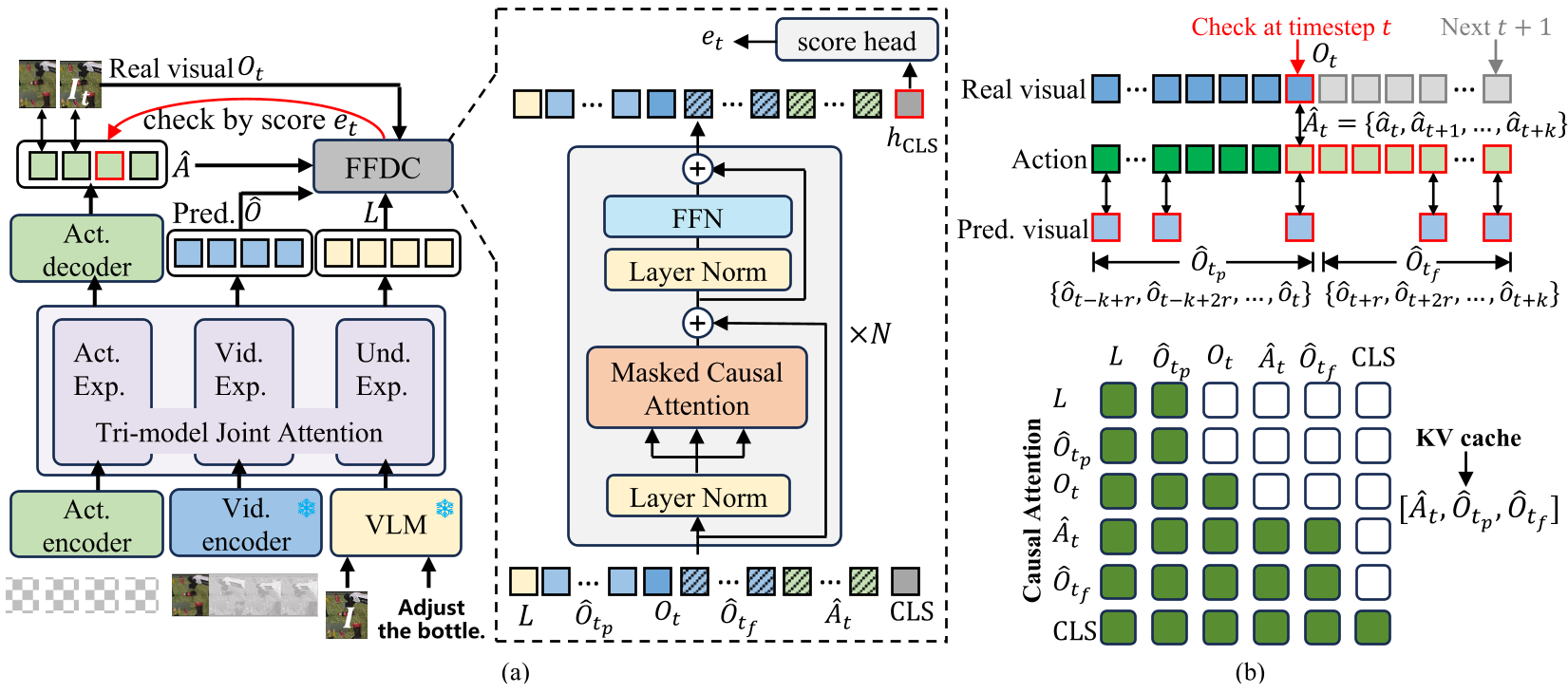
The authors solve this by introducing FFDC, a lightweight "sanity-check" module.
The Core Mechanism
FFDC acts as a high-frequency verifier that runs alongside the robot's hardware. It takes four specific inputs:
- Real Observations: What the camera sees right now.
- Predicted Visuals: What the WAM thought the camera would see at this step.
- Planned Actions: The remaining steps in the current action chunk.
- Language Instructions: The high-level goal (e.g., "hang the mug").
By using a structured causal attention mask, the verifier ensures that future visual predictions are only compared with temporally aligned actions.
Why It’s Efficient
Crucially, pixel-level decoding is expensive. FFDC avoids this because it operates on latent tokens already generated by the WAM's first inference. It uses a KV-cache to store these "imaginations," making the actual verification step extremely fast and lightweight.
Experiments: Robustness Meeting Efficiency
The team tested FFDC-WAM on the RoboTwin benchmark—a grueling environment with randomized lighting, clutter, and perturbations.
1. The Strategy Shift
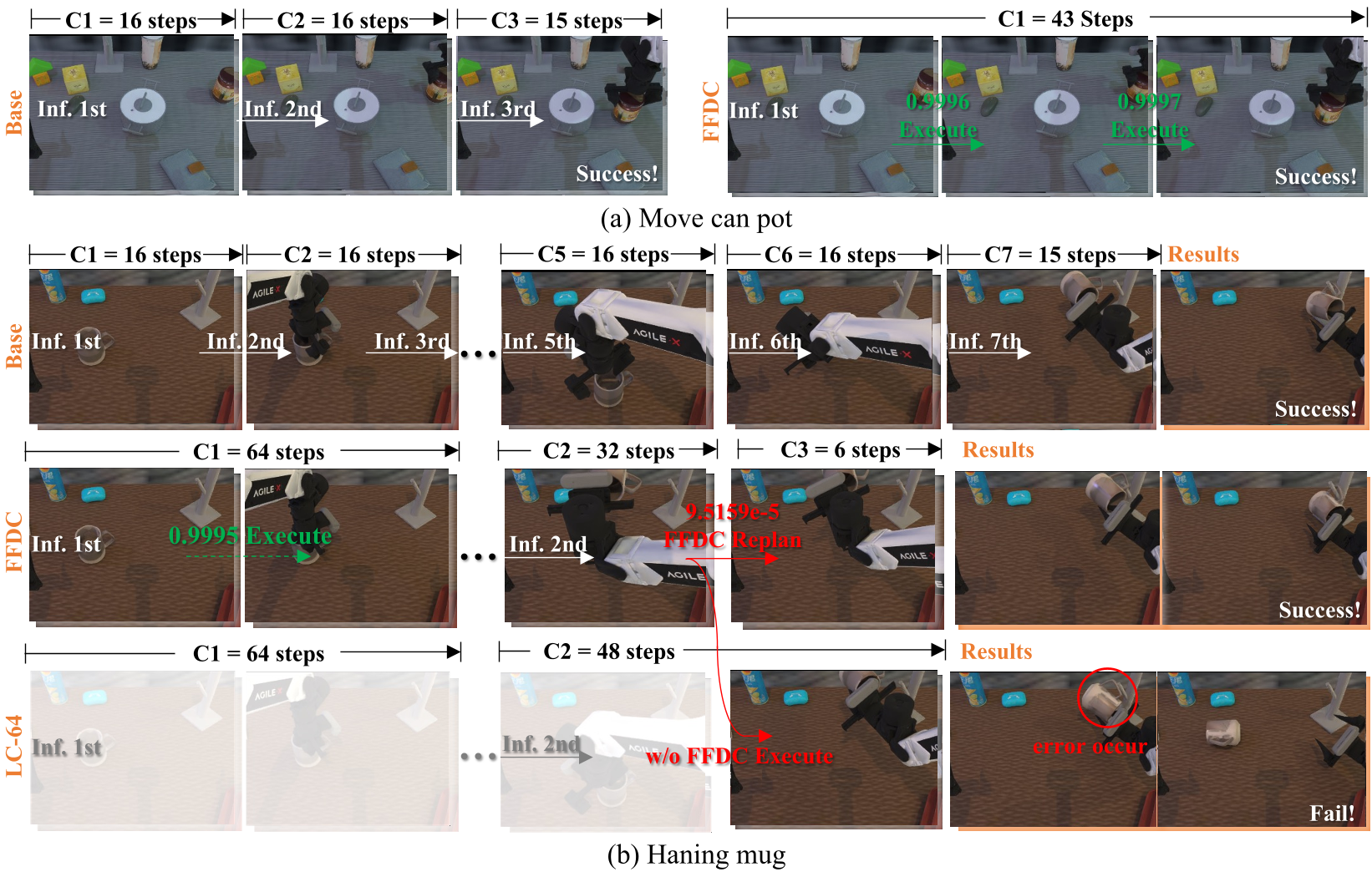
In simple tasks like "moving a pot," FFDC-WAM realized it could trust its imagination. It completed the task with a single inference call, whereas the baseline needed three. In hard tasks like "hanging a mug," the confidence score dropped sharply the moment the mug touched the rack, triggering immediate replanning to ensure a successful placement.
2. Quantitative Dominance
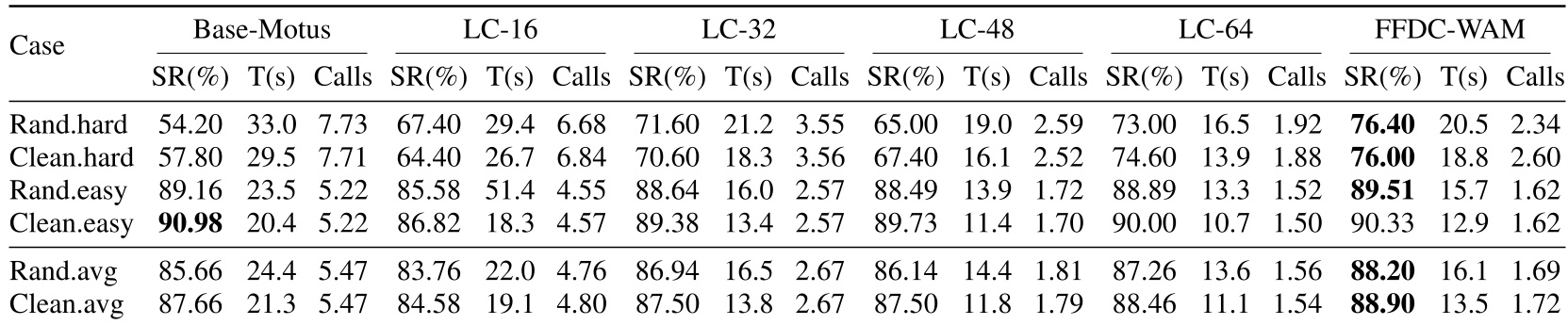
The "LC-64" (Long Chunk) baseline might be slightly faster, but its success rate plummets in hard tasks because it cannot adapt. FFDC-WAM provides the "Goldilocks" solution:
- Speed: 34% faster execution than short-chunk models.
- Robustness: 76.4% success on hard tasks (versus ~54% for standard models).
Real-World Impact
In physical trials with an Astribot S1, the system handled items like bananas and carrots. Real-world physics are notoriously messy due to perception noise and gripper slippage. FFDC-WAM successfully detected these "execution drifts" and corrected itself, achieving an 80% success rate where fixed-chunk models managed only 45%.
Deep Insight: Moving Beyond Hyperparameters
The true value of this paper isn't just a faster robot; it's a shift in how we handle Action Chunking. Instead of treating chunk size as a static hyperparameter to be tuned per task, the authors have turned it into an emergent property of the environment's complexity.
If the world is predictable, the chunk is long. If the world is chaotic, the chunk is short. This "future–reality verification" is exactly how humans navigate—we don't stare at our feet for every step of a familiar staircase, but we instantly freeze the moment our foot meets unexpected air.
Future Outlook
While the current binary ("trust" or "don't trust") supervision is a breakthrough, future iterations could likely benefit from "soft" adjustments or learning from richer failure modes via Self-Supervised Learning. FFDC-WAM brings us one step closer to robots that don't just follow recipes, but understand the consequences of their actions in real-time.